THE CLASSIC COLLECTION✦An outlaw’s diary: the CommuneCLASSIC FREE BOOKS
An outlaw’s diary: the Commune
Cécile Tormay
THE CLASSIC COLLECTION · 1923
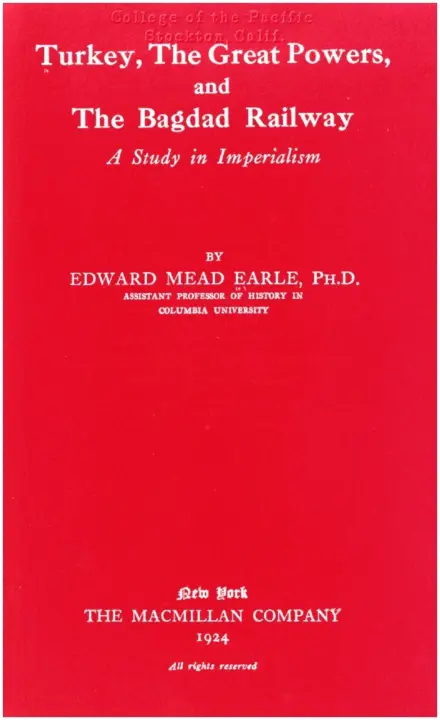
"Turkey, the Great Powers, and the Bagdad Railway: A Study in Imperialism" by Edward Mead Earle is a historical account written in the early 20th century. The book explores the intricate dynamics of imperialism as they relate to the rise of the Bagdad Railway project and its implications on Turkey and its global significance. Through meticulous analysis, it examines how various great powers engaged with the Ottoman Empire’s resources and strategic position. The opening of the book details the historical context leading to the significance of the Bagdad Railway, introducing it as an essential link reviving ancient trade routes during the 19th century. Earle outlines the broader implications of rail development on the economic and political stability of Turkey, emphasizing both the hopes tied to modernization and the inherent dangers posed by international rivalries. The narrative sets the stage for a deeper discussion on how this railway project emerged in a landscape fraught with imperial aspirations and the challenges the Ottoman Empire faced in asserting its sovereignty amidst foreign interests. Overall, the initial chapters lay a foundation for understanding the complexities that surrounded the construction of the Bagdad Railway as a symbol of both progress and contention in modern imperialism.
Introduction adapted from the source catalogue; source summaries may be automatically generated.
Free to read · English · 109,189 words · No account needed
MAKE TIME FOR A GOOD BOOK
On by default. Untick to stop anonymous reading totals. Each page counts after 10 seconds in view. How this works.
Anonymous counting is on unless you have switched it off.
[2] Paul Rohrbach, Germany’s Isolation, p. 50.
[3] Karl Helfferich, Die deutsche Türkenpolitik, p. 21.
[4] This quotation, together with many other facts in this chapter, is from a lengthy memorandum of Djavid Bey on the Bagdad Railway, prepared especially for the use of the author in the writing of this book. It is dated January 3, 1923, and was forwarded from the Lausanne Conference for Peace in the Near East. Unless otherwise specified, quotations from Djavid Bey here given are from this memorandum. There probably is no person who knows more of the Ottoman point of view on the Bagdad Railway than Djavid, who as Young Turk Minister of Finance and, later, as Turkish delegate to the Ottoman Public Debt Administration has had perhaps an unprecedented opportunity to observe the financial and economic ramifications of European imperialism in the Near East.
[5] Diplomatic and Consular Reports, No. 4835 (1911), p. 16; Mesopotamia, p. 41; The Annual Register, 1911, pp. 364–365; Armenia and Kurdistan, p. 62; Turkey in Europe, pp. 72–73; Anatolia, pp. 51–52, 81; infra, pp. 244–246.
[6] Pan-Turkism, or Pan-Turanianism, started as a cultural movement among Ottoman intellectuals. It assumed political aspects as a result of three important circumstances: 1. Aggressions against Turkey by foreign powers; 2. The ardent nationalism of the Balkan states bordering on Turkey; 3. The existence within Turkey of vigorous dissident nationalities, such as the Armenians and the Arabs. Pan-Turanianism and Pan-Islamism, although separate movements, had much in common. In 1911, at any rate, the Young Turks adopted Pan-Islamism as part of their program. Pinon, op. cit., pp. 134 et seq.; Mohammedan History, pp. 89–96; Sir Thomas Barclay, The Turco-Italian War and Its Problems (London, 1912), pp. 100 et seq.
[7] For an excellent statement of the reaction of Turkish nationalism upon European politics see The Quarterly Review, Volume 228 (1917), pp. 511 et seq.
[8] Regarding the coincidence of German and Turkish interests during the reign of Abdul Hamid cf. supra, pp. 64–65, 125–130.
[9] Report of the Anatolian Railway Company, 1908 and 1909, pp. 8–9; The Annual Register, 1909, pp. 337 et seq.; Stenographische Berichte, XII Legislaturperiode, 1 Session, Volume 260 (1910), pp. 2174d et seq.
[10] From Djavid Bey’s memorandum. For scattered details of these negotiations see The Annual Register, 1910, pp. 336–340; Report of the Deutsche Bank, 1910, pp. 13 et seq.; K. Helfferich, Die deutsche Türkenpolitik, pp. 23 et seq.; Ostrorog, op. cit., pp. 60–61.
[11] Parliamentary Debates, House of Commons, fifth series, Volume 22 (1911), pp. 1284–1285. For further details of the negotiations of 1909–1911 cf. B. von Siebert, Diplomatische Aktenstücke zur Geschichte der Ententepolitik der Vorkriegsjahre (Berlin and Leipzig, 1921), Chapters VIII and IX. Hereinafter cited as de Siebert documents.
[12] Cf. foreign correspondence of The Times, March 21, 1911.
[13] Troisième convention additionelle à la convention du 5 Mars, 1903, relative au chemin de fer de Bagdad (Constantinople, 1911); supra, pp. 111–113.
[14] Cf. infra, Chapter X.
[15] The Nineteenth Century, Volume 65 (1909), pp. 1083–1084.
[16] Diplomatic and Consular Reports, No. 3140 (1903), p. 29.
Your reading position is saved on this browser. Take it to another device with a library code. Reading pages adapt to text, rather than matching a printed edition.
BEHIND THE BOOK
This eBook is for the use of anyone anywhere in the United States and most other parts of the world at no cost and with almost no restrictions whatsoever. You may copy it, give it away or re-use it under the terms of the Project Gutenberg License included with this eBook or online at www.gutenberg.org. If you are not located in the United States, you will have to check the laws of the country where you are located before using this eBook. Read the source licence.
The original source file, including credits and licence, is retained by this library. Request an original-format copy at no charge. Please include the book title and Project Gutenberg identifier #66221.
KEEP YOUR CURIOSITY GOING
Cécile Tormay

Moritz Busch
John L. Ransom
Frances Wright
Cécile Tormay

Mabel Potter Daggett