THE CLASSIC COLLECTION✦An outlaw’s diary: the CommuneCLASSIC FREE BOOKS
An outlaw’s diary: the Commune
Cécile Tormay
THE CLASSIC COLLECTION · 1923
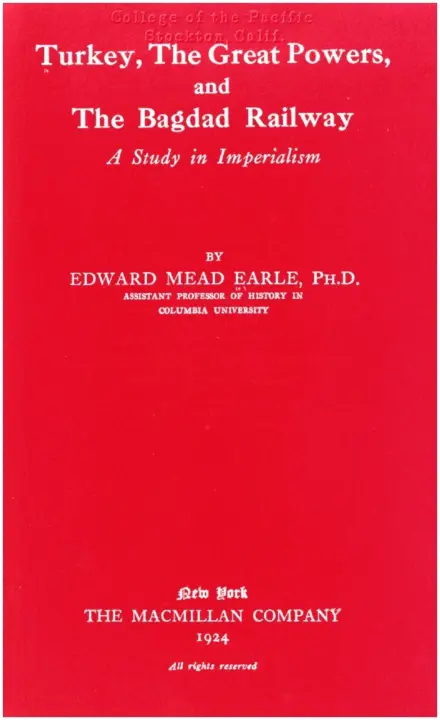
"Turkey, the Great Powers, and the Bagdad Railway: A Study in Imperialism" by Edward Mead Earle is a historical account written in the early 20th century. The book explores the intricate dynamics of imperialism as they relate to the rise of the Bagdad Railway project and its implications on Turkey and its global significance. Through meticulous analysis, it examines how various great powers engaged with the Ottoman Empire’s resources and strategic position. The opening of the book details the historical context leading to the significance of the Bagdad Railway, introducing it as an essential link reviving ancient trade routes during the 19th century. Earle outlines the broader implications of rail development on the economic and political stability of Turkey, emphasizing both the hopes tied to modernization and the inherent dangers posed by international rivalries. The narrative sets the stage for a deeper discussion on how this railway project emerged in a landscape fraught with imperial aspirations and the challenges the Ottoman Empire faced in asserting its sovereignty amidst foreign interests. Overall, the initial chapters lay a foundation for understanding the complexities that surrounded the construction of the Bagdad Railway as a symbol of both progress and contention in modern imperialism.
Introduction adapted from the source catalogue; source summaries may be automatically generated.
Free to read · English · 109,189 words · No account needed
MAKE TIME FOR A GOOD BOOK
On by default. Untick to stop anonymous reading totals. Each page counts after 10 seconds in view. How this works.
Anonymous counting is on unless you have switched it off.
Furthermore, the German railways in Turkey, the failure of which had been freely prophesied, proved to be successful business enterprises. The directors took all possible steps to build up the earning power of the lines, rather than depend upon the minimum return guaranteed by the Ottoman Government. The railways were efficiently and intelligently administered—the operating expenses of the Anatolian and Bagdad lines never exceeded 47% of the gross receipts, although the operating expenses of the chief European railways, under much more favorable conditions, varied from 54% to 62% of gross receipts during the same period. Occasional dividends of 5% or 6% were paid by the Anatolian and Bagdad Railway Companies between 1906 and 1914, but only when the disbursements were warranted by earnings. In 1911, a notable advance was made by the introduction of oil-burning locomotives on the Bagdad lines; henceforth the German railways in Turkey were operated with fuel purchased from the Standard Oil Company of New Jersey![18]
This scrupulously careful management eventually brought its reward. In 1911, the earnings of the Angora line exceeded the kilometric guarantee and, in accordance with the terms of the concession, the Ottoman Government received a share of the receipts. In 1912, the returns of the Eski Shehr-Konia line also exceeded the sum guaranteed by the Government, the Ottoman Treasury receiving a share of the earnings of the Anatolian system to an amount of more than $200,000. After 1913, no further payments to the Anatolian Railway Company were required under the kilometric guarantees.[19]
The results on the completed sections of the Bagdad Railway were equally promising, as will be indicated by the following table:[20]
Year Kilometres Passengers Freight Gross Total in Tons Receipts per Government Operation Kilometre Subsidy (Francs) (Francs)
1906 200 29,629 13,693 1,368.83 624,028.21 1907 200 37,145 23,643 1,754.44 546,129.77 1908 200 52,759 15,941 1,839.86 529,443.12 1909 200 57,026 15,364 1,936.72 509,565.45 1910 200 71,665 27,756 2,571.43 381,135.58 1911 238 95,884 38,046 3,379.34 238,166.59 1912 609 288,833 57,670 5,315.67 278,785.25 1913 609 407,474 78,645 3,786.53 216,295.17 1914 887 597,675 116,194 8,177.97 2,939,983.00
Figures in italics indicate payments to the Turkish Government of its share of the receipts in excess of the guarantee of 4,500 francs per kilometre.
The improvement in the economic conditions of Anatolia, and the success of the German railways as business enterprises, were sources of great satisfaction and profit to the Imperial Ottoman Government. Not only was the Treasury receiving revenue from the railway lines which had formerly been a drain upon the financial resources of the empire, but the receipts from taxes in the regions traversed by the railways were constantly increasing. As early as 1893 the Ottoman Ministry of Public Works announced that the increase in tithes and the increased value of farm lands in Asia Minor had more than justified expenditures by the Sultan’s Government in subsidies to the Anatolian Railway.[21] For those portions of Anatolia which were served by the Railway, the amount of the tithes had almost doubled in twenty years: in 1889, the year after the award of the Anatolian concession, $639,760 was collected; in 1898, $948,070; in 1908, $1,240,450. In certain districts the amount of the tithes collected in 1908 was five or six times as great as the yield before the construction of the Railway.[22]
Your reading position is saved on this browser. Take it to another device with a library code. Reading pages adapt to text, rather than matching a printed edition.
BEHIND THE BOOK
This eBook is for the use of anyone anywhere in the United States and most other parts of the world at no cost and with almost no restrictions whatsoever. You may copy it, give it away or re-use it under the terms of the Project Gutenberg License included with this eBook or online at www.gutenberg.org. If you are not located in the United States, you will have to check the laws of the country where you are located before using this eBook. Read the source licence.
The original source file, including credits and licence, is retained by this library. Request an original-format copy at no charge. Please include the book title and Project Gutenberg identifier #66221.
KEEP YOUR CURIOSITY GOING
Cécile Tormay

Moritz Busch
John L. Ransom
Frances Wright
Cécile Tormay

Mabel Potter Daggett