THE CLASSIC COLLECTION✦An outlaw’s diary: the CommuneCLASSIC FREE BOOKS
An outlaw’s diary: the Commune
Cécile Tormay
THE CLASSIC COLLECTION · 1923
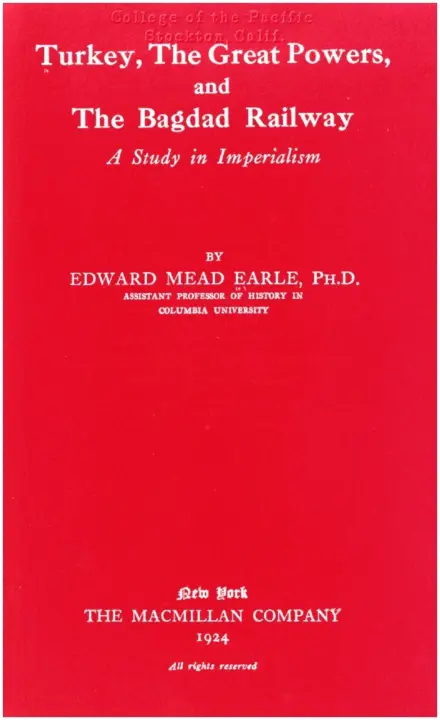
"Turkey, the Great Powers, and the Bagdad Railway: A Study in Imperialism" by Edward Mead Earle is a historical account written in the early 20th century. The book explores the intricate dynamics of imperialism as they relate to the rise of the Bagdad Railway project and its implications on Turkey and its global significance. Through meticulous analysis, it examines how various great powers engaged with the Ottoman Empire’s resources and strategic position. The opening of the book details the historical context leading to the significance of the Bagdad Railway, introducing it as an essential link reviving ancient trade routes during the 19th century. Earle outlines the broader implications of rail development on the economic and political stability of Turkey, emphasizing both the hopes tied to modernization and the inherent dangers posed by international rivalries. The narrative sets the stage for a deeper discussion on how this railway project emerged in a landscape fraught with imperial aspirations and the challenges the Ottoman Empire faced in asserting its sovereignty amidst foreign interests. Overall, the initial chapters lay a foundation for understanding the complexities that surrounded the construction of the Bagdad Railway as a symbol of both progress and contention in modern imperialism.
Introduction adapted from the source catalogue; source summaries may be automatically generated.
Free to read · English · 109,189 words · No account needed
MAKE TIME FOR A GOOD BOOK
On by default. Untick to stop anonymous reading totals. Each page counts after 10 seconds in view. How this works.
Anonymous counting is on unless you have switched it off.
[30] Parliamentary Debates, House of Commons, fifth series, Volume 21
(1911), pp. 241–242.
[31] Infra, pp. 258–265.
[32] For the views of a typical British imperialist on the Persian situation, cf., Curzon, Persia and the Persian Question, Volume II, Chapter XXX; a later account is that of the American, W. Morgan Shuster, The Strangling of Persia (New York, 1912); cf., also, H. F. B. Lynch, “Railways in the Middle East,” in Proceedings of the Central Asian Society (London), March 1, 1911.
[33] See P. Rohrbach, Die Bagdadbahn, p. 18; Reventlow, op. cit., pp. 338–343. That Rohrbach’s frank avowal of the menace of the Bagdad Railway to India and Egypt was not without influence in Great Britain is evidenced by the fact that long quotations from Die Bagdadbahn were read into the records of the House of Commons by the Earl of Ronaldshay, on March 23, 1911. Parliamentary Debates, fifth series, Volume 23, p. 628.
[34] Herr Scheidemann, in an eloquent speech to the Reichstag, March 30, 1911, pleaded with the German Government to be sympathetic with the position in which Great Britain found herself. No nation with the imperial responsibilities of Great Britain could afford to neglect to take precautionary steps against the possibility of the Bagdad Railway being used as a weapon of offense against Egypt, the Suez Canal, and India. “Complications upon complications,” he said, “are certain to arise as a result of the construction of the Bagdad Railway. But we expect of our Government, at the very least, that in the course of protecting the legitimate German economic interests which are involved in the Bagdad Railway, it will leave no stone unturned to prevent the development of Anglo-German hostility over the matter. We want to do everything possible to effect a thorough understanding with England. Only by such a policy can we hope to quiet the fears of British imperialists that the Railway is a menace to the Empire.” Stenographische Berichte, XII Legislaturperiode, 2 Session, Volume 266 (1911), pp. 5980c-5984b.
[35] Parliamentary Debates, House of Commons, fifth series, Volume 21
(1911), pp. 241–242.
[36] Cf. H. N. Brailsford, The War of Steel and Gold, Chapter III,
“The Egyptian Model.”
[37] Supra, pp. 181–182.
[38] André Tardieu, France and the Alliances (New York, 1908), p. 46. For M. Tardieu’s analysis of the causes of the growing Anglo-German hostility, cf. pp. 48–57. It was in the latter part of April, 1903, that the Bagdad Railway negotiations fell through. In May, Edward VII paid an official visit to Paris; in October, an arbitration agreement was signed by France and Great Britain. The following spring the treaties constituting the Entente Cordiale were executed. Sir Thomas Barclay, Thirty Years’ Reminiscences (London, 1906), pp. 175 et seq. For the text of these agreements cf. Parliamentary Papers, Volume 103 (1905), No. Cd. 2384.
Your reading position is saved on this browser. Take it to another device with a library code. Reading pages adapt to text, rather than matching a printed edition.
BEHIND THE BOOK
This eBook is for the use of anyone anywhere in the United States and most other parts of the world at no cost and with almost no restrictions whatsoever. You may copy it, give it away or re-use it under the terms of the Project Gutenberg License included with this eBook or online at www.gutenberg.org. If you are not located in the United States, you will have to check the laws of the country where you are located before using this eBook. Read the source licence.
The original source file, including credits and licence, is retained by this library. Request an original-format copy at no charge. Please include the book title and Project Gutenberg identifier #66221.
KEEP YOUR CURIOSITY GOING
Cécile Tormay

Moritz Busch
John L. Ransom
Frances Wright
Cécile Tormay

Mabel Potter Daggett