THE CLASSIC COLLECTION✦An outlaw’s diary: the CommuneCLASSIC FREE BOOKS
An outlaw’s diary: the Commune
Cécile Tormay
THE CLASSIC COLLECTION · 1923
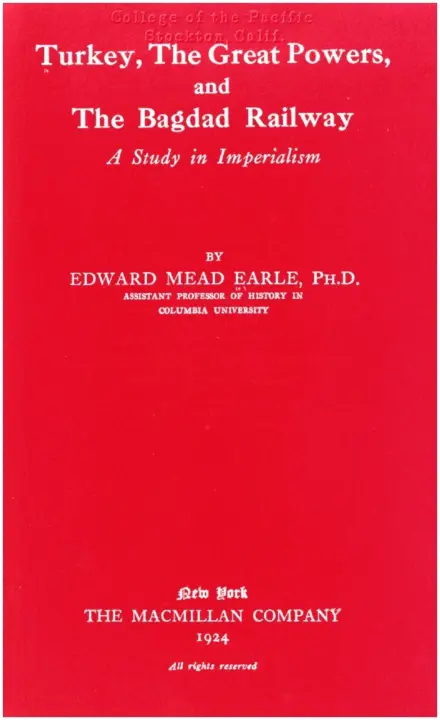
"Turkey, the Great Powers, and the Bagdad Railway: A Study in Imperialism" by Edward Mead Earle is a historical account written in the early 20th century. The book explores the intricate dynamics of imperialism as they relate to the rise of the Bagdad Railway project and its implications on Turkey and its global significance. Through meticulous analysis, it examines how various great powers engaged with the Ottoman Empire’s resources and strategic position. The opening of the book details the historical context leading to the significance of the Bagdad Railway, introducing it as an essential link reviving ancient trade routes during the 19th century. Earle outlines the broader implications of rail development on the economic and political stability of Turkey, emphasizing both the hopes tied to modernization and the inherent dangers posed by international rivalries. The narrative sets the stage for a deeper discussion on how this railway project emerged in a landscape fraught with imperial aspirations and the challenges the Ottoman Empire faced in asserting its sovereignty amidst foreign interests. Overall, the initial chapters lay a foundation for understanding the complexities that surrounded the construction of the Bagdad Railway as a symbol of both progress and contention in modern imperialism.
Introduction adapted from the source catalogue; source summaries may be automatically generated.
Free to read · English · 109,189 words · No account needed
MAKE TIME FOR A GOOD BOOK
On by default. Untick to stop anonymous reading totals. Each page counts after 10 seconds in view. How this works.
Anonymous counting is on unless you have switched it off.
[16] It will be recalled that the Hamburg-American Line established a Persian Gulf service in 1906. Supra, pp. 108–109. Regarding the activities of British shipping and commercial interests in opposing the Bagdad Railway see Diplomatic and Consular Reports, No. 2950 (1902), pp. 25 et seq., No. 3140 (1904), pp. 24 et seq.; The Times, April 24, 1903.
[17] G. N. Curzon, Persia and the Persian Question (2 volumes, London, 1892), Volume I, p. 635; a similar view was set forth by Sir Thomas Sutherland, of the P. & O., in a letter to The Times, April 27, 1903.
[18] E. Banse, Auf den Spuren der Bagdadbahn (Weimar, 1913), Chapter XI, Die Wahrheit über die Bagdadbahn, a critical analysis of the value of the Railway in Eastern trade, pp. 145–146. Cf., also, Dr. R. Hennig, “Der verkehrsgeographische Wert des Suez- und des Bagdad-Weges,” in Geographische Zeitschrift, Volume 22 (1916), pp. 649–656.
[19] Specifications, Articles 24–25. It might be added that the Company loyally observed this restriction; C. W. Whittall & Co., largest British merchants in Turkey so testified. Anatolia, p. 103; von Gwinner, loc. cit., p. 1090. Sir Edward Grey said no complaints of discrimination against British goods had come to the attention of the Foreign Office. Parliamentary Debates, House of Commons, 5 Series, Volume 53 (1913), pp. 392–393.
[20] Diplomatic and Consular Reports, No. 3140, p. 30.
[21] Consider the dedication of Lord Curzon’s Persia and the Persian Question: “To the officials, military and civil, in India, whose hands uphold the noblest fabric yet reared by the genius of a conquering nation, I dedicate this work, the unworthy tribute of the pen to a cause, which by justice or the sword, it is their high mission to defend, but whose ultimate safeguard is the spirit of the British people.”
[22] Woolf, op. cit., p. 24.
[23] Regarding the Anglo-Russian rivalry in the Middle East, cf. Rose, op. cit., Part II, Chapters I-IV; Curzon, Persia and the Persian Question, Volume II, Chapter XXX.
[24] See a statement by Lord Lansdowne, in the House of Lords, Parliamentary Debates, fourth series, Volume 121 (1903), p. 1347, and a statement by Lord Curzon, ibid., fifth series, Volume 7 (1911), pp. 583–587; also Curzon, Persia and the Persian Question, Volume II, Chapter XXVII. The strategic importance of the Persian Gulf to the British Empire was realized by foreign observers, as well as by English statesmen. Writing in 1902, Admiral A. T. Mahan, an American, said, “The control of the Persian Gulf by a foreign state of considerable naval potentiality, a ‘fleet in being’ there based upon a strong military port, would reproduce the relations of Cadiz, Gibraltar, and Malta to the Mediterranean. It would flank all the routes to the farther East, to India, and to Australia, the last two actually internal to the Empire, regarded as a political system; and although at present Great Britain unquestionably could check such a fleet, so placed, by a division of her own, it might well require a detachment large enough to affect seriously the general strength of her naval position.” A. T. Mahan, Retrospect and Prospect (New York, 1902), pp. 224–225. Lord Curzon is said to have remarked that he “would not hesitate to indict as a traitor to his country any British minister who would consent to a foreign Power establishing a station on the Persian Gulf.” A. J. Dunn, British Interests in the Persian Gulf (London, 1907), p. 7. See also The Persian Gulf (No. 76 of the Foreign Office Handbooks); Handbook of Arabia, Volume I (Admiralty Intelligence Division, London, 1916); Lovat Fraser, India under Curzon and After (London, 1911).
Your reading position is saved on this browser. Take it to another device with a library code. Reading pages adapt to text, rather than matching a printed edition.
BEHIND THE BOOK
This eBook is for the use of anyone anywhere in the United States and most other parts of the world at no cost and with almost no restrictions whatsoever. You may copy it, give it away or re-use it under the terms of the Project Gutenberg License included with this eBook or online at www.gutenberg.org. If you are not located in the United States, you will have to check the laws of the country where you are located before using this eBook. Read the source licence.
The original source file, including credits and licence, is retained by this library. Request an original-format copy at no charge. Please include the book title and Project Gutenberg identifier #66221.
KEEP YOUR CURIOSITY GOING
Cécile Tormay

Moritz Busch
John L. Ransom
Frances Wright
Cécile Tormay

Mabel Potter Daggett