THE CLASSIC COLLECTION✦An outlaw’s diary: the CommuneCLASSIC FREE BOOKS
An outlaw’s diary: the Commune
Cécile Tormay
THE CLASSIC COLLECTION · 1923
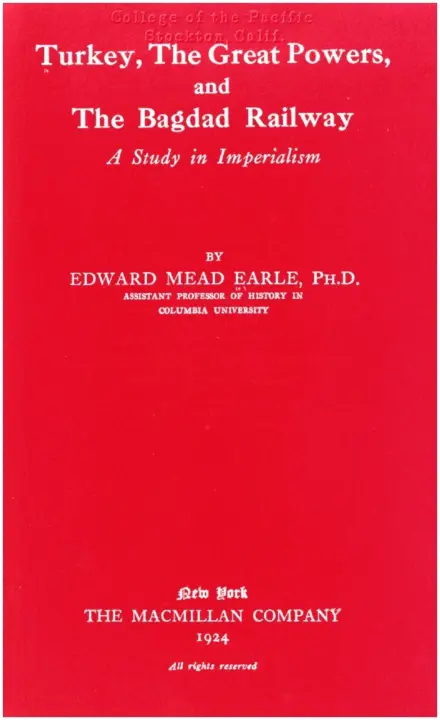
"Turkey, the Great Powers, and the Bagdad Railway: A Study in Imperialism" by Edward Mead Earle is a historical account written in the early 20th century. The book explores the intricate dynamics of imperialism as they relate to the rise of the Bagdad Railway project and its implications on Turkey and its global significance. Through meticulous analysis, it examines how various great powers engaged with the Ottoman Empire’s resources and strategic position. The opening of the book details the historical context leading to the significance of the Bagdad Railway, introducing it as an essential link reviving ancient trade routes during the 19th century. Earle outlines the broader implications of rail development on the economic and political stability of Turkey, emphasizing both the hopes tied to modernization and the inherent dangers posed by international rivalries. The narrative sets the stage for a deeper discussion on how this railway project emerged in a landscape fraught with imperial aspirations and the challenges the Ottoman Empire faced in asserting its sovereignty amidst foreign interests. Overall, the initial chapters lay a foundation for understanding the complexities that surrounded the construction of the Bagdad Railway as a symbol of both progress and contention in modern imperialism.
Introduction adapted from the source catalogue; source summaries may be automatically generated.
Free to read · English · 109,189 words · No account needed
MAKE TIME FOR A GOOD BOOK
On by default. Untick to stop anonymous reading totals. Each page counts after 10 seconds in view. How this works.
Anonymous counting is on unless you have switched it off.
[18] The Revue Bleue, April 6, 1907, p. 429; Syria and Palestine, p. 126. Many of the claims that the Bagdad Railway jeopardized French prosperity were purely fantastic. It was maintained that the opening of the great Mesopotamian granary would cripple French agriculture, already seriously handicapped by the competition of the new world. To this was added the suggestion that development of cotton-growing in Turkey would stifle the infant efforts at the cultivation of cotton in the French colonies. It is incredible that Mesopotamian grain and cotton would have interfered with the flourishing prosperity of the French peasantry; in any event, any such danger was at least a generation removed. France raised high tariff barriers against foreign competition in the home market for agricultural products; she was not an exporter of grain.
[19] Journal Officiel, Débats parlementaires, Chambre des Députés, March 25, 1902, pp. 1467 et seq.
[20] Cf., M. Montbel, “Les puissances coloniales devant l’Islam,” in Questions diplomatiques et coloniales, Volume 37 (1914), pp. 348–362.
[21] Journal Officiel, Débats parlementaires, Chambre des Députés, November 20, 1905, p. 2798. The italics are mine.
[22] Revue des deux mondes, Volume 149 (1898), p. 29.
[23] Sources of the treaties granting special privileges to France are sighted in Note 3, Chapter II. Regarding the origins and nature of the French protectorate over Roman Catholic missions see the article “Capitulations” in the Encyclopedia Britannica, previously cited; J. Brucker, “The Protectorate of Missionaries in the Near East,” in the Catholic Encyclopedia, Volume XII, pp. 488–492; A. Schopoff, Les Réformes et la Protection des Chrétiens en Turquie, 1673–1904 (Paris, 1904); Livre de propagande de l’alliance française, 1883–1893 (Paris, 1894), especially pp. 35 et seq.; Viscomte Aviau de Piolant, La défense des intérêts catholiques en Terre Sainte et en Asie Mineure (Paris, 1886).
[24] Syria and Palestine, pp. 43–45, 54–55; L. Bréhier, “Turkish Empire—Missions,” in Catholic Encyclopedia, Volume XV, pp. 101–102; J. Atalla, “Les solutions de la question syrienne,” in Questions diplomatiques et coloniales, Volume 24 (1907), p. 472.
[25] Bulletin de la Chambre de Commerce française de Constantinople, June 30, 1897, pp. 112–113, November 30, 1897, p. 149.
[26] Brucker, loc. cit., p. 490.
[27] It should be added that the Treaty also stipulated that “the acquired rights of France are explicitly reserved, and there shall be no interference with the statu quo in the Holy Places.” E. Hertslet, The Map of Europe by Treaty, Volume IV (London, 1891), p. 2797.
[28] Revue des deux mondes, Volume 149, (1898), pp. 24–25; Brucker,
loc. cit., p. 491.
Your reading position is saved on this browser. Take it to another device with a library code. Reading pages adapt to text, rather than matching a printed edition.
BEHIND THE BOOK
This eBook is for the use of anyone anywhere in the United States and most other parts of the world at no cost and with almost no restrictions whatsoever. You may copy it, give it away or re-use it under the terms of the Project Gutenberg License included with this eBook or online at www.gutenberg.org. If you are not located in the United States, you will have to check the laws of the country where you are located before using this eBook. Read the source licence.
The original source file, including credits and licence, is retained by this library. Request an original-format copy at no charge. Please include the book title and Project Gutenberg identifier #66221.
KEEP YOUR CURIOSITY GOING
Cécile Tormay

Moritz Busch
John L. Ransom
Frances Wright
Cécile Tormay

Mabel Potter Daggett