THE CLASSIC COLLECTION✦An outlaw’s diary: the CommuneCLASSIC FREE BOOKS
An outlaw’s diary: the Commune
Cécile Tormay
THE CLASSIC COLLECTION · 1923
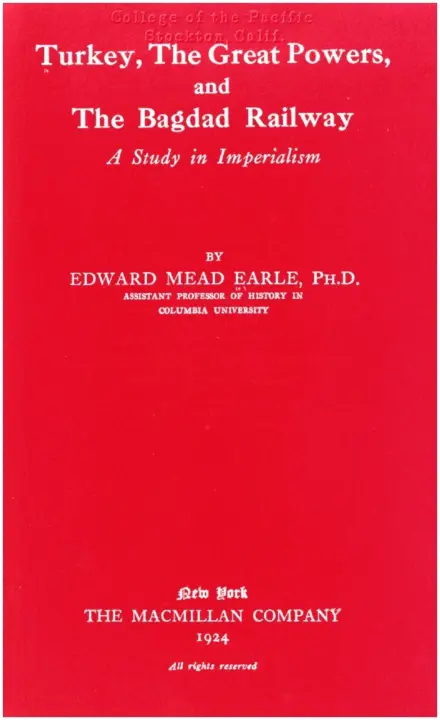
"Turkey, the Great Powers, and the Bagdad Railway: A Study in Imperialism" by Edward Mead Earle is a historical account written in the early 20th century. The book explores the intricate dynamics of imperialism as they relate to the rise of the Bagdad Railway project and its implications on Turkey and its global significance. Through meticulous analysis, it examines how various great powers engaged with the Ottoman Empire’s resources and strategic position. The opening of the book details the historical context leading to the significance of the Bagdad Railway, introducing it as an essential link reviving ancient trade routes during the 19th century. Earle outlines the broader implications of rail development on the economic and political stability of Turkey, emphasizing both the hopes tied to modernization and the inherent dangers posed by international rivalries. The narrative sets the stage for a deeper discussion on how this railway project emerged in a landscape fraught with imperial aspirations and the challenges the Ottoman Empire faced in asserting its sovereignty amidst foreign interests. Overall, the initial chapters lay a foundation for understanding the complexities that surrounded the construction of the Bagdad Railway as a symbol of both progress and contention in modern imperialism.
Introduction adapted from the source catalogue; source summaries may be automatically generated.
Free to read · English · 109,189 words · No account needed
MAKE TIME FOR A GOOD BOOK
On by default. Untick to stop anonymous reading totals. Each page counts after 10 seconds in view. How this works.
Anonymous counting is on unless you have switched it off.
The proposal that French consent to the Bagdad Railway could be purchased with compensations in North Africa met with no enthusiasm in Germany. Herr Bassermann, leader of the National Liberals in the Reichstag, urged the Foreign Office to meet any such diplomatic maneuver on the part of France with a sharp rebuff.[42] At the time of the Agadir crisis, furthermore, Baron Marschall von Bieberstein is said to have warned Bethmann-Hollweg that Germany would have to stand firm on Morocco, for “if, notwithstanding Damascus and Tangier, we abandon Morocco, we lose at one blow our position in Turkey, and with it the advantages and prospects for the future which we have acquired painfully by years of toil.”[43]
It was not until 1914 that an agreement was reached between France and Germany on Asiatic Turkey. For more than ten years, then, the Bagdad Railway was a stinging irritant in the relations between the Republic and the Empire. It aggravated an open wound which needed, not salt, but balm. We shall return later to consider its consequences. But in the meantime we must turn our attention to Great Britain, standing astride the Persian Gulf and blocking the way.
[1] Regarding Russian railways in the Near East cf. the article “Russia—Railways,” in the Encyclopedia Britannica, 11th edition, Volume 23, p. 891. The trans-Persian railway from Resht, a Persian port on the Caspian, to Teheran was completed in September, 1899. Cf. “Russia’s Tightening Grip on Persia,” in The Globe (London), August 24, 1899; also “Russian Railways in Asia,” The Financial News (London), August 14, 1899. The Bagdad Railway frequently was referred to in the French and Russian press as the Petit Transasiatique.
[2] Foreign correspondence of The Globe, July 28, 1899; Commerce (London), August 2, 1899; articles quoted from the Novoe Vremya in The Globe, August 10, 1899; The Engineer (London), August 11, 1899; The Observer, August 13, 1899; R. Henry, “L’intérêt française en Asie occidentale—Le chemin de fer de Bagdad et l’alliance franco-russe,” in Questions diplomatiques et coloniales, Volume 15 (1903), pp. 673–688.
[3] Corps de droit ottoman, Volume IV, pp. 64 et seq.; Paul Imbert, “Le chemin de fer de Bagdad,” in Revue des deux mondes, 5 period, Volume 38 (1907), pp. 657–659.
[4] Quoted by Georges Mazel, Le chemin de fer de Bagdad (Montpelier, 1911), p. 324. It should be remembered that Russia at this time was experiencing the Industrial Revolution. Cf. James Mavor, An Economic History of Russia, Volume II (Toronto, 1914), Book VI.
[5] Annual Register, 1902, p. 323; 1903, pp. 293–294.
[6] Memoirs of Count Witte, edited and translated by A. Yarmolinsky (Garden City, 1921), pp. 75 et seq.; G. Drage, Russian Affairs (London, 1904), pp. 507 et seq.; A. Sauzède, “Le développement des voies ferrées en Russie,” in Questions diplomatiques et coloniales, Volume 37 (1914), pp. 272–281; F. H. Skrine, The Expansion of Russia (Cambridge, 1904), passim.
Your reading position is saved on this browser. Take it to another device with a library code. Reading pages adapt to text, rather than matching a printed edition.
BEHIND THE BOOK
This eBook is for the use of anyone anywhere in the United States and most other parts of the world at no cost and with almost no restrictions whatsoever. You may copy it, give it away or re-use it under the terms of the Project Gutenberg License included with this eBook or online at www.gutenberg.org. If you are not located in the United States, you will have to check the laws of the country where you are located before using this eBook. Read the source licence.
The original source file, including credits and licence, is retained by this library. Request an original-format copy at no charge. Please include the book title and Project Gutenberg identifier #66221.
KEEP YOUR CURIOSITY GOING
Cécile Tormay

Moritz Busch
John L. Ransom
Frances Wright
Cécile Tormay

Mabel Potter Daggett