THE CLASSIC COLLECTION✦An outlaw’s diary: the CommuneCLASSIC FREE BOOKS
An outlaw’s diary: the Commune
Cécile Tormay
THE CLASSIC COLLECTION · 1923
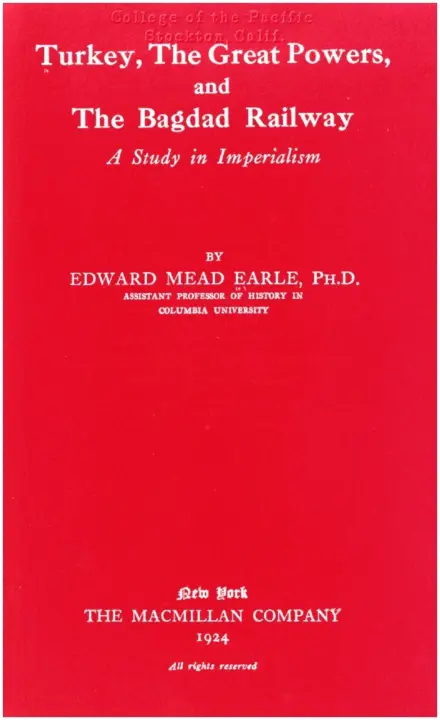
"Turkey, the Great Powers, and the Bagdad Railway: A Study in Imperialism" by Edward Mead Earle is a historical account written in the early 20th century. The book explores the intricate dynamics of imperialism as they relate to the rise of the Bagdad Railway project and its implications on Turkey and its global significance. Through meticulous analysis, it examines how various great powers engaged with the Ottoman Empire’s resources and strategic position. The opening of the book details the historical context leading to the significance of the Bagdad Railway, introducing it as an essential link reviving ancient trade routes during the 19th century. Earle outlines the broader implications of rail development on the economic and political stability of Turkey, emphasizing both the hopes tied to modernization and the inherent dangers posed by international rivalries. The narrative sets the stage for a deeper discussion on how this railway project emerged in a landscape fraught with imperial aspirations and the challenges the Ottoman Empire faced in asserting its sovereignty amidst foreign interests. Overall, the initial chapters lay a foundation for understanding the complexities that surrounded the construction of the Bagdad Railway as a symbol of both progress and contention in modern imperialism.
Introduction adapted from the source catalogue; source summaries may be automatically generated.
Free to read · English · 109,189 words · No account needed
MAKE TIME FOR A GOOD BOOK
On by default. Untick to stop anonymous reading totals. Each page counts after 10 seconds in view. How this works.
Anonymous counting is on unless you have switched it off.
Thus the Bagdad Railway was an imperial enterprise. It became an important concern of the Foreign Office, a matter of national prestige. It was one of the stakes of pre-war diplomacy. Its success was associated with the national honor, to be defended, if need be, by military force and military alliances. The Railway was no longer a railway alone, but a state of mind. Professor Jastrow called it “the spectre of the twentieth century”![41]
[1] Die Bagdadbahn, p. 46.
[2] Stenographische Berichte, XII Legislaturperiode, 1 Session, Volume 231 (1908), pp. 4226a, 4253c.
[3] Wile, op. cit., pp. 39–40.
[4] Riesser, op. cit., p. 543; The Quarterly Review, Volume 235
(1921), p. 315.
[5] Parliamentary Debates, House of Lords, Volume 121 (1903), p. 1348.
[6] For an interesting discussion of this point see George von Siemens, “The National Importance of the Bourse,” in The Nation (London), October 6, 1900. Cf., also, W. M. Shuster, The Strangling of Persia: a Record of European Diplomacy and Oriental Intrigue (New York, 1912).
[7] W. M. Sombart, Die deutsche Volkswirtschaft in neunzehnten Jahrhundert (second edition, Berlin, 1909), p. 184.
[8] Regarding early German interest in Near Eastern colonization cf. K. A. Sprenger, Babylonien, das reichste Land in der Vorzeit und das lohnendste Kolonisationsfeld für die Gegenwart (Heidelberg, 1886); Paul Dehn, Deutschland und die Orientbahnen (Munich, 1883); K. Karger, Kleinasien, ein deutsches Kolonisationsfeld (Berlin, 1892); Deutsche Ansprüche an das türkischen Erbe (Munich, 1896), a symposium including an article by von Moltke.
[9] C. Nawratski, Die jüdische Kolonisation Palästinas (Munich, 1914); Syria and Palestine, p. 59; Mesopotamia, pp. 6–7, 11; Anatolia, pp. 4–7.
[10] Supra, p. 84; H. F. B. Lynch, “The Bagdad Railway,” in the Fortnightly Review, March 1, 1911, pp. 376–377; A. Brisse, “Les intérêts de l’Allemagne dans l’Empire Ottoman,” in Revue de Géographie, June, 1902, pp. 486–487; P. Rohrbach, Die Bagdadbahn, pp. 17–21, 35.
[11] Stenographische Berichte, XII Legislaturperiode, 1 Session, Volume 231 (1908), p. 4253c; P. Rohrbach, Die Bagdadbahn, p. 16, and Deutschland unter den Weltvölkern, pp. 51–53; Von Gwinner, loc. cit., p. 1090.
[12] Die Bagdadbahn, p. 16. Cf., also, R. Henry, Des Montes Bohèmes au Golfe Persique; l’Asie Turque et le Chemin de fer de Bagdad (Paris, 1908), p. 509 et seq.; C. H. Becker, Deutschland und der Islam (Stuttgart and Berlin, 1914); Ernst Jäckh, Die deutsch-türkische Waffenbrüderschaft (Stuttgart and Berlin, 1915).
[13] H. A. Gibbons, The Reconstruction of Poland and the Near East (New York, 1917), pp. 109–110.
[14] Quoted by Marriot, op. cit., p. 356.
[15] Die Bagdadbahn, pp. 18–19.
[16] In this connection see an important statement by Sir Thomas Barclay in the Proceedings of the Central Asian Society (London), March 1, 1911, pp. 21–22, and the opinion of Karl Helfferich, Die deutsche Türkenpolitik, p. 14.
Your reading position is saved on this browser. Take it to another device with a library code. Reading pages adapt to text, rather than matching a printed edition.
BEHIND THE BOOK
This eBook is for the use of anyone anywhere in the United States and most other parts of the world at no cost and with almost no restrictions whatsoever. You may copy it, give it away or re-use it under the terms of the Project Gutenberg License included with this eBook or online at www.gutenberg.org. If you are not located in the United States, you will have to check the laws of the country where you are located before using this eBook. Read the source licence.
The original source file, including credits and licence, is retained by this library. Request an original-format copy at no charge. Please include the book title and Project Gutenberg identifier #66221.
KEEP YOUR CURIOSITY GOING
Cécile Tormay

Moritz Busch
John L. Ransom
Frances Wright
Cécile Tormay

Mabel Potter Daggett