THE CLASSIC COLLECTION✦Red Saunders’ Pets and Other CrittersCLASSIC FREE BOOKS
Red Saunders’ Pets and Other Critters
Henry Wallace Phillips
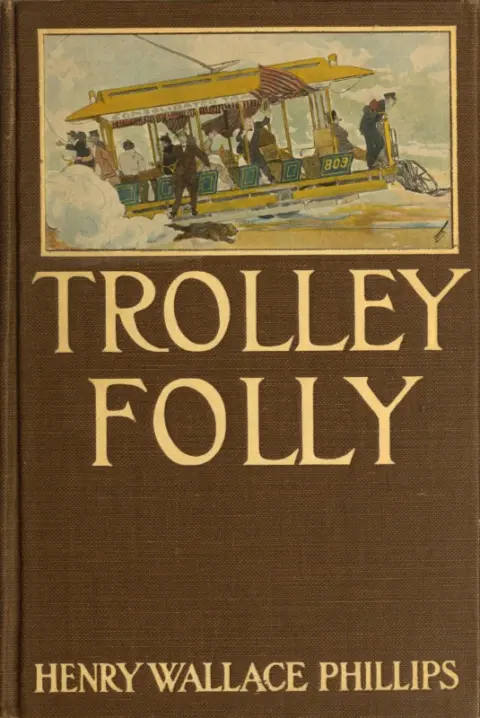
THE CLASSIC COLLECTION · 1909
"Trolley Folly" by Henry Wallace Phillips is a novel written in the early 20th century. The story follows Jimmie Horgan, a carefree young man working as a motorman for the Suburban Trolley Company, who unexpectedly discovers he has inherited five thousand dollars from a long-lost uncle. With this newfound fortune comes a sense of ambition and a desire to break free from the ordinary, leading him and his conductor friend Tommie to take their trolley car on an adventure that quickly spirals into a series of comedic mishaps. The beginning of the novel introduces Jimmie's character and established context by highlighting his reckless yet cheerful demeanor as he navigates life on the trolley while managing a comedic blend of irony and cynicism. After learning of his unexpected inheritance, Jimmie shares the news with Tommie, and together they decide to abandon their usual routes and explore the city with a sense of newfound freedom. Their journey quickly turns chaotic, with their trolley car becoming emblematic of their desire to defy convention and break free from societal constraints, culminating in humorous encounters with passengers and the challenges of running a trolley service unpredictably.
Introduction adapted from the source catalogue; source summaries may be automatically generated.
Free to read · English · 39,451 words · No account needed
MAKE TIME FOR A GOOD BOOK
On by default. Untick to stop anonymous reading totals. Each page counts after 10 seconds in view. How this works.
Anonymous counting is on unless you have switched it off.
“What’d I tell you?” says Stranger, turning in at a butcher shop. And there he asks may we use the scales, and pours our ill-gotten gains into both scoops till they balance. “Take your choice, pardner,” he says. “You’re short on faith, but you’re hell on works!”
Next to a restaurant. Before our order comes, in steps Billy Edwards. He was a deputy sheriff, but white. “Would you mind my asking your name? ’Cause Frenchy doesn’t know. He’s swearing out a warrant for you, alleging assault with intent to kill,” says Billy politely. “They haven’t give me the warrant yet. Course if they had I wouldn’t tell you this, for you might get away before I found you.”
I’d never thought to ask his name!
“Artemus G. Jones,” says he, and he stuck his thumb in his vest. “Set down and take supper with us.”
“Ar--ahem. Er--what does the G. stand for?”
Artie looks embarrassed. “Galatians,” he sighs.
“What? Was you named after--”
“I was named,” says Artie, “after a family scrap. Can’t you suppress it? Artemus G. ought to identify me.”
“I--I thought it might spell easier,” says Billy.
After supper we walks over and gets the warrant. Billy arrests Artie and disarms him. “You know your business--I’ll make any kind of bet on that,” says Billy; “but in your place I should have been far away on a bounding bronco.”
We went to be tried before Judge Eliot. Frenchy kept a jack-leg lawyer named Satterlee, and he was helping persecute.
“Have you legal advice, prisoner?” says his Honor.
“A little,” says Artie softly.
“Proceed. Call the plaintiff.”
Frenchy took the stand and told a terrible tale of wanton robbery and brutal, unprovoked violence. He had won an election bet from prisoner, and prisoner had taken the money by force. He showed his wounds. He shore looked like he’d been playing goat with a buzz-saw.
Brown and the lookout was good witnesses, but they let out, when the Judge questioned them, that Artie had the money in his sack before the trouble began and that Frenchy had a gun. And not a word about my presence of mind.
Artie allowed he wouldn’t cross-examine them. His Honor was riled. “Will you take the stand, sir?” he says.
Artie stretches. “Oh, no--I guess it’s not worth while to take up your time. Ugh--o--oaoh,” he says, yawning.
Judge was furious. “Prisoner, if you’ve got any witnesses in your defense, call ’em. As the evidence stands--up you go!”
Artie placed himself on top of his feet. “Your Honor,” he says “call
Billy Edwards.”
Your reading position is saved on this browser. Take it to another device with a library code. Reading pages adapt to text, rather than matching a printed edition.
Henry Wallace Phillips
Henry Wallace Phillips
Henry Wallace Phillips
Henry Wallace Phillips
BEHIND THE BOOK
This eBook is for the use of anyone anywhere in the United States and most other parts of the world at no cost and with almost no restrictions whatsoever. You may copy it, give it away or re-use it under the terms of the Project Gutenberg License included with this eBook or online at www.gutenberg.org. If you are not located in the United States, you will have to check the laws of the country where you are located before using this eBook. Read the source licence.
The original source file, including credits and licence, is retained by this library. Request an original-format copy at no charge. Please include the book title and Project Gutenberg identifier #57494.
KEEP YOUR CURIOSITY GOING
Coulson Kernahan

Maurice Baring
Frances Wright
Cécile Tormay

Frederic Jesup Stimson

W. H. P. (William Henry Pope) Jarvis