
English Society
George Du Maurier

THE CLASSIC COLLECTION · 1894
"Trilby" by George du Maurier is a sensation novel published in 1894. Set in bohemian 1850s Paris, it follows three British art students who befriend Trilby O'Ferrall, a tone-deaf artist's model beloved by all who meet her. When the sinister musician Svengali enters her life, he transforms her through hypnosis into a celebrated opera singer. But this mysterious power comes at a terrible cost, leading to tragedy for all involved. The novel shaped popular notions of bohemian life and became a cultural phenomenon.
Introduction adapted from the source catalogue; source summaries may be automatically generated.
Free to read · English · 101,520 words · No account needed
MAKE TIME FOR A GOOD BOOK
On by default. Untick to stop anonymous reading totals. Each page counts after 10 seconds in view. How this works.
Anonymous counting is on unless you have switched it off.
He sang, with a very cracked and rather hiccupy voice, his only song (it seems)--an English one, of which the burden, he explained, was French:
"Veeverler veeverler veeverler vee
Veeverler companyee!"
And Zouzou and Dodor complimented him so profusely on his French accent that he was with difficulty prevented from singing it all over again.
Then everybody sang in rotation.
The Laird, with a capital barytone, sang
"Hie diddle Dee for the Lowlands low,"
which was encored.
Little Billee sang "Little Billee."
Vincent sang
"Old Joe kicking up behind and afore.
And the yaller gal a-kicking up behind old Joe."
A capital song, with words of quite a masterly scansion.
Antony sang "Le Sire de Framboisy." Enthusiastic encore.
Lorrimer, inspired no doubt by the occasion, sang the "Hallelujah
Chorus," and accompanied himself on the piano, but failed to obtain an
encore.
Durien sang
"Plaisir d'amour ne dure qu'un moment;
Chagrin d'amour dure toute la vie...."
It was his favorite song, and one of the beautiful songs of the world, and he sang it very well--and it became popular in the quartier latin ever after.
The Greek couldn't sing, and very wisely didn't.
Zouzou sang capitally a capital song in praise of "le vin à quat' sous!"
Taffy, in a voice like a high wind (and with a very good imitation of the Yorkshire brogue), sang a Somersetshire hunting-ditty, ending:
"Of this 'ere song should I be axed the reason for to show,
I don't exactly know, I don't exactly know!
But all my fancy dwells upon Nancy,
And I sing Tally-ho!"
It is a quite superexcellent ditty, and haunts my memory to this day; and one felt sure that Nancy was a dear and a sweet, wherever she lived, and when. So Taffy was encored twice--once for her sake, once for his own.
And finally, to the surprise of all, the bold dragoon sang (in English) "My Sister Dear," out of Masaniello, with such pathos, and in a voice so sweet and high and well in tune, that his audience felt almost weepy in the midst of their jollification, and grew quite sentimental, as Englishmen abroad are apt to do when they are rather tipsy and hear pretty music, and think of their dear sisters across the sea, or their friends' dear sisters.
Your reading position is saved on this browser. Take it to another device with a library code. Reading pages adapt to text, rather than matching a printed edition.
George Du Maurier
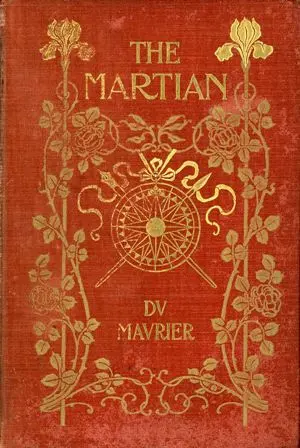
George Du Maurier
George Du Maurier
George Du Maurier
BEHIND THE BOOK
This eBook is for the use of anyone anywhere in the United States and most other parts of the world at no cost and with almost no restrictions whatsoever. You may copy it, give it away or re-use it under the terms of the Project Gutenberg License included with this eBook or online at www.gutenberg.org. If you are not located in the United States, you will have to check the laws of the country where you are located before using this eBook. Read the source licence.
The original source file, including credits and licence, is retained by this library. Request an original-format copy at no charge. Please include the book title and Project Gutenberg identifier #39858.
KEEP YOUR CURIOSITY GOING
Coulson Kernahan

Maurice Baring
Frances Wright
Cécile Tormay

Frederic Jesup Stimson

W. H. P. (William Henry Pope) Jarvis