
English Society
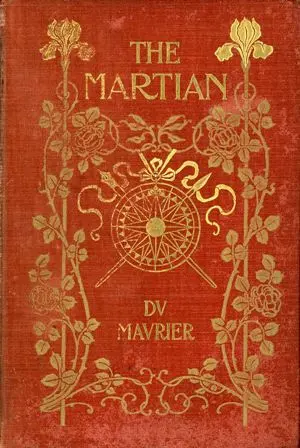
George Du Maurier

THE CLASSIC COLLECTION · 1894
"Trilby" by George du Maurier is a sensation novel published in 1894. Set in bohemian 1850s Paris, it follows three British art students who befriend Trilby O'Ferrall, a tone-deaf artist's model beloved by all who meet her. When the sinister musician Svengali enters her life, he transforms her through hypnosis into a celebrated opera singer. But this mysterious power comes at a terrible cost, leading to tragedy for all involved. The novel shaped popular notions of bohemian life and became a cultural phenomenon.
Introduction adapted from the source catalogue; source summaries may be automatically generated.
Free to read · English · 101,520 words · No account needed
MAKE TIME FOR A GOOD BOOK
On by default. Untick to stop anonymous reading totals. Each page counts after 10 seconds in view. How this works.
Anonymous counting is on unless you have switched it off.
And all for the sake of a high heel and a ridiculously pointed toe--mean
things, at the best!
Conversely, when Mother Nature has taken extra pains in the building of it, and proper care or happy chance has kept it free of lamentable deformations, indurations, and discolorations--all those grewsome boot-begotten abominations which have made it so generally unpopular--the sudden sight of it, uncovered, comes as a very rare and singularly pleasing surprise to the eye that has learned how to see!
Nothing else that Mother Nature has to show, not even the human face divine, has more subtle power to suggest high physical distinction, happy evolution, and supreme development; the lordship of man over beast, the lordship of man over man, the lordship of woman over all!
En, voilà, de l'éloquence--à propos de bottes!
Trilby had respected Mother Nature's special gift to herself--had never worn a leather boot or shoe, had always taken as much care of her feet as many a fine lady takes of her hands. It was her one coquetry, the only real vanity she had.
Gecko, his fiddle in one hand and his bow in the other, stared at her in open-mouthed admiration and delight, as she ate her sandwich of soldier's bread and fromage à la crème quite unconcerned.
When she had finished she licked the tips of her fingers clean of cheese, and produced a small tobacco-pouch from another military pocket, and made herself a cigarette, and lit it and smoked it, inhaling the smoke in large whiffs, filling her lungs with it, and sending it back through her nostrils, with a look of great beatitude.
Svengali played Schubert's "Rosemonde," and flashed a pair of languishing black eyes at her with intent to kill.
But she didn't even look his way. She looked at Little Billee, at big Taffy, at the Laird, at the casts and studies, at the sky, the chimney-pots over the way, the towers of Notre Dame, just visible from where she sat.
Only when he finished she exclaimed: "Maïe, aïe! c'est rudement bien tapé, c'te musique-là! Seulement, c'est pas gai, vous savez! Comment q'ça s'appelle?"
"It is called the 'Rosemonde' of Schubert, matemoiselle," replied
Svengali. (I will translate.)
"And what's that--Rosemonde?" said she.
"Rosemonde was a princess of Cyprus, matemoiselle, and Cyprus is an
island."
"Ah, and Schubert, then--where's that?"
"Schubert is not an island, matemoiselle. Schubert was a compatriot of mine, and made music, and played the piano, just like me."
"Ah, Schubert was a monsieur, then. Don't know him; never heard his
name."
"That is a pity, matemoiselle. He had some talent. You like this better, perhaps," and he strummed,
Your reading position is saved on this browser. Take it to another device with a library code. Reading pages adapt to text, rather than matching a printed edition.
George Du Maurier
George Du Maurier
George Du Maurier
George Du Maurier
BEHIND THE BOOK
This eBook is for the use of anyone anywhere in the United States and most other parts of the world at no cost and with almost no restrictions whatsoever. You may copy it, give it away or re-use it under the terms of the Project Gutenberg License included with this eBook or online at www.gutenberg.org. If you are not located in the United States, you will have to check the laws of the country where you are located before using this eBook. Read the source licence.
The original source file, including credits and licence, is retained by this library. Request an original-format copy at no charge. Please include the book title and Project Gutenberg identifier #39858.
KEEP YOUR CURIOSITY GOING
Coulson Kernahan

Maurice Baring
Frances Wright
Cécile Tormay

Frederic Jesup Stimson

W. H. P. (William Henry Pope) Jarvis