THE CLASSIC COLLECTION✦Little Guzzy, and other storiesCLASSIC FREE BOOKS
Little Guzzy, and other stories
John Habberton
THE CLASSIC COLLECTION · 1897
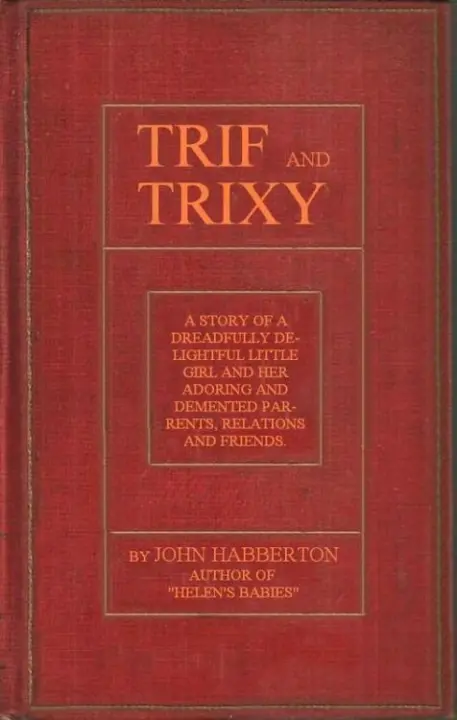
"Trif and Trixy" by John Habberton is a novel written in the late 19th century. The story revolves around the delightful escapades of Trixy, a precocious seven-year-old girl, and her mother Trif, who navigates the challenges of parenthood amid Trixy's endearing antics. The narrative delves into the dynamics of family interactions, childhood innocence, and the various relationships that form around Trixy, who is often described as a "dreadfully delightful" character. At the start of the book, we are introduced to Trixy, who has recently turned seven, but her family continues to refer to her as the "baby." Her mother, Trif, is described as both proud and loving, handling her daughter's lively and unfiltered nature with a mixture of affection and exasperation. The opening chapters set up various family dynamics, including Trif's sister Fenie's infatuation with young men and the comedic situations arising from Trixy's candid observations and misunderstandings. Through Trixy's interactions with her family and the adult world around her, the reader gets a glimpse of the humor and warmth that characterize Habberton's storytelling, establishing a tone that suggests both lightheartedness and deeper explorations of relationships as the story unfolds.
Introduction adapted from the source catalogue; source summaries may be automatically generated.
Free to read · English · 60,373 words · No account needed
MAKE TIME FOR A GOOD BOOK
On by default. Untick to stop anonymous reading totals. Each page counts after 10 seconds in view. How this works.
Anonymous counting is on unless you have switched it off.
"All right; I'm very much obliged. First, though, you'd better begin and read what's already wrote, 'cause it's so long since mamma began this letter for me that I can't remember what I told her to say."
"H'm--let me see," said the Admiral, adjusting his glasses. "'Dear Old
Papa'----"
"Go on."
The Admiral, who, like most men of affairs, had acquired a way of reading a page at a glance, suddenly looked at Trixy in astonishment. Then he re-read the letter, and said, with a twinkle of his eyes:
"Aren't you rather young to take so much interest in match-making?"
"What's match-makin'?" asked the child, with wondering eyes.
"Oh, you seem to understand the subject very well. The idea of a child planning a marriage between a man and a woman--quite suited to each other though they certainly are--who never met until this week!"
"Who do you mean? Aunt Fee and Harry? Why, they've----"
"No, no--I don't mean them. This is another couple--a lady and an army
officer."
"Oh, you mean Mr. Jermyn and Miss Trewman? Why, I don' remember tellin' mamma to write anythin' about them. Come to think of it, though, I said to her, over at guard mount the other day, that 'twould be nice if they got married; but she said 'Sh--h--,' and that means the same thing as don't when mamma says it."
"Yes--to be sure; it used to be so in our family, when I was a boy. But how did this subject get into the letter, if you didn't tell your mother to write it?"
"I'm sure I don't know, unless mamma put it in just for fun. Sometimes she helps me with things to say, when I want to write a real long letter."
"H'm!" The Admiral looked very alert as he recalled customs of his own family when he was a young father. "Trixy, would you mind telling me your father's name--his first name?"
"It's Philip."
"Ah, yes. And is that what your mother usually calls him?"
"Goodness, no! When she says 'Philip,' papa pretends to be awfully scared. Sometimes she calls him Phil, but usually she says 'papa.'"
"Just as I supposed." The Admiral was silent and grave so long that the
child timidly asked:
"You don't think it's improper for her to do it, do you?"
"Improper? No, indeed! I'd give half my pay--yes, all of it--to hear my wife call me 'papa' again." Tears came into the veteran's eyes, and Trixy, following home custom regarding such matters, kissed them away, which operation made the Admiral's face as cheery as a sunburst. Nevertheless, the old man did some more thinking, and finally he said:
Your reading position is saved on this browser. Take it to another device with a library code. Reading pages adapt to text, rather than matching a printed edition.
John Habberton

John Habberton
John Habberton

John Habberton
BEHIND THE BOOK
This eBook is for the use of anyone anywhere in the United States and most other parts of the world at no cost and with almost no restrictions whatsoever. You may copy it, give it away or re-use it under the terms of the Project Gutenberg License included with this eBook or online at www.gutenberg.org. If you are not located in the United States, you will have to check the laws of the country where you are located before using this eBook. Read the source licence.
The original source file, including credits and licence, is retained by this library. Request an original-format copy at no charge. Please include the book title and Project Gutenberg identifier #51788.
KEEP YOUR CURIOSITY GOING
Coulson Kernahan

Maurice Baring
Frances Wright
Cécile Tormay

Frederic Jesup Stimson

W. H. P. (William Henry Pope) Jarvis