THE CLASSIC COLLECTION✦Little Guzzy, and other storiesCLASSIC FREE BOOKS
Little Guzzy, and other stories
John Habberton
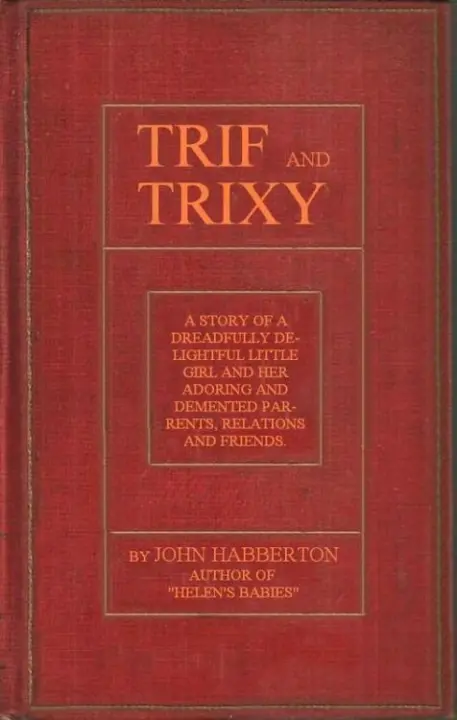
THE CLASSIC COLLECTION · 1897
"Trif and Trixy" by John Habberton is a novel written in the late 19th century. The story revolves around the delightful escapades of Trixy, a precocious seven-year-old girl, and her mother Trif, who navigates the challenges of parenthood amid Trixy's endearing antics. The narrative delves into the dynamics of family interactions, childhood innocence, and the various relationships that form around Trixy, who is often described as a "dreadfully delightful" character. At the start of the book, we are introduced to Trixy, who has recently turned seven, but her family continues to refer to her as the "baby." Her mother, Trif, is described as both proud and loving, handling her daughter's lively and unfiltered nature with a mixture of affection and exasperation. The opening chapters set up various family dynamics, including Trif's sister Fenie's infatuation with young men and the comedic situations arising from Trixy's candid observations and misunderstandings. Through Trixy's interactions with her family and the adult world around her, the reader gets a glimpse of the humor and warmth that characterize Habberton's storytelling, establishing a tone that suggests both lightheartedness and deeper explorations of relationships as the story unfolds.
Introduction adapted from the source catalogue; source summaries may be automatically generated.
Free to read · English · 60,373 words · No account needed
MAKE TIME FOR A GOOD BOOK
On by default. Untick to stop anonymous reading totals. Each page counts after 10 seconds in view. How this works.
Anonymous counting is on unless you have switched it off.
"You dreadful fellow!" exclaimed Trif. "The idea of you keeping a secret from me--and for three whole days!"
"But, pardon me," said the Admiral, "do either of you find it
impossible to forgive me?"
"On the contrary," replied Phil, "it is impossible to see where you were to blame. Trixy herself took the letter to you and asked you to finish it, so you couldn't help reading it. Neither could you help supposing it to be what she thought it, her own letter, for it began 'Dear Old Papa.'"
"But," persisted the Admiral, "I was guilty, shamefully so, that in my absent-mindedness I took it from my pocket at the club, to sketch upon."
"Just as I frequently use letters to figure upon," said Phil.
"Thank you--thank you. And poor Jermyn, in making his own sketch, and knowing, of course, the subject of conversation, looked at the written portion, supposing it to be something pertinent to the subject."
"Quite naturally, and each of you afterward had a lot of trouble which he didn't in the least deserve."
"I don't see," said Trif, "that anyone is to blame but I. The experience teaches me never again to leave a letter unfinished."
"Thank you, my dear," said Phil. "You see, Admiral, that your loss is to be my gain. Hereafter I'm not to be disappointed when longing for letters."
"What letters, papa?" asked Trixy from the sitting-room, where she was conducting a spelling lesson for dolls.
"None, dear--tis nothing that you would understand."
"If there is no feeling against me, therefore," said the Admiral, adhering to the purpose of his call, "would you mind, after erasing Mrs. Highwood's lines, giving the sketches to me?"
"It will give me the greatest pleasure to place them in your hands," said Phil, taking some papers from the pocket of his coat. "Why, they're not here! Hem! Ah, I remember; I changed some papers hurriedly this morning to my coat at the office, and apparently those were among them. I'll get them to you to-morrow, and leave them at your hotel as I come up town."
"I shall be there to receive them," said the Admiral, putting on a look of resignation. "Excuse my eagerness and anxiety in the matter, but those sketches have become a veritable nightmare to me."
"I don't wonder," said Phil, "considering what they represent. Trixy, dear, don't laugh so loud. What is the matter?"
"Oh, I'm tellin' the dolls somethin' funny, and I have to do the laughin' for the whole lot of them, don't you see?"
Your reading position is saved on this browser. Take it to another device with a library code. Reading pages adapt to text, rather than matching a printed edition.
John Habberton
John Habberton
John Habberton
John Habberton
BEHIND THE BOOK
This eBook is for the use of anyone anywhere in the United States and most other parts of the world at no cost and with almost no restrictions whatsoever. You may copy it, give it away or re-use it under the terms of the Project Gutenberg License included with this eBook or online at www.gutenberg.org. If you are not located in the United States, you will have to check the laws of the country where you are located before using this eBook. Read the source licence.
The original source file, including credits and licence, is retained by this library. Request an original-format copy at no charge. Please include the book title and Project Gutenberg identifier #51788.
KEEP YOUR CURIOSITY GOING
Coulson Kernahan

Maurice Baring
Frances Wright
Cécile Tormay

Frederic Jesup Stimson

W. H. P. (William Henry Pope) Jarvis