THE CLASSIC COLLECTION✦Travels into North America, Volume 3 (of 3)CLASSIC FREE BOOKS
Travels into North America, Volume 3 (of 3)
Pehr Kalm
THE CLASSIC COLLECTION · 1771
"Travels into North America, Volume 2 (of 3)" by Pehr Kalm is a scientific travel narrative written in the mid-18th century. The work presents an in-depth exploration of North America's natural history, agriculture, and the social practices of its inhabitants, with Kalm drawing on his personal observations and experiences during his travels. The book combines detailed descriptions of botany, agriculture, and the ecological interactions between settlers and indigenous populations, offering readers a nuanced perspective on early American society. At the start of the narrative, Kalm recounts his experiences in New Jersey on December 7, 1748, highlighting the favorable conditions that contribute to higher population growth in the region compared to Europe. He shares anecdotes about local families, detailing their large progeny and longevity, which illustrates the opportunities and social freedoms available in colonial America. Kalm continues by discussing various insects native to the area, including mosquitoes, locusts, and caterpillars, emphasizing their impacts on local agriculture. His observations on the natural environment are enriched with descriptions of the flora, fauna, and daily life of the colonists, setting the stage for a comprehensive study of North America as he saw it in the 18th century.
Introduction adapted from the source catalogue; source summaries may be automatically generated.
Free to read · English · 76,463 words · No account needed
MAKE TIME FOR A GOOD BOOK
On by default. Untick to stop anonymous reading totals. Each page counts after 10 seconds in view. How this works.
Anonymous counting is on unless you have switched it off.
The Peach-trees were now every where in blossom; their leaves were not yet come out of the buds, and therefore the flowers shewed to greater advantage; their beautiful pale red colour had a very fine effect; and they sat so close that the branches were entirely clad with them. The other fruit-trees were not yet in flower; however the apple-blossoms began to appear.
The English and the Swedes of America give the name of Currants [32] to a shrub which grows in wet ground, and near swamps, and which was now in blossom; its flowers are white, have a very agreeable fragrancy, and grow in oblong bunches; the fruit is very good eating, when it is ripe; the Style (Stylus) is thread-shaped (filiformis), and shorter than the Stamina; it is divided in the middle, into five parts, or Stigmata. Dr. Linnæus calls it Cratægus [33], and Dr. Gronovius calls it a Mespilus [34].
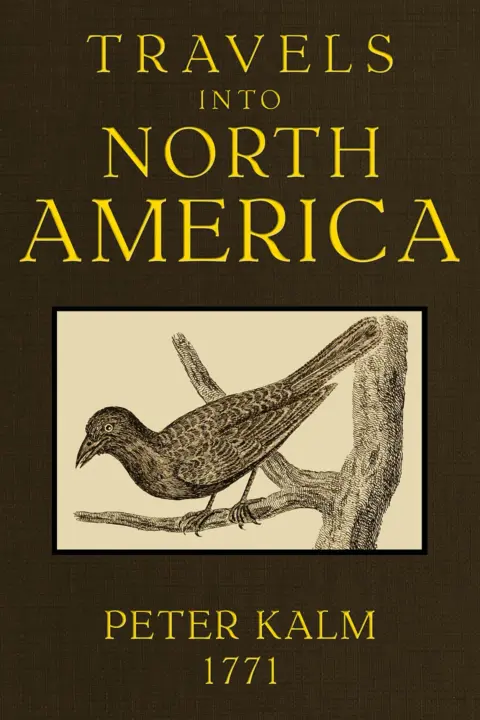
April the 22d. The Swedes give the name of Whipperiwill, and the English that of Whip-poor-will, to a kind of nocturnal bird, whose voice is heard in North America, almost throughout the whole night. Catesby and Edwards both have described and figured it [35]. Dr. Linnæus calls it a variety of the Caprimulgus Europæus, or Goat-sucker: its shape, colour, size, and other qualities, make it difficult to distinguish them from each other. But the peculiar note of the American one distinguishes it from the European one, and from all other birds: it is not found here during winter, but returns with the beginning of summer. I heard it to-day, for the first time, and many other people said, that they had not heard it before this summer; its English and Swedish name is taken from its note; but, accurately speaking, it does not call Whipperiwill, nor Whip-poor-will, but rather Whipperiwhip so that the first and last syllables are accented, and the intermediate ones but slightly pronounced. The English change the call of this bird into Whip-poor-will, that it may have some kind of signification: it is neither heard nor seen in day-time; but soon after sun-set it begins to call, and continues for a good while, as the cuckow does in Europe. After it has continued calling in a place for some time, it removes to another, and begins again: it commonly comes several times in a night, and settles close to the houses; I have seen it coming late in the evening, and settling on the steps of the house, in order to sing its song; it is very shy, and when a person stood still, it would settle close by him, and begin to call. It came to the houses in order to get its food, which consists of insects; and those always abound near the houses at night; when it sat and called its whipperiwhip, and saw an insect passing, it flew up and caught it, and settled again. Sometimes you hear four or five, or more, near each other, calling as it were for a wager, and raising a great noise in the woods. They were seldom heard in towns, being either extirpated there, or frightened away, by frequent shooting. They do not like to sit on trees, but are commonly on the ground, or very low in bushes, or on the lower poles of the enclosures. They always fly near the ground: they continue their calling at night till it grows quite dark; they are silent till the dawn of day comes on, and then they call till the sun rises. The sun seems to stop their mouths, or dazzle their eyes, so as to make them sit still. I have never heard them call in the midst of night, though I hearkened very attentively, on purpose to hear it; and many others have done the same. I am told they make no nest, but lay two eggs in the open fields. My servant shot at one which sat on a bush near the house, and though he did not hit it, yet it fell down through fear, and lay for some time quite dead; but recovered afterwards. It never attempted to bite when it was held in the hands, only endeavouring to get loose by stirring itself about. Above, and close under the eyes, were several black, long, and stiff bristles, as in other nocturnal birds. The Europeans eat it. Mr. Catesby says, the Indians affirm, that they never saw these birds, or heard of them, before a certain great battle, in which the Europeans killed a great number of Indians. Therefore, they suppose that these birds, which are restless, and utter their plaintive note at night, are the souls of their ancestors who died in battle.
Your reading position is saved on this browser. Take it to another device with a library code. Reading pages adapt to text, rather than matching a printed edition.
BEHIND THE BOOK
This eBook is for the use of anyone anywhere in the United States and most other parts of the world at no cost and with almost no restrictions whatsoever. You may copy it, give it away or re-use it under the terms of the Project Gutenberg License included with this eBook or online at www.gutenberg.org. If you are not located in the United States, you will have to check the laws of the country where you are located before using this eBook. Read the source licence.
The original source file, including credits and licence, is retained by this library. Request an original-format copy at no charge. Please include the book title and Project Gutenberg identifier #72103.
KEEP YOUR CURIOSITY GOING
Wilfrid Scawen Blunt
Wilfrid Scawen Blunt

E. W. (Edgar Watson) Howe
Cécile Tormay

Moritz Busch
John L. Ransom