THE CLASSIC COLLECTION✦My diaries, being a personal narrative of events 1888-1914, Part 2 (1900-1914)CLASSIC FREE BOOKS
My diaries, being a personal narrative of events 1888-1914, Part 2 (1900-1914)
Wilfrid Scawen Blunt
THE CLASSIC COLLECTION · 1822
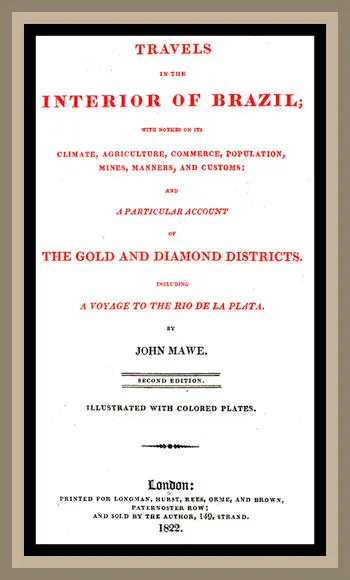
"Travels in the Interior of Brazil" by John Mawe is a detailed travelogue written in the early 19th century. This work chronicles the author's various journeys through Brazil, providing insights into its climate, agriculture, commerce, population, and rich mineral resources, particularly focusing on the gold and diamond districts. As Mawe documents his exploration, he also shares personal adventures and observations that reveal the nuances of Brazilian society and its landscape. At the start of the narrative, Mawe recounts his ill-fated voyage to the Rio de la Plata, where he experiences imprisonment and political turmoil. Upon arrival in Monte Video, he suffers the loss of his cargo, faces hostility from local authorities, and recounts incidents that illustrate the precariousness of foreign travelers in a politically charged environment. The opening sets the stage for Mawe’s broader explorations into Brazil, detailing both the challenges he faces and the fascinating aspects of the regions he explores, laying the groundwork for a compelling exploration of Brazil's interior.
Introduction adapted from the source catalogue; source summaries may be automatically generated.
Free to read · English · 123,410 words · No account needed
MAKE TIME FOR A GOOD BOOK
On by default. Untick to stop anonymous reading totals. Each page counts after 10 seconds in view. How this works.
Anonymous counting is on unless you have switched it off.
The intercourse of this port with India, in common with Mozambique, has been much annoyed by the privateers of the Isle of France, and will therefore, in all probability, florish equally by their suppression. A voyage thither and back is performed with great expedition: one large ship of eight hundred tons sailed, loaded at Surat, and returned within the space of seven months. A voyage to China seldom occupies a longer period. The trade thither will no doubt be revived, and it is not improbable that this port may, at no great distance of time, become an entrepôt for India goods destined for Europe.
Rio de Janeiro is conveniently situated for supplying a great variety of necessaries to the Cape of Good Hope and to New South Wales; indeed, of late years, English manufactures have been sold here so cheap, that it has been found more advantageous to ship them hence for those colonies than from home. Ships going on the South Sea whale-fishery touch here, and lay in large quantities of spirituous liquors, wine, sugar, coffee, tobacco, soap, and live stock.
The imports from the mother-country consist chiefly in vinegar, hardware, coarse linen, hats, silks, wine, and oil. From Sweden some iron, also pitch and tar are occasionally brought: it is preferred to English iron, particularly for mules’ shoes, on account of its greater ductility.
The exports consist principally of cotton, sugar, rum, coffee, rice, ship-timber, various fine cabinet-woods, hides, tallow, indigo, and coarse cotton cloths, in immense quantities, for clothing the Peons in the provinces of the River Plate. Among the more precious articles of export may be enumerated gold, in chains and other ornaments, diamonds, topazes of various colors, amethysts, tourmalines, (that are frequently sold for emeralds), chrysoberyls, aqua-marinas, and wrought jewelry.
This market has been greatly overstocked with English manufactures, in consequence of the sanguine speculations to which our merchants were incited by the late emigration. The supply exceeded the demand in a tenfold degree, and the excess gave rise to auctions, where goods were sold at unprecedentedly reduced prices. In proportion as English merchandize lowered, that of Brazil rose in value; and so great was the demand for it, owing to the numerous vessels waiting for cargoes, that within a year after the arrival of the Prince Regent, the price of every article of produce was doubled. Gold quickly disappeared; for the monied Portuguese, perceiving the avidity and impolitic eagerness with which the English forced their goods upon them, cautiously withheld their specie, and, by the alternative of barter, got rid of their own produce at a very high price, and obtained our merchandize almost at their own valuation. The losing party in this unequal traffic, though they had chiefly to blame their own imprudence in engaging in it, were loud in their complaints and remonstrances against the Portuguese merchants. A treaty of commerce was concluded, by which the duties on English merchandize were fixed at fifteenper cent. while other nations were to pay twenty-four per cent. ad valorem. A judge was appointed to attend solely to the concerns of the English, and to see justice done them: he was entitled the Juiz Conservador of the English nation. The person who now fills this important office is one of the most enlightened and upright of men; his official conduct, of which I have seen much, has secured him the respect of all parties, and has done credit to the choice of the Prince Regent, confirmed by the approval of his Excellency Lord Strangford. Further to cultivate and extend the interests of commerce, his Royal Highness has established a Board of Trade, in which are some experienced and intelligent men, to whose consideration every particular case, and every new regulation, is referred. One of the members of this Board, Dr. José da Silva Lisboa, has greatly distinguished himself by his zeal for the English nation, displayed in various publications on commerce, particularly in one dated May 1810, which contains a fund of solid argument on the principles laid down and acknowledged by our most celebrated statesmen and political writers. It is to be hoped that the diffusion of views so liberal, under the auspices of ministers, will banish that narrow-minded jealousy with which certain opulent individuals of the Brazilian capital regard the English merchants, whom they stigmatize as intruders; and that the general interests of commerce in this thriving colony will gain, through fair competition, what they have heretofore lost through overstocked markets.
Your reading position is saved on this browser. Take it to another device with a library code. Reading pages adapt to text, rather than matching a printed edition.
BEHIND THE BOOK
This eBook is for the use of anyone anywhere in the United States and most other parts of the world at no cost and with almost no restrictions whatsoever. You may copy it, give it away or re-use it under the terms of the Project Gutenberg License included with this eBook or online at www.gutenberg.org. If you are not located in the United States, you will have to check the laws of the country where you are located before using this eBook. Read the source licence.
The original source file, including credits and licence, is retained by this library. Request an original-format copy at no charge. Please include the book title and Project Gutenberg identifier #50653.
KEEP YOUR CURIOSITY GOING
Wilfrid Scawen Blunt
Wilfrid Scawen Blunt

E. W. (Edgar Watson) Howe
Cécile Tormay

Moritz Busch
John L. Ransom