THE CLASSIC COLLECTION✦My diaries, being a personal narrative of events 1888-1914, Part 2 (1900-1914)CLASSIC FREE BOOKS
My diaries, being a personal narrative of events 1888-1914, Part 2 (1900-1914)
Wilfrid Scawen Blunt
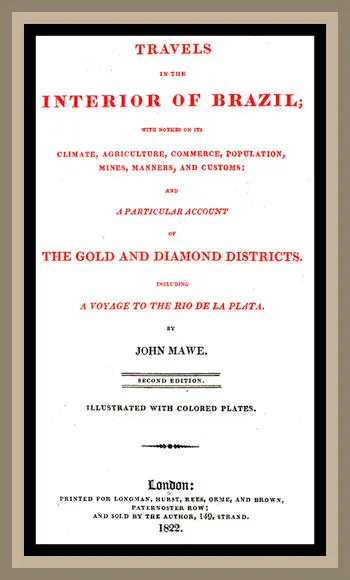
THE CLASSIC COLLECTION · 1822
"Travels in the Interior of Brazil" by John Mawe is a detailed travelogue written in the early 19th century. This work chronicles the author's various journeys through Brazil, providing insights into its climate, agriculture, commerce, population, and rich mineral resources, particularly focusing on the gold and diamond districts. As Mawe documents his exploration, he also shares personal adventures and observations that reveal the nuances of Brazilian society and its landscape. At the start of the narrative, Mawe recounts his ill-fated voyage to the Rio de la Plata, where he experiences imprisonment and political turmoil. Upon arrival in Monte Video, he suffers the loss of his cargo, faces hostility from local authorities, and recounts incidents that illustrate the precariousness of foreign travelers in a politically charged environment. The opening sets the stage for Mawe’s broader explorations into Brazil, detailing both the challenges he faces and the fascinating aspects of the regions he explores, laying the groundwork for a compelling exploration of Brazil's interior.
Introduction adapted from the source catalogue; source summaries may be automatically generated.
Free to read · English · 123,410 words · No account needed
MAKE TIME FOR A GOOD BOOK
On by default. Untick to stop anonymous reading totals. Each page counts after 10 seconds in view. How this works.
Anonymous counting is on unless you have switched it off.
After travelling onward four leagues, we arrived at the ancient mines of Jaraguá, famed for the immense treasures they produced nearly two centuries ago, when at the ports of Santos and S, Vicente, whence the gold was shipped for Europe, this district was regarded as the Peru of Brazil. The face of the country is uneven and rather mountainous. The rock, where it appeared exposed, I found to be granite, and sometimes gneiss, containing a portion of hornblende, with mica. The soil is red, and remarkably ferruginous, in many places apparently of great depth. The gold lies, for the most part, in a stratum of rounded pebbles and gravel, called cascalho, immediately incumbent on the solid rock. In the valleys, where there is water, occur frequent excavations, made by the gold-washers, to a considerable extent, some of them fifty or a hundred feet wide, and eighteen or twenty deep. On many of the hills, where water can be collected for washing, particles of gold are found in the soil, scarcely deeper than the roots of the grass.
The mode of working these mines, more fitly to be denominated washings, is simple, and may be easily explained:
Suppose a loose gravel-like stratum of rounded quartzose pebbles and adventitious matter, incumbent on granite, and covered by earthy matter of variable thickness. Where water of sufficiently high level can be commanded, the ground is cut in steps, each twenty or thirty feet wide, two or three broad, and about one deep. Near the bottom a trench is cut to the depth of two or three feet. On each step stand six or eight negroes, who, as the water flows gently from above, keep the earth continually in motion with shovels, until the whole is reduced to liquid mud and washed below. The particles of gold contained in this earth descend to the trench, where, by reason of their specific gravity, they quickly precipitate. Workmen are continually employed at the trench to remove the stones, and clear away the surface, which operation is much assisted by the current of water which falls into it. After five days’ washing, the precipitation in the trench is carried to some convenient stream, to undergo a second clearance. For this purpose wooden bowls are provided, of a funnel shape, about two feet wide at the mouth, and five or six inches deep, called gamellas. Each workman standing in the stream, takes into his bowl five or six pounds weight of the sediment, which generally consists of heavy matter, such as granular oxide of iron, pyrites, ferruginous quartz, &c. and often precious stones. They admit certain quantities of water into the bowls, which they move about so dexterously, that the precious metal, separating from the inferior and lighter substances, settles to the bottom and sides of the vessel. They then rinse their bowls in a larger vessel of clean water, leaving the gold in it, and begin again. The washing of each bowlful occupies from five to eight or nine minutes; the gold produced is extremely variable in quantity, and in the size of its particles, some of which are so minute, that they float, while others are found as large as peas, and not unfrequently much larger. This operation is superintended by overseers, as the result is of considerable importance. When the whole is finished, the gold is placed upon a brass pan, over a slow fire, to be dried, and at a convenient time is taken to the permutation office, where it is weighed, and a fifth is reserved for the Prince. The remainder is smelted with muriate of mercury, then cast into ingots, assayed, and stamped according to its intrinsic value, a certificate of which is given with it; after a copy of that instrument has been duly entered at the mint-office, the ingots circulate as specie.
Your reading position is saved on this browser. Take it to another device with a library code. Reading pages adapt to text, rather than matching a printed edition.
BEHIND THE BOOK
This eBook is for the use of anyone anywhere in the United States and most other parts of the world at no cost and with almost no restrictions whatsoever. You may copy it, give it away or re-use it under the terms of the Project Gutenberg License included with this eBook or online at www.gutenberg.org. If you are not located in the United States, you will have to check the laws of the country where you are located before using this eBook. Read the source licence.
The original source file, including credits and licence, is retained by this library. Request an original-format copy at no charge. Please include the book title and Project Gutenberg identifier #50653.
KEEP YOUR CURIOSITY GOING
Wilfrid Scawen Blunt
Wilfrid Scawen Blunt

E. W. (Edgar Watson) Howe
Cécile Tormay

Moritz Busch
John L. Ransom