READ · DISCOVER · ENJOYClassic literature · Always free
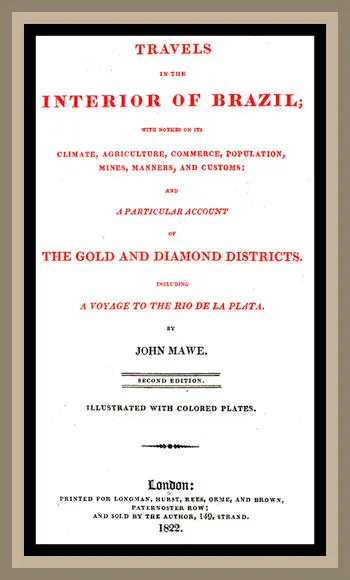
Travels in the interior of Brazil with notices on its climate, agriculture, commerce, population, mines, manners, and customs: and a particular account of the gold and diamond districts. — digital edition cover

THE CLASSIC COLLECTION · 1822

Travels in the interior of Brazil with notices on its climate, agriculture, commerce, population, mines, manners, and customs: and a particular account of the gold and diamond districts.

"Travels in the Interior of Brazil" by John Mawe is a detailed travelogue written in the early 19th century. This work chronicles the author's various journeys through Brazil, providing insights into its climate, agriculture, commerce, population, and rich mineral resources, particularly focusing on the gold and diamond districts. As Mawe documents his exploration, he also shares personal adventures and observations that reveal the nuances of Brazilian society and its landscape. At the start of the narrative, Mawe recounts his ill-fated voyage to the Rio de la Plata, where he experiences imprisonment and political turmoil. Upon arrival in Monte Video, he suffers the loss of his cargo, faces hostility from local authorities, and recounts incidents that illustrate the precariousness of foreign travelers in a politically charged environment. The opening sets the stage for Mawe’s broader explorations into Brazil, detailing both the challenges he faces and the fascinating aspects of the regions he explores, laying the groundwork for a compelling exploration of Brazil's interior.

Introduction adapted from the source catalogue; source summaries may be automatically generated.

Start reading ↓

Free to read · English · 123,410 words · No account needed

MAKE TIME FOR A GOOD BOOK

Travels in the interior of Brazil with notices on its climate, agriculture, commerce, population, mines, manners, and customs: and a particular account of the gold and diamond districts.

On by default. Untick to stop anonymous reading totals. Each page counts after 10 seconds in view. How this works.

Anonymous counting is on unless you have switched it off.

Travels in the interior of Brazil with notices on its climate, agriculture, commerce, population, mines, manners, and customs: and a particular account of the gold and diamond districts.

Here are considerable herds of small deer, which in this fine country would afford the sportsman excellent diversion; but unfortunately the dogs are good for nothing, as there is no attention paid to the preservation and improvement of the breed. The rivers produce tortoises and other amphibious animals, but they are chiefly noted for a variety of singularly ugly fish, which afford tolerable but by no means good eating.

During a residence of six months in this remote district, as a prisoner at large, or in fact as a welcome guest at the house of a most hospitable man, my life passed away in an equable tenor, uninterrupted by those vicissitudes that elsewhere befel me, and therefore a narrative of it is little calculated to interest the reader. Rather than occupy his attention by relating my various hopes and disappointments, as the prospect of liberation became more or less favorable, I have chosen to present him with the result of some general observations on the country, made during the daily excursions which I enjoyed through the liberality of my friend. The longer I resided in his house, the greater was his kindness to me in allowing me those indulgences, and the more did he and his family strive to render my exile agreeable. An event at length occurred which at once delighted and distressed me; because while it afforded me hopes of immediate deliverance, it destroyed for a time the harmony which had so long subsisted between me and my protector. I allude to the taking of Monte Video by the British troops under Sir Samuel Auchmuty.

On hearing of the surrender of the place, I solicited Mr. Martinez to liberate me, as I thought myself no longer a prisoner. He seemed much astonished at this, and gave me to understand that I continued a prisoner, because, not being actually at Monte Video, I was still in the power and under the jurisdiction of the Viceroy of Buenos Ayres. This worthy man’s mind was so distracted by the fall of the town, and by the disgrace of the Spanish arms, that he secluded himself from society, and avoided all communication with me. In these circumstances I was advised to attempt my escape, but I felt great repugnance at the idea of thus wounding the feelings of a man who had humanely released me from confinement, and had ever treated me as a brother. Averse to such an act of ingratitude, I intreated his amiable wife to intercede for me, and to suggest that, on returning to Monte Video, it might be in my power to be of service to him. But he rejected the proposal in the most vehement manner, and forbade any one to talk to him on the subject. I now thought that my liberty was unreasonably denied me, and as I saw no probability of obtaining it but through my own exertions, I determined at all events to make the attempt. After deliberating for some days, and consulting with two men who had frequently mentioned the subject to me, I decided on my plan of escape, and gave them six ounces of gold to provide horses and every thing necessary. On the appointed night, all was in readiness, the horses were saddled, and the men waiting to escort me. This moment was one of the most melancholy in my life; I reflected with compunction, that, while striving to regain my freedom, I was apparently abusing the confidence of a man of honor, who had done all in his power to merit my friendship. Agitated by these emotions, and oppressed by a sadness which the thick gloom of the night rendered more heavy, I was walking to and fro in the neighbourhood, on the spot appointed for my guides to meet me, when a voice, with which I was familiar, accosted me. The person was very near me, but owing to the extreme darkness I could not see him. He asked me what I was doing there. I replied, “only walking about.” “Don Juan,” said he “you are going to escape to-night.” I answered, “indeed I am not.” He replied, “you are; and the men whom you have chosen for your guides are to murder you, to seize your money, and to bury you in a ravine about a league distant. The man in whom you have most confided has a knife concealed in his saddle, with which he is to give you the fatal blow.” This so staggered me, that I was unable, at the moment, to make any answer. I felt confident that no one knew of my intended departure, except the two men and myself. On asking, “how do you know this?” he replied, “I overheard them talking of it.” He added, “you know they are both gamblers, and one of them killed two men last year.” Ere I had recovered my surprise, so as to speak again, the man went away. While meditating on the choice of evils, namely, whether to run the risk of being murdered and thrown into a ravine, or to abandon my design and remain a prisoner, one of my hired Peons came to inform me that the horses were waiting. I told him I had a violent pressure at my stomach and could not ride. He treated this very lightly, and urged me with great earnestness to mount at all events. Considering at this moment that money was of little value in comparison with my life and liberty, I offered to give him two ounces of gold if he would perform a piece of service for me, which I would explain to him through my room-window at midnight. He still used every argument to persuade me immediately to set out, but finding that I persisted in alleging my indisposition as an excuse, he at length acceded to my proposal. Having reached my chamber, I wrote to a magistrate at Monte Video, who, I knew, would, if he had survived the assault of the town, send an order for my liberation. When I had finished writing, the man appeared at the window according to agreement; I gave him the letter, charged him to convey it to Monte Video, and presenting him with two ounces of gold, promised him another ounce if he should bring me an answer. He departed unknown to any of our good family, and on the fifth day following, in the forenoon, returned, to my inexpressible joy, with a paper signed by Don Francisco Juanico, the magistrate to whom I had written, stating that I was free, and ought immediately to proceed thither. On receiving this welcome intelligence, I hastened to Mr. Martinez, and joyfully embracing him, gave him the paper to read; after examining its contents, he observed, that it was nothing official, but would avail me as a reasonable pretext for going away, to which he cordially acquiesced. He immediately ordered three Peons and a trusty old Creole to accompany me, with twenty-five horses, that we might perform the journey with greater expedition. The best dinner was provided which the time would allow, and while partaking of it I received the sincerest congratulations on my liberation from my worthy host and his amiable lady. I then took an affectionate leave of every branch of this good family, expressing my warm acknowledgments of the many obligations they had conferred on me. Having joined my guides, we each mounted a horse, and, at three in the afternoon, set off at full speed, driving the rest of the cattle before us. My first horse bore me forty miles, and I changed him at ten o’clock. The night was fine, and after a rapid but pleasant journey, we forded the river St. Lucia and halted at two in the morning, half way on the route to Monte Video. At the house, into the corral of which our horses were driven for the purpose of changing them, I procured a slight repast of dried figs, after which we again mounted and travelled tolerably fresh until six in the morning, when we were again obliged to change, having proceeded about one hundred English miles. Our horses now began to lose their generous spirit, and were much distressed. As our progress became slower and our changes more frequent, my anxiety increased, because I was aware there were Spanish parties scouring the country about Monte Video, and stopping the passage of all provisions from the interior. To avoid suspicion, I rode in the dress of a Peon, with the lazo coiled up and hung at my saddle. At eleven o’clock the heat of the day became oppressive, and our horses flagged exceedingly. To add to my distress I had a violent hæmorrhage from the nose, and could obtain no water to drink or wash with, so that, through thirst and the coagulation of the blood, I was nearly suffocated. On arriving within six miles of Monte Video, our horses were nearly worn out; but no rest could be allowed for either them or the men. At noon we reached an English piquet-guard on the out-posts; after the usual questions I was conducted by a soldier to the officer on guard, and having explained some particulars to him, I rode to General Lumley’s tent, and afterwards into the town.

Your reading position is saved on this browser. Take it to another device with a library code. Reading pages adapt to text, rather than matching a printed edition.

BEHIND THE WORDS

About John Mawe

John Mawe (1764–1829). Explore Travels in the interior of Brazil with notices on its climate, agriculture, commerce, population, mines, manners, and customs: and a particular account of the gold and diamond districts. in this collection. These books span history, travel & exploration.

Explore this author’s books →

THE READERS’ VERDICT

How did this story stay with you?

Not rated yet
Your rating for Travels in the interior of Brazil with notices on its climate, agriculture, commerce, population, mines, manners, and customs: and a particular account of the gold and diamond districts.

Be the first to share your verdict.

One rating per browser, which you can change or remove. A necessary browser identifier remembers your vote. How ratings work

A GOOD STORY DESERVES COMPANY

Pass this book along.

A great read is even better when it’s shared.

SEND A LITTLE INSPIRATION

Share this book

BEHIND THE BOOK

Edition & source details.

Title
Travels in the interior of Brazil with notices on its climate, agriculture, commerce, population, mines, manners, and customs: and a particular account of the gold and diamond districts.
Author
John Mawe
First publication (Open Library catalogue match)
1822
Digital edition publisher
Project Gutenberg
Gutenberg release date
2015-12-09
Language
English
Source edition imprint
Not stated in source catalogue
Source identifier
Project Gutenberg #50653
Contributors
No additional named contributors in source metadata

Public-domain source & licence

This eBook is for the use of anyone anywhere in the United States and most other parts of the world at no cost and with almost no restrictions whatsoever. You may copy it, give it away or re-use it under the terms of the Project Gutenberg License included with this eBook or online at www.gutenberg.org. If you are not located in the United States, you will have to check the laws of the country where you are located before using this eBook. Read the source licence.

Full source licence and obtaining an original copy

The original source file, including credits and licence, is retained by this library. Request an original-format copy at no charge. Please include the book title and Project Gutenberg identifier #50653.

the full Project Gutenberg License must appear
prominently whenever any copy of a Project Gutenberg work (any work
on which the phrase “Project Gutenberg” appears, or with which the
phrase “Project Gutenberg” is associated) is accessed, displayed,
performed, viewed, copied or distributed:

This eBook is for the use of anyone anywhere in the United States and most
other parts of the world at no cost and with almost no restrictions
whatsoever. You may copy it, give it away or re-use it under the terms
of the Project Gutenberg™ License included with this eBook or online
at www.gutenberg.org. If you
are not located in the United States, you will have to check the laws
of the country where you are located before using this eBook.

1.E.2. If an individual Project Gutenberg electronic work is
derived from texts not protected by U.S. copyright law (does not
contain a notice indicating that it is posted with permission of the
copyright holder), the work can be copied and distributed to anyone in
the United States without paying any fees or charges. If you are
redistributing or providing access to a work with the phrase “Project
Gutenberg” associated with or appearing on the work, you must comply
either with the requirements of paragraphs 1.E.1 through 1.E.7 or
obtain permission for the use of the work and the Project Gutenberg
trademark as set forth in paragraphs 1.E.8 or 1.E.9.

1.E.3. If an individual Project Gutenberg electronic work is posted
with the permission of the copyright holder, your use and distribution
must comply with both paragraphs 1.E.1 through 1.E.7 and any
additional terms imposed by the copyright holder. Additional terms
will be linked to the Project Gutenberg License for all works
posted with the permission of the copyright holder found at the
beginning of this work.

1.E.4. Do not unlink or detach or remove the full Project Gutenberg
License terms from this work, or any files containing a part of this
work or any other work associated with Project Gutenberg.

1.E.5. Do not copy, display, perform, distribute or redistribute this
electronic work, or any part of this electronic work, without
prominently displaying the sentence set forth in paragraph 1.E.1 with
active links or immediate access to the full terms of the Project
Gutenberg License.

1.E.6. You may convert to and distribute this work in any binary,
compressed, marked up, nonproprietary or proprietary form, including
any word processing or hypertext form. However, if you provide access
to or distribute copies of a Project Gutenberg work in a format
other than “Plain Vanilla ASCII” or other format used in the official
version posted on the official Project Gutenberg website
(www.gutenberg.org), you must, at no additional cost, fee or expense
to the user, provide a copy, a means of exporting a copy, or a means
of obtaining a copy upon request, of the work in its original “Plain
Vanilla ASCII” or other form. Any alternate format must include the
full Project Gutenberg License as specified in paragraph 1.E.1.

1.E.7. Do not charge a fee for access to, viewing, displaying,
performing, copying or distributing any Project Gutenberg works
unless you comply with paragraph 1.E.8 or 1.E.9.

1.E.8. You may charge a reasonable fee for copies of or providing
access to or distributing Project Gutenberg electronic works
provided that:

• You pay a royalty fee of 20% of the gross profits you derive from
the use of Project Gutenberg works calculated using the method
you already use to calculate your applicable taxes. The fee is owed
to the owner of the Project Gutenberg trademark, but he has
agreed to donate royalties under this paragraph to the Project
Gutenberg Literary Archive Foundation. Royalty payments must be paid
within 60 days following each date on which you prepare (or are
legally required to prepare) your periodic tax returns. Royalty
payments should be clearly marked as such and sent to the Project
Gutenberg Literary Archive Foundation at the address specified in
Section 4, “Information about donations to the Project Gutenberg
Literary Archive Foundation.”

• You provide a full refund of any money paid by a user who notifies
you in writing (or by e-mail) within 30 days of receipt that s/he
does not agree to the terms of the full Project Gutenberg™
License. You must require such a user to return or destroy all
copies of the works possessed in a physical medium and discontinue
all use of and all access to other copies of Project Gutenberg™
works.

• You provide, in accordance with paragraph 1.F.3, a full refund of
any money paid for a work or a replacement copy, if a defect in the
electronic work is discovered and reported to you within 90 days of
receipt of the work.

• You comply with all other terms of this agreement for free
distribution of Project Gutenberg™ works.


1.E.9. If you wish to charge a fee or distribute a Project
Gutenberg™ electronic work or group of works on different terms than
are set forth in this agreement, you must obtain permission in writing
from the Project Gutenberg Literary Archive Foundation, the manager of
the Project Gutenberg™ trademark. Contact the Foundation as set
forth in Section 3 below.

1.F.

1.F.1. Project Gutenberg volunteers and employees expend considerable
effort to identify, do copyright research on, transcribe and proofread
works not protected by U.S. copyright law in creating the Project
Gutenberg™ collection. Despite these efforts, Project Gutenberg™
electronic works, and the medium on which they may be stored, may
contain “Defects,” such as, but not limited to, incomplete, inaccurate
or corrupt data, transcription errors, a copyright or other
intellectual property infringement, a defective or damaged disk or
other medium, a computer virus, or computer codes that damage or
cannot be read by your equipment.

1.F.2. LIMITED WARRANTY, DISCLAIMER OF DAMAGES - Except for the “Right
of Replacement or Refund” described in paragraph 1.F.3, the Project
Gutenberg Literary Archive Foundation, the owner of the Project
Gutenberg™ trademark, and any other party distributing a Project
Gutenberg™ electronic work under this agreement, disclaim all
liability to you for damages, costs and expenses, including legal
fees. YOU AGREE THAT YOU HAVE NO REMEDIES FOR NEGLIGENCE, STRICT
LIABILITY, BREACH OF WARRANTY OR BREACH OF CONTRACT EXCEPT THOSE
PROVIDED IN PARAGRAPH 1.F.3. YOU AGREE THAT THE FOUNDATION, THE
TRADEMARK OWNER, AND ANY DISTRIBUTOR UNDER THIS AGREEMENT WILL NOT BE
LIABLE TO YOU FOR ACTUAL, DIRECT, INDIRECT, CONSEQUENTIAL, PUNITIVE OR
INCIDENTAL DAMAGES EVEN IF YOU GIVE NOTICE OF THE POSSIBILITY OF SUCH
DAMAGE.

1.F.3. LIMITED RIGHT OF REPLACEMENT OR REFUND - If you discover a
defect in this electronic work within 90 days of receiving it, you can
receive a refund of the money (if any) you paid for it by sending a
written explanation to the person you received the work from. If you
received the work on a physical medium, you must return the medium
with your written explanation. The person or entity that provided you
with the defective work may elect to provide a replacement copy in
lieu of a refund. If you received the work electronically, the person
or entity providing it to you may choose to give you a second
opportunity to receive the work electronically in lieu of a refund. If
the second copy is also defective, you may demand a refund in writing
without further opportunities to fix the problem.

1.F.4. Except for the limited right of replacement or refund set forth
in paragraph 1.F.3, this work is provided to you ‘AS-IS’, WITH NO
OTHER WARRANTIES OF ANY KIND, EXPRESS OR IMPLIED, INCLUDING BUT NOT
LIMITED TO WARRANTIES OF MERCHANTABILITY OR FITNESS FOR ANY PURPOSE.

1.F.5. Some states do not allow disclaimers of certain implied
warranties or the exclusion or limitation of certain types of
damages. If any disclaimer or limitation set forth in this agreement
violates the law of the state applicable to this agreement, the
agreement shall be interpreted to make the maximum disclaimer or
limitation permitted by the applicable state law. The invalidity or
unenforceability of any provision of this agreement shall not void the
remaining provisions.

1.F.6. INDEMNITY - You agree to indemnify and hold the Foundation, the
trademark owner, any agent or employee of the Foundation, anyone
providing copies of Project Gutenberg™ electronic works in
accordance with this agreement, and any volunteers associated with the
production, promotion and distribution of Project Gutenberg™
electronic works, harmless from all liability, costs and expenses,
including legal fees, that arise directly or indirectly from any of
the following which you do or cause to occur: (a) distribution of this
or any Project Gutenberg work, (b) alteration, modification, or
additions or deletions to any Project Gutenberg work, and (c) any
Defect you cause.

Section 2. Information about the Mission of Project Gutenberg

Project Gutenberg is synonymous with the free distribution of
electronic works in formats readable by the widest variety of
computers including obsolete, old, middle-aged and new computers. It
exists because of the efforts of hundreds of volunteers and donations
from people in all walks of life.

Volunteers and financial support to provide volunteers with the
assistance they need are critical to reaching Project Gutenberg’s
goals and ensuring that the Project Gutenberg collection will
remain freely available for generations to come. In 2001, the Project
Gutenberg Literary Archive Foundation was created to provide a secure
and permanent future for Project Gutenberg and future
generations. To learn more about the Project Gutenberg Literary
Archive Foundation and how your efforts and donations can help, see
Sections 3 and 4 and the Foundation information page at www.gutenberg.org.

Section 3. Information about the Project Gutenberg Literary Archive Foundation

The Project Gutenberg Literary Archive Foundation is a non-profit
501(c)(3) educational corporation organized under the laws of the
state of Mississippi and granted tax exempt status by the Internal
Revenue Service. The Foundation’s EIN or federal tax identification
number is 64-6221541. Contributions to the Project Gutenberg Literary
Archive Foundation are tax deductible to the full extent permitted by
U.S. federal laws and your state’s laws.

The Foundation’s business office is located at 41 Watchung Plaza #516,
Montclair NJ 07042, USA, +1 (862) 621-9288. Email contact links and up
to date contact information can be found at the Foundation’s website
and official page at www.gutenberg.org/contact

Section 4. Information about Donations to the Project Gutenberg
Literary Archive Foundation

Project Gutenberg™ depends upon and cannot survive without widespread
public support and donations to carry out its mission of
increasing the number of public domain and licensed works that can be
freely distributed in machine-readable form accessible by the widest
array of equipment including outdated equipment. Many small donations
($1 to $5,000) are particularly important to maintaining tax exempt
status with the IRS.

The Foundation is committed to complying with the laws regulating
charities and charitable donations in all 50 states of the United
States. Compliance requirements are not uniform and it takes a
considerable effort, much paperwork and many fees to meet and keep up
with these requirements. We do not solicit donations in locations
where we have not received written confirmation of compliance. To SEND
DONATIONS or determine the status of compliance for any particular state
visit www.gutenberg.org/donate.

While we cannot and do not solicit contributions from states where we
have not met the solicitation requirements, we know of no prohibition
against accepting unsolicited donations from donors in such states who
approach us with offers to donate.

International donations are gratefully accepted, but we cannot make
any statements concerning tax treatment of donations received from
outside the United States. U.S. laws alone swamp our small staff.

Please check the Project Gutenberg web pages for current donation
methods and addresses. Donations are accepted in a number of other
ways including checks, online payments and credit card donations. To
donate, please visit: www.gutenberg.org/donate.

Section 5. General Information About Project Gutenberg electronic works

Professor Michael S. Hart was the originator of the Project
Gutenberg concept of a library of electronic works that could be
freely shared with anyone. For forty years, he produced and
distributed Project Gutenberg eBooks with only a loose network of
volunteer support.

Project Gutenberg eBooks are often created from several printed
editions, all of which are confirmed as not protected by copyright in
the U.S. unless a copyright notice is included. Thus, we do not
necessarily keep eBooks in compliance with any particular paper
edition.

Most people start at our website which has the main PG search
facility: www.gutenberg.org.

This website includes information about Project Gutenberg,
including how to make donations to the Project Gutenberg Literary
Archive Foundation, how to help produce our new eBooks, and how to
subscribe to our email newsletter to hear about new eBooks.


KEEP YOUR CURIOSITY GOING

Your next chapter awaits.

Your privacy choices

Reading is always free. You can change these settings at any time.

Book banners link to our books on simonward.net. They do not use advertising cookies or tracking.

Privacy & cookie policy · Reading data and privacy controls