THE CLASSIC COLLECTION✦My diaries, being a personal narrative of events 1888-1914, Part 2 (1900-1914)CLASSIC FREE BOOKS
My diaries, being a personal narrative of events 1888-1914, Part 2 (1900-1914)
Wilfrid Scawen Blunt
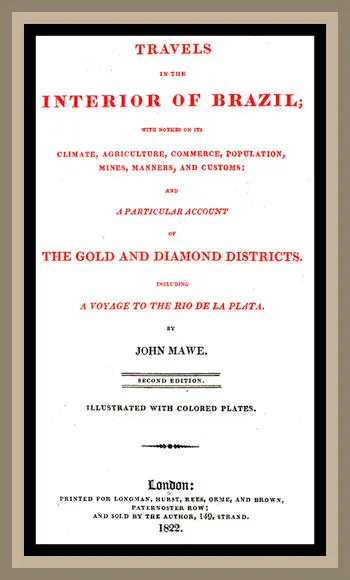
THE CLASSIC COLLECTION · 1822
"Travels in the Interior of Brazil" by John Mawe is a detailed travelogue written in the early 19th century. This work chronicles the author's various journeys through Brazil, providing insights into its climate, agriculture, commerce, population, and rich mineral resources, particularly focusing on the gold and diamond districts. As Mawe documents his exploration, he also shares personal adventures and observations that reveal the nuances of Brazilian society and its landscape. At the start of the narrative, Mawe recounts his ill-fated voyage to the Rio de la Plata, where he experiences imprisonment and political turmoil. Upon arrival in Monte Video, he suffers the loss of his cargo, faces hostility from local authorities, and recounts incidents that illustrate the precariousness of foreign travelers in a politically charged environment. The opening sets the stage for Mawe’s broader explorations into Brazil, detailing both the challenges he faces and the fascinating aspects of the regions he explores, laying the groundwork for a compelling exploration of Brazil's interior.
Introduction adapted from the source catalogue; source summaries may be automatically generated.
Free to read · English · 123,410 words · No account needed
MAKE TIME FOR A GOOD BOOK
On by default. Untick to stop anonymous reading totals. Each page counts after 10 seconds in view. How this works.
Anonymous counting is on unless you have switched it off.
[65] Bucking-irons, are pieces of cast-iron with wood handles, used at the lead mines, to break the ore from what it adheres to.
[66] A lixivium of strong ashes is made, and a quantity of lime is put into it: or sometimes the ashes are mixed with a larger proportion of lime, and the clear fluid running from the mixture is added to the juice in various quantities, at the discretion of the negro who manages the process: respecting this temper various opinions prevail. Every negro has his peculiar mode of making, mixing, and applying it.
[67] In skimming, lading, and managing the syrup during the operation, the negroes display great dexterity.
[68] Large trees are cut into planks of these dimensions for making the cases, which are preferred to hogsheads.
[69] The West India sugars are not clayed, consequently much stronger and fit for refining and making loaves.
It is much to be desired that the very excellent work, written by Bryan Edwards, upon sugar making, and distilling rum, was introduced in Brazil.
[70] It is considered bad policy to subject the raw material, as cotton, to a heavy duty, and very discouraging to planters, who must have large capitals employed, and who are greatly exposed to loss if the crops fail. Too much stimulus cannot be given to the growers; and they ought to be encouraged by a premium, rather than to pay a tax on the unmanufactured article.
[71] During the past few years, the Governors of Matto Grosso have used every effort to shorten the distance from these remote provinces to the sea ports, by making roads, cutting down woods, and forming establishments to accommodate passengers, so that canoes, &c. may be transported over land, and make straight-forward communications from one river to another, which has shortened this journey at least two months.
[72] Sutaò. This is a place understood to be uninhabitable for Europeans, being the residence of uncivilized Indians, and covered with almost impenetrable woods.
[73] So called, because they abound with these animals.
[74] This river being the grand channel of communication from Rio de Janeiro, Santos, S. Paulo, and other places, to the interesting districts of Cuiaba, Matto Grosso, the whole of Paraguay, the river Plata, Potosi, Chiquisaca, and a great part of Peru, I have preserved the particular detail given in this paper, of its numerous falls, and the difficulties of its navigation, as it is now well known, and there is great reason to suppose, that it will soon be much more frequented.
Your reading position is saved on this browser. Take it to another device with a library code. Reading pages adapt to text, rather than matching a printed edition.
BEHIND THE BOOK
This eBook is for the use of anyone anywhere in the United States and most other parts of the world at no cost and with almost no restrictions whatsoever. You may copy it, give it away or re-use it under the terms of the Project Gutenberg License included with this eBook or online at www.gutenberg.org. If you are not located in the United States, you will have to check the laws of the country where you are located before using this eBook. Read the source licence.
The original source file, including credits and licence, is retained by this library. Request an original-format copy at no charge. Please include the book title and Project Gutenberg identifier #50653.
KEEP YOUR CURIOSITY GOING
Wilfrid Scawen Blunt
Wilfrid Scawen Blunt

E. W. (Edgar Watson) Howe
Cécile Tormay

Moritz Busch
John L. Ransom