THE CLASSIC COLLECTION✦My diaries, being a personal narrative of events 1888-1914, Part 2 (1900-1914)CLASSIC FREE BOOKS
My diaries, being a personal narrative of events 1888-1914, Part 2 (1900-1914)
Wilfrid Scawen Blunt
THE CLASSIC COLLECTION · 1822
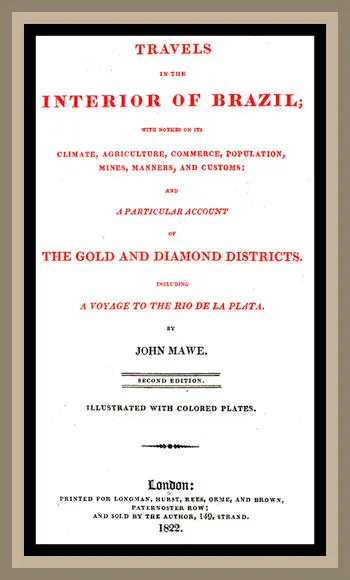
"Travels in the Interior of Brazil" by John Mawe is a detailed travelogue written in the early 19th century. This work chronicles the author's various journeys through Brazil, providing insights into its climate, agriculture, commerce, population, and rich mineral resources, particularly focusing on the gold and diamond districts. As Mawe documents his exploration, he also shares personal adventures and observations that reveal the nuances of Brazilian society and its landscape. At the start of the narrative, Mawe recounts his ill-fated voyage to the Rio de la Plata, where he experiences imprisonment and political turmoil. Upon arrival in Monte Video, he suffers the loss of his cargo, faces hostility from local authorities, and recounts incidents that illustrate the precariousness of foreign travelers in a politically charged environment. The opening sets the stage for Mawe’s broader explorations into Brazil, detailing both the challenges he faces and the fascinating aspects of the regions he explores, laying the groundwork for a compelling exploration of Brazil's interior.
Introduction adapted from the source catalogue; source summaries may be automatically generated.
Free to read · English · 123,410 words · No account needed
MAKE TIME FOR A GOOD BOOK
On by default. Untick to stop anonymous reading totals. Each page counts after 10 seconds in view. How this works.
Anonymous counting is on unless you have switched it off.
The principal exports from Maranham are cotton, rice, hides, and Indian corn. Its cotton ranks next in quality to that of Pernambuco, and obtains a price very little inferior. The quantity annually exported has been estimated at sixty thousand bags, of which more than three fourths may be considered as destined for the English market. The annual export of rice exceeds three hundred thousand arrobas. It is calculated that the trade of this port employs yearly upwards of one hundred sail, of which one half are destined for England. Sugar is beginning to form a considerable article of commerce at this port, many extensive plantations having been made. Sweetmeats and confectionery are cured here, and at the above mentioned places in great perfection, and are exported in quantities almost beyond credibility.
The foreign commerce of Para may be considered still in its infancy, as its principal city, Belem, is accessible only to vessels of small burthen. Its cottons are considered little inferior to those of Bahia. Its other exports consist of excellent cocoa, coffee, rice, in great quantities, sarsaparilla, raw and tanned hides, gums, various drugs, some sugar, molasses, timber, and curious woods. The vast territories of this capitania are but little known, and very thinly peopled.
In terminating the present work, the author cannot but express his earnest hope, that the new order of things now instituted in the mother country may tend to the permanent welfare of Brazil, to the developement of its rich and various resources, to the intellectual, moral, and social improvement of its people, to the extension of their commerce, and to the continuance of that connection with Great Britain, which has hitherto contributed, and may henceforth more largely contribute, to the prosperity of both nations.
IN page 368 of this work, I have stated, that it was my intention to enquire into, and to make some observations on the present regulations relative to diamonds. These beautiful gems have been found in such abundance in Brazil, as to supply not only Europe, but Asia; as those of India are become extremely scarce, diamonds from Brazil have been often sent thither, and have usurped their name. The question we are at present about to examine is, how far it would be consistent with the interest of the Portuguese Government to permit the searching for diamonds, in the same way as for gold, under peculiar laws. The monopoly is ineffectual, because the diamonds are found in so many parts widely distant from each other, that it is impossible to prevent the searching for them. The attempt to preserve grounds known to contain these riches, by forming a distacamento, has not produced any good effect; and it is by no means improbable, that the best of these (supposed) preserved lands are already worked, therefore the soldiers are guarding the casket after the jewels have been taken away. How many places might be mentioned (out of the district of Cerro do Frio), where troops of negroes daily work! It has been stated, that government probably receive little more than a moiety of the gems found at their own expense; if so, it is certainly time to abandon a trade so exposed, or to change the system altogether. Is it the interest of Brazil to keep her enterprizing subjects in continual torture and fear respecting these precious gifts, which the bounteous hand of Providence has placed there? But indeed as his majesty’s subjects increase and become more enlightened, this severe monopoly will destroy itself and soon begin to give way to a wise and political government, which will prefer a rich and powerful population in the very heart of the colony to a few individuals. How happens it, that diamonds, in the hands of private persons, meet a more ready sale than those of government? Because they are better stones, and are offered in quantities more convenient for the purchasers: next, because they can be sold cheaper since they cost less. If diamonds were subject to pay a fifth, government would have such power as to enable them to command the market; and if they should become cheaper in Europe, the demand for them would become more general, therefore their price would not be likely to fall in Brazil; and, even if it did, is it not the blindest policy for the court to put such a yoke round the neck of her valuable subjects, who venture their lives in trackless deserts searching for mines, and exposing themselves to every danger? Would it have been possible for Portugal to colonize Brazil if there had been no gold mines to attract adventurers? To deny men the treasures with which nature has enriched the country, is to oppose one great check to its population; for the example of one adventurer becoming rich, is the means of inducing hundreds to follow him. Under the present system, there is so great a struggle between the temptation of becoming suddenly rich, and the fear of being ruined by detection, that when a man finds a diamond by accident, he knows not whether to appropriate it, or to surrender it to the government; even in the latter case, he has little prospect of reward, and runs the risk of being accused as a smuggler. Instances have not been uncommon of men having found diamonds, who have thrown them away[84] rather than involve themselves and their families in ruin, either by keeping them, or delivering them to government.
Your reading position is saved on this browser. Take it to another device with a library code. Reading pages adapt to text, rather than matching a printed edition.
BEHIND THE BOOK
This eBook is for the use of anyone anywhere in the United States and most other parts of the world at no cost and with almost no restrictions whatsoever. You may copy it, give it away or re-use it under the terms of the Project Gutenberg License included with this eBook or online at www.gutenberg.org. If you are not located in the United States, you will have to check the laws of the country where you are located before using this eBook. Read the source licence.
The original source file, including credits and licence, is retained by this library. Request an original-format copy at no charge. Please include the book title and Project Gutenberg identifier #50653.
KEEP YOUR CURIOSITY GOING
Wilfrid Scawen Blunt
Wilfrid Scawen Blunt

E. W. (Edgar Watson) Howe
Cécile Tormay

Moritz Busch
John L. Ransom