THE CLASSIC COLLECTION✦My diaries, being a personal narrative of events 1888-1914, Part 2 (1900-1914)CLASSIC FREE BOOKS
My diaries, being a personal narrative of events 1888-1914, Part 2 (1900-1914)
Wilfrid Scawen Blunt
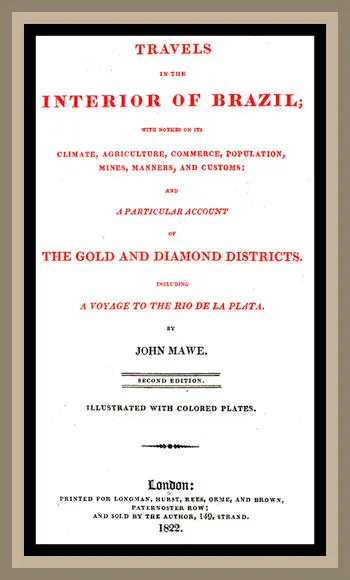
THE CLASSIC COLLECTION · 1822
"Travels in the Interior of Brazil" by John Mawe is a detailed travelogue written in the early 19th century. This work chronicles the author's various journeys through Brazil, providing insights into its climate, agriculture, commerce, population, and rich mineral resources, particularly focusing on the gold and diamond districts. As Mawe documents his exploration, he also shares personal adventures and observations that reveal the nuances of Brazilian society and its landscape. At the start of the narrative, Mawe recounts his ill-fated voyage to the Rio de la Plata, where he experiences imprisonment and political turmoil. Upon arrival in Monte Video, he suffers the loss of his cargo, faces hostility from local authorities, and recounts incidents that illustrate the precariousness of foreign travelers in a politically charged environment. The opening sets the stage for Mawe’s broader explorations into Brazil, detailing both the challenges he faces and the fascinating aspects of the regions he explores, laying the groundwork for a compelling exploration of Brazil's interior.
Introduction adapted from the source catalogue; source summaries may be automatically generated.
Free to read · English · 123,410 words · No account needed
MAKE TIME FOR A GOOD BOOK
On by default. Untick to stop anonymous reading totals. Each page counts after 10 seconds in view. How this works.
Anonymous counting is on unless you have switched it off.
The quantity of hides exported from hence is almost incredible; they furnish many vessels with entire cargoes, which are carried to the northern ports, and from thence embarked for Europe. The annual average may be estimated at not less than three hundred thousand.
Tallow forms another considerable article of commerce, which in general is shipped in the crude state, and not refined, as in the river Plata. The greater part is consumed in Brazil, and the dealers find it preferable to refine the article on the spot, where they manufacture it into candles. It is packed in waste raw-hide packages.[77]
Horns and horse-hair form an inferior branch of the commerce, and are shipped from this port in great quantities.
The above are the staple productions of Rio Grande, which give employment perhaps to a hundred sail of coasters, some of which make two or three voyages in a year, carrying thither rum, sugar, tobacco, cotton, rice, coarse manufactured cotton, sweet meats, &c.[78]
Of European merchandise, they bring wine, olive-oil, glass, and a great variety of English commodities, particularly iron, (though they much prefer the Swedish), baizes, coatings, stout woollen cloths, Manchester velverets of various qualities and colors, printed cottons, calicoes, muslins, handkerchiefs, silk, cotton, and worsted hosiery, hats, flannels, &c.
Sail-cloth, cordage, anchors, tar, paints, fowling pieces, ammunition of all sorts, hardware of every description, particularly slaughter-knives, some plated ware, and fancy articles. A great part of the goods are conveyed upon horses into the interior, where they are carried from house to house for sale or exchange.
During the old system, so lately as within these four years, a most lucrative trade was here carried on with the Spaniards, who came in numbers, and most eagerly bought up the tobacco, and such of the English manufactures as could be transported on horseback, at great prices. Thus Rio Grande and its vicinity became very enviable situations, where considerable fortunes were made in a little time, as the goods bought were much in request, though contraband, and were paid for in specie. This trade, so advantageous to each party, is now entirely ruined through the eagerness of our speculators in over-stocking the markets, and selling for two what would have been eagerly bought for six.
The neighbourhood of the capital is an unpleasant place, being surrounded with sand and sandhills of no inconsiderable size, formed by the wind blowing the sand in heaps in various directions, which become half indurated, and appear stratified. The excessively high winds, which frequently prevail, blow the sand so as to be very disagreeable, as it enters every part of the house.
Your reading position is saved on this browser. Take it to another device with a library code. Reading pages adapt to text, rather than matching a printed edition.
BEHIND THE BOOK
This eBook is for the use of anyone anywhere in the United States and most other parts of the world at no cost and with almost no restrictions whatsoever. You may copy it, give it away or re-use it under the terms of the Project Gutenberg License included with this eBook or online at www.gutenberg.org. If you are not located in the United States, you will have to check the laws of the country where you are located before using this eBook. Read the source licence.
The original source file, including credits and licence, is retained by this library. Request an original-format copy at no charge. Please include the book title and Project Gutenberg identifier #50653.
KEEP YOUR CURIOSITY GOING
Wilfrid Scawen Blunt
Wilfrid Scawen Blunt

E. W. (Edgar Watson) Howe
Cécile Tormay

Moritz Busch
John L. Ransom