THE CLASSIC COLLECTION✦My diaries, being a personal narrative of events 1888-1914, Part 2 (1900-1914)CLASSIC FREE BOOKS
My diaries, being a personal narrative of events 1888-1914, Part 2 (1900-1914)
Wilfrid Scawen Blunt
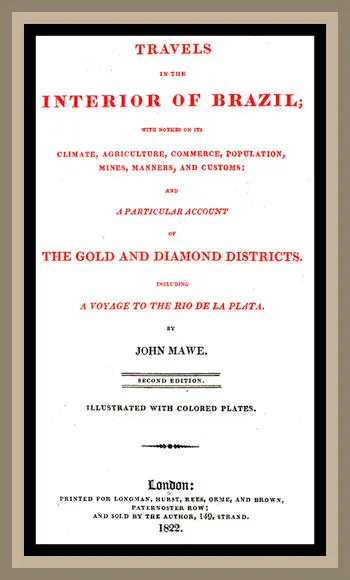
THE CLASSIC COLLECTION · 1822
"Travels in the Interior of Brazil" by John Mawe is a detailed travelogue written in the early 19th century. This work chronicles the author's various journeys through Brazil, providing insights into its climate, agriculture, commerce, population, and rich mineral resources, particularly focusing on the gold and diamond districts. As Mawe documents his exploration, he also shares personal adventures and observations that reveal the nuances of Brazilian society and its landscape. At the start of the narrative, Mawe recounts his ill-fated voyage to the Rio de la Plata, where he experiences imprisonment and political turmoil. Upon arrival in Monte Video, he suffers the loss of his cargo, faces hostility from local authorities, and recounts incidents that illustrate the precariousness of foreign travelers in a politically charged environment. The opening sets the stage for Mawe’s broader explorations into Brazil, detailing both the challenges he faces and the fascinating aspects of the regions he explores, laying the groundwork for a compelling exploration of Brazil's interior.
Introduction adapted from the source catalogue; source summaries may be automatically generated.
Free to read · English · 123,410 words · No account needed
MAKE TIME FOR A GOOD BOOK
On by default. Untick to stop anonymous reading totals. Each page counts after 10 seconds in view. How this works.
Anonymous counting is on unless you have switched it off.
The river Parana is of great breadth and weight of water, and is navigated against its current up to the mouth of the fine river Tieté. In the first three leagues occurs the island of Manoel Homem. Five leagues above this island the Rio Verde falls into the Parana, by a mouth of forty-two fathoms, on its western bank, and at an equal distance above, on the opposite eastern side, the river Aguapehy enters, by a mouth apparently above twenty yards wide. Eight leagues above this river, and on the west side of the Parana, the large river Sucuriu has its mouth, at least fifty fathoms wide, and, after four leagues of navigation further, on the same side of the Parana, is found the mouth of the large and interesting river, the Tieté[74]. The distance between the rivers Tieté and Pardo, according to the windings of the Parana, may be estimated at thirty-five leagues; the direction north, inclining to the east. Passing up the Tieté, in the first three leagues is found the great Salto de Itapura (a great cascade) to avoid which, the canoes are dragged sixty fathoms over-land. A league above is the difficult fall of Itapura-mirim; another league upwards are the three falls, called Tres Irmaos, and little more than that distance onward, that of Itupiru, half a league long; two leagues further is the fall of Uaicurituba-mirim, and in the upper part of it the small river Sucury enters the Tieté upon its north bank. One league above it is the fall of Utupiba, a quarter of a league in length. The same distance above is the fall of Araracangua-uassu, which is passed with unloaded canoes. Five leagues above this is found the Araracangua-mirim; one league further, the Arassatuba, and at the same distance, Uaicurituba, from which, in the space of nine leagues, occur seven falls. Three and a half leagues above the last of them is that of the Escaramunca, so called from the abrupt windings of the river among a thousand rocks and stoppages. Two leagues above this is the large fall of Avanhandava, where the canoes are unloaded, and their cargoes carried half a mile over-land[75], and the canoes hauled the greatest part of the way, to avoid a cataract sixteen yards perpendicular. A league and a half above this is the fall of Avanhandava-mirim, and very near it, that of the Campo, from which there are fourteen leagues of clear navigation to those of the Camboyu-voca, and next to the Tambau-mirim and Uassu, both within the compass of two leagues. One league further is the fall of Tambitiririca; three leagues from thence, the Uamicanga, and a little more than two leagues upwards, the Jacuripipira enters the Tieté on the north side, and has a mouth fifteen fathoms broad. A league and a half above this is the Jacuripipira-mirim, six leagues from whence is the fall of Congouha, a league in length. For the space of eight leagues from this there are six falls, of which the last is Banharem. From this it is three leagues and a half to the mouth of the Paraniaba, thirty-eight fathoms broad: it enters the Tieté on the north; and the latter river from this point immediately narrows itself to forty fathoms wide. From the mouth of the Paraniaba there is a navigation of four leagues to the small fall of Ilha, and fourteen leagues more, with frequent windings to that of Itahy, near a populous village, called Jundahy. Six leagues from this is the fall of Pedrenegoa, which is a quarter of a league long; and half a league above it, the river Sorecaba, which comes from the town of the same name, in lat. 23° 31′, empties itself on the south into the Tieté. Near this town are several mountains, called Guaraceaba, some of which abound with rich oxide of iron, which on smelting, has proved very good. Upon them grows fine timber for machinery, and wood of every size, fit for reducing into charcoal. Numerous streams flow from them, which may be employed to great advantage, and their base is washed by the river Campanhes, near the Capivara, both of which empty themselves into the Tieté at a short distance. From the river Sorecaba it is only six leagues to Porto Felix, where all the embarkation is now made to Matto Grosso from S. Paulo, the distance being about twenty-three leagues from that city. Through this conveyance, salt, iron, ammunition, clothing for the troops, &c. are sent annually by Government.—Trading parties frequently arrive at S. Paulo from Cuiaba in the month of February, and return in April or May.
Your reading position is saved on this browser. Take it to another device with a library code. Reading pages adapt to text, rather than matching a printed edition.
BEHIND THE BOOK
This eBook is for the use of anyone anywhere in the United States and most other parts of the world at no cost and with almost no restrictions whatsoever. You may copy it, give it away or re-use it under the terms of the Project Gutenberg License included with this eBook or online at www.gutenberg.org. If you are not located in the United States, you will have to check the laws of the country where you are located before using this eBook. Read the source licence.
The original source file, including credits and licence, is retained by this library. Request an original-format copy at no charge. Please include the book title and Project Gutenberg identifier #50653.
KEEP YOUR CURIOSITY GOING
Wilfrid Scawen Blunt
Wilfrid Scawen Blunt

E. W. (Edgar Watson) Howe
Cécile Tormay

Moritz Busch
John L. Ransom