THE CLASSIC COLLECTION✦My diaries, being a personal narrative of events 1888-1914, Part 2 (1900-1914)CLASSIC FREE BOOKS
My diaries, being a personal narrative of events 1888-1914, Part 2 (1900-1914)
Wilfrid Scawen Blunt
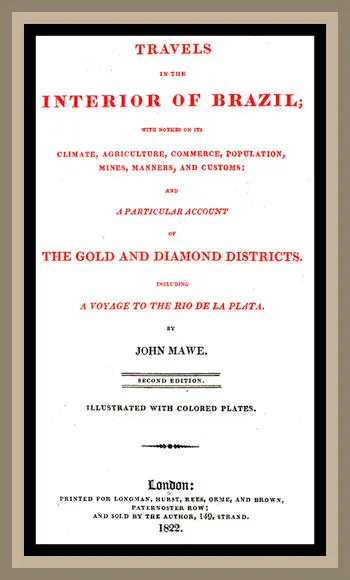
THE CLASSIC COLLECTION · 1822
"Travels in the Interior of Brazil" by John Mawe is a detailed travelogue written in the early 19th century. This work chronicles the author's various journeys through Brazil, providing insights into its climate, agriculture, commerce, population, and rich mineral resources, particularly focusing on the gold and diamond districts. As Mawe documents his exploration, he also shares personal adventures and observations that reveal the nuances of Brazilian society and its landscape. At the start of the narrative, Mawe recounts his ill-fated voyage to the Rio de la Plata, where he experiences imprisonment and political turmoil. Upon arrival in Monte Video, he suffers the loss of his cargo, faces hostility from local authorities, and recounts incidents that illustrate the precariousness of foreign travelers in a politically charged environment. The opening sets the stage for Mawe’s broader explorations into Brazil, detailing both the challenges he faces and the fascinating aspects of the regions he explores, laying the groundwork for a compelling exploration of Brazil's interior.
Introduction adapted from the source catalogue; source summaries may be automatically generated.
Free to read · English · 123,410 words · No account needed
MAKE TIME FOR A GOOD BOOK
On by default. Untick to stop anonymous reading totals. Each page counts after 10 seconds in view. How this works.
Anonymous counting is on unless you have switched it off.
During my stay at Monte Video another adventure befel me, which had well nigh cost me my life; I am induced to relate it, by reason of the insight it gives into the character of a certain class of the people. I had gone on a shooting excursion to the promontory opposite Monte Video, with my much-valued friend Captain Collet, owner of two or three large American ships, and M. Godefroy, a merchant, resident in the town. After some hours’ sport we met a party of four Spaniards, among whom were Mr. Ortiga, the consignee of Captain Collet, and a person called Manuel d’Iago. Our friend M. Godefroy had some conversation with them at a short distance from us, and on his return gave us to understand, that d’Iago had said it would not cost him above five hundred dollars to send a pair of bullets through me, and that had I been alone he would not have scrupled to do it. For this blood-thirsty insinuation I was at a loss to conjecture any motive, nor knew I the man, except by report, which designated him as a captain of militia, extremely rigorous in his treatment of the unfortunate English, whenever his turn to mount guard at the prison subjected them to his authority.
We pursued our diversion; he and his party meanwhile arrived at the Signal-house, about three miles above us, where they took refreshment. Some space of time afterward we observed a horse-soldier ride down towards us, who on approaching eyed us with a look of great suspicion. I had some little talk with him, having frequently seen him there before. He returned directly to the Guard-house, and an hour afterwards five blandengues, or horse-soldiers, sallied from the place at full speed, and, surrounding us, demanded our arms at the peril of our lives. Each of us obeyed, by surrendering his fowling-piece, M. Godefroy at the same time enquiring the cause of this extraordinary treatment; but they ordered him to be silent, and to march on along with us, or they would tie him on horseback. We were conducted to the Guard-house, and delivered (the officer being absent) to the corporal on guard, a fiery old Spaniard, who ordered us into an inner room, and placed two centinels at the door. The fellow was so stifled by passion, that we could not get an answer from him; at every moment he was drawing a long sabre which hung at his side, and venting his fury in the most abusive language. After a full half-hour of expostulation on our part, and menace on his, M. Godefroy obtained a hearing from him, and, declaring he was a merchant, married and actually settled in Monte Video, begged to know by what authority and under what pretext he was imprisoned. The corporal, on learning this, sent a soldier to the officer on guard, and while waiting his return, related that D’Iago had described us as Englishmen belonging to a privateer, who had landed with an intention to blow up the powder-magazines, kill bullocks, and plunder the natives. It was evident from his manner that he was very willing to believe this account, and that by treating us with severity he hoped to display his zeal for the service, and obtain promotion. M. Godefroy’s testimony being at length attended to, another soldier was dispatched to D’Iago’s party, who were not yet embarked, with notice that one of us affirmed himself to be a resident in Monte Video. This they did not contradict, but persisted in their accusations of the rest of our party; Mr. Ortiga denied any knowledge of Captain Collet, probably imagining that, in case of our conviction, he should benefit by the cargoes which the latter had consigned to him; and for me, whom they denounced as a spy, no punishment in their opinion could be too ignominious. On the return of the soldier, the corporal thought proper to release M. Godefroy, who took our boat to cross the port to Monte Video, with the intention of procuring an order for our liberation; but they had scarcely sailed, when a gust of wind arose, and as he and two boys he had with him could not manage the sails, they were nearly overset, and after considerable danger were picked up by a ship in the road. Meanwhile Captain Collet and I remained in strict custody, and at every syllable of complaint we uttered, the corporal brandished his sabre over our heads, roared out for the guard, and vociferated the most opprobrious language against the English. Thus threatened at every moment with assassination, we withdrew into a corner of the room, and quietly waited until the officer on guard arrived, when we were conducted in great form, between two men with drawn swords, into the room where he sat to receive us. Nothing could exceed my joyful surprise at recognizing in the officer an excellent and worthy friend, whom I had often visited at his farm, and who had given me repeated proofs of his liberal disposition and intelligent mind. His surprise exceeded mine; for instead of plunderers or spies, such as report had described us, he found an American merchant and a prisoner at large under bail. He was deeply grieved and ashamed at the treatment we had met with, liberated us immediately, mounted us on his own horses, and appointed a trusty person to attend us to Monte Video, where we arrived at eight in the evening. The disappointment of the corporal appeared as deep as his rage had been violent; and the recollection of his conduct operated on us as a warning against persons of his class, who rarely see an opportunity of doing mischief to a stranger, without a strong inclination to avail themselves of it.
Your reading position is saved on this browser. Take it to another device with a library code. Reading pages adapt to text, rather than matching a printed edition.
BEHIND THE BOOK
This eBook is for the use of anyone anywhere in the United States and most other parts of the world at no cost and with almost no restrictions whatsoever. You may copy it, give it away or re-use it under the terms of the Project Gutenberg License included with this eBook or online at www.gutenberg.org. If you are not located in the United States, you will have to check the laws of the country where you are located before using this eBook. Read the source licence.
The original source file, including credits and licence, is retained by this library. Request an original-format copy at no charge. Please include the book title and Project Gutenberg identifier #50653.
KEEP YOUR CURIOSITY GOING
Wilfrid Scawen Blunt
Wilfrid Scawen Blunt

E. W. (Edgar Watson) Howe
Cécile Tormay

Moritz Busch
John L. Ransom