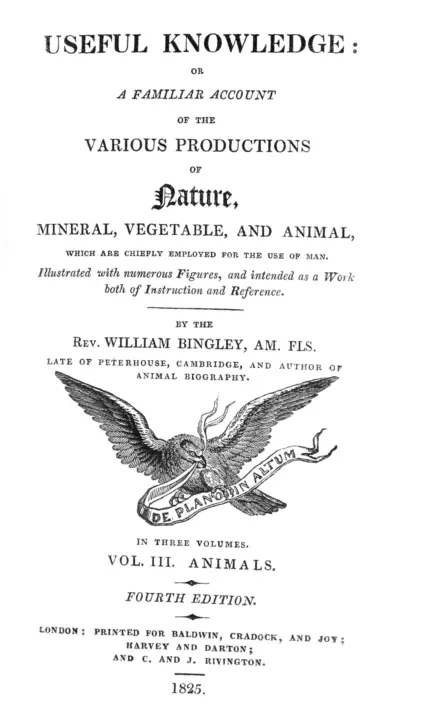
Useful Knowledge: Volume 3. Animals Or, a familiar account of the various productions of nature
William Bingley
THE CLASSIC COLLECTION · 1821
"Travels in North America, From Modern Writers" by William Bingley is a collection of travel narratives written in the early 19th century. The text compiles observations and accounts from various modern writers about their experiences and insights while traveling through North America, aiming to provide a comprehensive view of the geography, culture, and state of the continent during this period. This work is particularly designed for the education of young readers, enriching their understanding of the world. The opening of the book sets the stage for a detailed exploration of North America, describing its vast dimensions, varied geography, and natural resources while reflecting on the historical context of European colonization. It begins with a broad overview, noting the continent's size, the waterways that facilitate commerce, and the rich natural environment, including flora and fauna specific to the region. Specifically, it highlights the state of the United States and the experiences of various travelers, hinting at the diversity of life and culture that the readers can expect to encounter as they delve deeper into the narratives that follow. The introduction effectively combines factual information with anecdotal experiences to pique the interest of its audience, inviting them to learn more about the dynamics and intricacies of early 19th-century America.
Introduction adapted from the source catalogue; source summaries may be automatically generated.
Free to read · English · 116,508 words · No account needed
MAKE TIME FOR A GOOD BOOK
On by default. Untick to stop anonymous reading totals. Each page counts after 10 seconds in view. How this works.
Anonymous counting is on unless you have switched it off.
Seventeen miles of the ride from Pittsburgh on to Cannonsburg, was chiefly over clayey hills, well adapted for grass; but, in the present circumstances of the country, too stiff for profitable cultivation under the plough. From Cannonsburg to Washington, in Pennsylvania, eight miles, is a very desirable tract, containing much excellent land, with fine meadows.
Washington is a pretty, thriving town, which contains about two thousand five hundred inhabitants. It has a college, with about a hundred students; but, from the dirty condition of the schools, and the loitering habits of the young men, Mr. Birkbeck suspected it to be an ill-regulated institution.
From Washington, Mr. Birkbeck and his family proceeded still westward, and, on entering the State of Ohio, they found themselves in a country beautiful and fertile, and affording, to a plain, industrious, and thriving population, all that nature has decreed for the comfort of man. It contains rich land, good water, wholesome air; limestone, coal, mills, and navigation. It is also fully appropriated, and thickly settled; and land is worth from twenty to thirty dollars per acre: an advance of a thousand per cent. in about ten years!
A heavy fall of wet had rendered the roads muddy and unpleasant. On the 10th of June, the party arrived at Wheeling, a considerable but mean-looking town, of inns and stores, on the banks of the Ohio. Here they baited their horses, and took a repast of bread and milk. At this place the Ohio is divided into two channels, of five hundred yards each, by an island of three hundred acres.
Between Wheeling and St. Clairsville, they had sundry foaming creeks to ford; and sundry log-bridges to pass, which are a sort of commutation of danger. They had also a very muddy road, over hills of clay; and thunder and rain during nearly the whole of this their first stage: such thunder, and such rain, as they had heard of, but had seldom witnessed in England.
They were detained some days at St. Clairsville. This place consists of about one hundred and fifty houses; stores, taverns, doctors'-shops, and lawyers' offices, with the dwellings of sundry artisans; such as tailors, shoemakers, hatters, and smiths. Its chief street runs over one of the beautiful, round, and fertile hills which form this country. The court-house, a handsome brick edifice, on the summit, has a cheerful and a rather striking appearance. If the streets were paved, St. Clairsville would be a pleasant town, but, from the continued rains, they were, at this time, deep in mud.
Your reading position is saved on this browser. Take it to another device with a library code. Reading pages adapt to text, rather than matching a printed edition.
William Bingley
William Bingley
William Bingley
BEHIND THE BOOK
This eBook is for the use of anyone anywhere in the United States and most other parts of the world at no cost and with almost no restrictions whatsoever. You may copy it, give it away or re-use it under the terms of the Project Gutenberg License included with this eBook or online at www.gutenberg.org. If you are not located in the United States, you will have to check the laws of the country where you are located before using this eBook. Read the source licence.
The original source file, including credits and licence, is retained by this library. Request an original-format copy at no charge. Please include the book title and Project Gutenberg identifier #28323.
KEEP YOUR CURIOSITY GOING
Wilfrid Scawen Blunt
Wilfrid Scawen Blunt

E. W. (Edgar Watson) Howe
Cécile Tormay

Moritz Busch
John L. Ransom