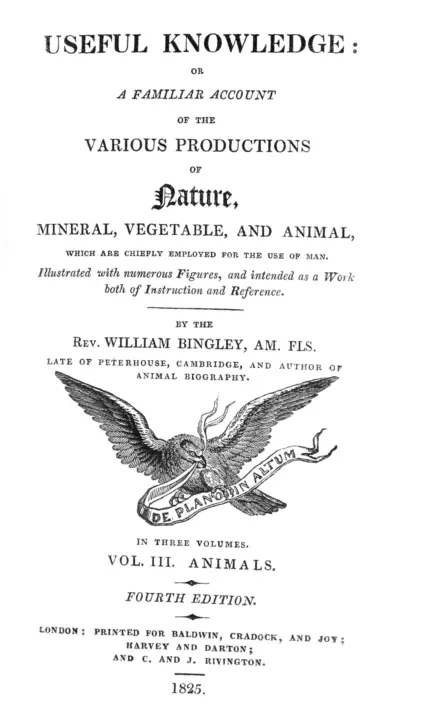
Useful Knowledge: Volume 3. Animals Or, a familiar account of the various productions of nature
William Bingley
THE CLASSIC COLLECTION · 1821
"Travels in North America, From Modern Writers" by William Bingley is a collection of travel narratives written in the early 19th century. The text compiles observations and accounts from various modern writers about their experiences and insights while traveling through North America, aiming to provide a comprehensive view of the geography, culture, and state of the continent during this period. This work is particularly designed for the education of young readers, enriching their understanding of the world. The opening of the book sets the stage for a detailed exploration of North America, describing its vast dimensions, varied geography, and natural resources while reflecting on the historical context of European colonization. It begins with a broad overview, noting the continent's size, the waterways that facilitate commerce, and the rich natural environment, including flora and fauna specific to the region. Specifically, it highlights the state of the United States and the experiences of various travelers, hinting at the diversity of life and culture that the readers can expect to encounter as they delve deeper into the narratives that follow. The introduction effectively combines factual information with anecdotal experiences to pique the interest of its audience, inviting them to learn more about the dynamics and intricacies of early 19th-century America.
Introduction adapted from the source catalogue; source summaries may be automatically generated.
Free to read · English · 116,508 words · No account needed
MAKE TIME FOR A GOOD BOOK
On by default. Untick to stop anonymous reading totals. Each page counts after 10 seconds in view. How this works.
Anonymous counting is on unless you have switched it off.
At the back of the town, and behind the court-house, is a parade, where the troops are exercised. The ground, along this part, is considerably elevated, and forms a steep bank, several hundred yards in length. Here the inhabitants walk in an evening, and enjoy a beautiful view of the suburbs of St. Lawrence and St. Antoine; and of numerous gardens, orchards, and plantations, adorned with neat, and, in many instances, even handsome villas. Green fields are interspersed amidst this rich variety of objects, which are concentrated in an extensive valley, that gradually rises towards a lofty mountain, about two miles and a half distant; and covered, towards its upper part, with trees and shrubs. It is from this mountain that the town obtained its name of Montreal, or "Royal Mount."
All the principal north-west merchants reside in this town; which is the emporium of their trade, and the grand mart of the commerce carried on between Canada and the United States: they live in a splendid style, and keep expensive tables.
The markets of Montreal are plentifully supplied with provisions, which are much cheaper here than in Quebec. Large supplies are brought in, every winter, from the United States; particularly cod-fish, which is packed in ice, and conveyed in sledges from Boston. Two weekly newspapers, called the Gazette and the Canadian Courant, are published here.
At Montreal, the winter is considered to be two months shorter than it is at Quebec; and the heat of summer is more oppressive.
Twenty-third Day's Instruction.
The Route, from Montreal to Fort Chepewyan, pursued by a company of traders, called the North-west Company.
The requisite number of canoes being purchased, the goods being formed into packages, and the lakes and rivers being free from ice, which they usually are in the beginning of May, the persons employed by the North-west Company set out from La Chine, eight miles above Montreal.
Each canoe carries eight or ten men, and a luggage consisting of sixty-five packages of goods, about six hundred weight of biscuit, two hundred weight of pork, and three bushels of peas, for the men's provisions: two oil-cloths to cover the goods, a sail, and an axe, a towing-line, a kettle, and a sponge to bail out the water; together with a quantity of gum, bark, and watape, to repair the canoe. An European, on seeing these slender vessels, thus laden, heaped up, and their sides not more than six inches out of the water, would imagine it impossible that they should perform a long and perilous voyage; but the Canadians are so expert in the management of them, that few accidents happen.
Your reading position is saved on this browser. Take it to another device with a library code. Reading pages adapt to text, rather than matching a printed edition.
William Bingley
William Bingley
William Bingley
BEHIND THE BOOK
This eBook is for the use of anyone anywhere in the United States and most other parts of the world at no cost and with almost no restrictions whatsoever. You may copy it, give it away or re-use it under the terms of the Project Gutenberg License included with this eBook or online at www.gutenberg.org. If you are not located in the United States, you will have to check the laws of the country where you are located before using this eBook. Read the source licence.
The original source file, including credits and licence, is retained by this library. Request an original-format copy at no charge. Please include the book title and Project Gutenberg identifier #28323.
KEEP YOUR CURIOSITY GOING
Wilfrid Scawen Blunt
Wilfrid Scawen Blunt

E. W. (Edgar Watson) Howe
Cécile Tormay

Moritz Busch
John L. Ransom