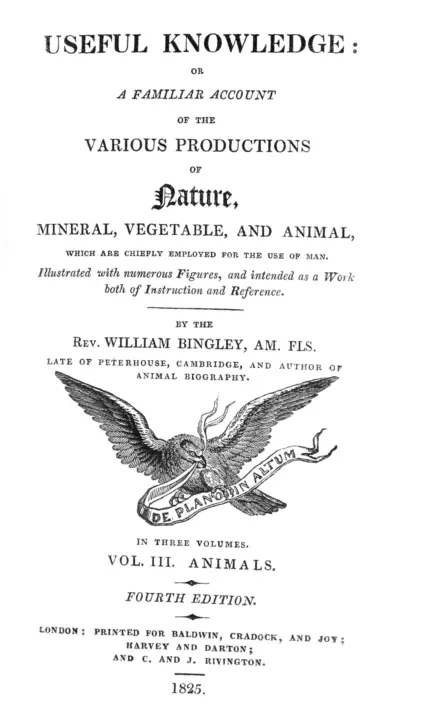
Useful Knowledge: Volume 3. Animals Or, a familiar account of the various productions of nature
William Bingley
THE CLASSIC COLLECTION · 1821
"Travels in North America, From Modern Writers" by William Bingley is a collection of travel narratives written in the early 19th century. The text compiles observations and accounts from various modern writers about their experiences and insights while traveling through North America, aiming to provide a comprehensive view of the geography, culture, and state of the continent during this period. This work is particularly designed for the education of young readers, enriching their understanding of the world. The opening of the book sets the stage for a detailed exploration of North America, describing its vast dimensions, varied geography, and natural resources while reflecting on the historical context of European colonization. It begins with a broad overview, noting the continent's size, the waterways that facilitate commerce, and the rich natural environment, including flora and fauna specific to the region. Specifically, it highlights the state of the United States and the experiences of various travelers, hinting at the diversity of life and culture that the readers can expect to encounter as they delve deeper into the narratives that follow. The introduction effectively combines factual information with anecdotal experiences to pique the interest of its audience, inviting them to learn more about the dynamics and intricacies of early 19th-century America.
Introduction adapted from the source catalogue; source summaries may be automatically generated.
Free to read · English · 116,508 words · No account needed
MAKE TIME FOR A GOOD BOOK
On by default. Untick to stop anonymous reading totals. Each page counts after 10 seconds in view. How this works.
Anonymous counting is on unless you have switched it off.
On landing at La Charrette, the first village on this side of the United States, they were joyfully received by the inhabitants, who had long abandoned all hopes of their return. On the 23d of September they descended the Mississippi to St. Louis, which place they reached about noon; having, in two years and nine months, completed a journey of nearly nine thousand miles.
At St. Louis we shall resume the narrative of Mr. Pike, who, in the month of July, 1806, set out from that place on an expedition westward, through the immense territory of Louisiana, towards New Spain. The chief objects of this expedition were to arrange an amicable treaty between the Americans and Indians of this quarter; and to ascertain the direction, extent, and navigation, of two great rivers, known by the names of Arkansaw and Red River.
Eighteenth Day's Instruction.
Narrative of Mr. Pike's Journey from St. Louis, through Louisiana, to
Santa Fe, New Spain.
The party engaged in this expedition, were Mr. Pike and another lieutenant, a surgeon, a serjeant, two corporals, sixteen private soldiers, and one interpreter. They had, under their charge, some chiefs of the Osage and Pawnee nations, who, with several women and children, had been redeemed from captivity, and now, to the number of fifty-one, were about to be restored to their friends.
They set out from St. Louis on the 15th of July, 1806, and proceeded, in two boats, up the Missouri. About six miles from the village of St. Charles, they passed a hill of solid coal, so extensive that it would probably afford fuel sufficient for the whole population of Louisiana.
Mr. Pike says that, every morning, he was awaked by the lamentations of the savages who accompanied him. These invariably began to cry about day-light, and continued to do so for an hour. On enquiry respecting this practice, he was informed that it was customary, not only with persons who had recently lost their friends; but also with others who called to mind the loss of some friend, dead long before. They seemed to be extremely affected: tears ran down their cheeks, and they sobbed bitterly; but, when the hour was expired, they, in a moment, ceased their cries, and dried their cheeks.
In their progress up the river, the Indians walked along the banks, and, every night, encamped near the boats. On the 28th the boats reached the mouth of the Osage river. For some distance the southern shore of the Missouri had been hilly, and covered with trees; and on the north were low bottoms and heavy timber. The soil was rich, and well adapted for cultivation.
Your reading position is saved on this browser. Take it to another device with a library code. Reading pages adapt to text, rather than matching a printed edition.
William Bingley
William Bingley
William Bingley
BEHIND THE BOOK
This eBook is for the use of anyone anywhere in the United States and most other parts of the world at no cost and with almost no restrictions whatsoever. You may copy it, give it away or re-use it under the terms of the Project Gutenberg License included with this eBook or online at www.gutenberg.org. If you are not located in the United States, you will have to check the laws of the country where you are located before using this eBook. Read the source licence.
The original source file, including credits and licence, is retained by this library. Request an original-format copy at no charge. Please include the book title and Project Gutenberg identifier #28323.
KEEP YOUR CURIOSITY GOING
Wilfrid Scawen Blunt
Wilfrid Scawen Blunt

E. W. (Edgar Watson) Howe
Cécile Tormay

Moritz Busch
John L. Ransom