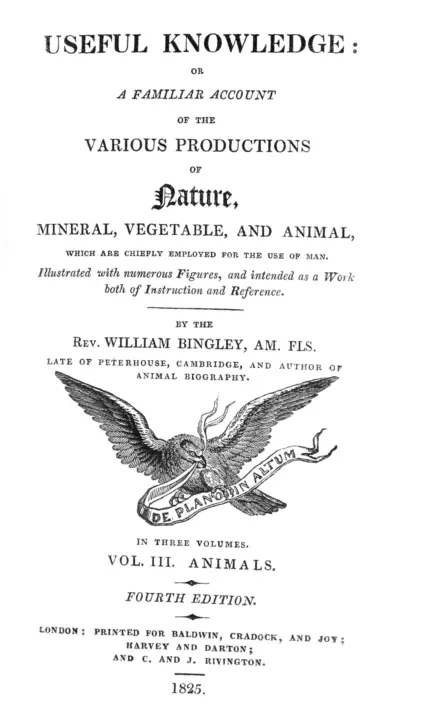
Useful Knowledge: Volume 3. Animals Or, a familiar account of the various productions of nature
William Bingley
THE CLASSIC COLLECTION · 1821
"Travels in North America, From Modern Writers" by William Bingley is a collection of travel narratives written in the early 19th century. The text compiles observations and accounts from various modern writers about their experiences and insights while traveling through North America, aiming to provide a comprehensive view of the geography, culture, and state of the continent during this period. This work is particularly designed for the education of young readers, enriching their understanding of the world. The opening of the book sets the stage for a detailed exploration of North America, describing its vast dimensions, varied geography, and natural resources while reflecting on the historical context of European colonization. It begins with a broad overview, noting the continent's size, the waterways that facilitate commerce, and the rich natural environment, including flora and fauna specific to the region. Specifically, it highlights the state of the United States and the experiences of various travelers, hinting at the diversity of life and culture that the readers can expect to encounter as they delve deeper into the narratives that follow. The introduction effectively combines factual information with anecdotal experiences to pique the interest of its audience, inviting them to learn more about the dynamics and intricacies of early 19th-century America.
Introduction adapted from the source catalogue; source summaries may be automatically generated.
Free to read · English · 116,508 words · No account needed
MAKE TIME FOR A GOOD BOOK
On by default. Untick to stop anonymous reading totals. Each page counts after 10 seconds in view. How this works.
Anonymous counting is on unless you have switched it off.
Notwithstanding their miseries they were cheerful, and, in many important points of character, were superior to any other tribes whom the travellers had seen. They never begged: they were not tempted to a single act of dishonesty by the sight of the treasures which their visitors displayed; and they were ready to share with their guests, the little which they themselves possessed. They were also a high-spirited people. The Spaniards, the only white men with whom they had hitherto had any intercourse, would not supply them with fire-arms, alleging that, if they were possessed of such weapons, they would only be the more induced to kill one another. The Shoshonees, perhaps, do not perceive that policy is the real motive of the Spaniards; but they clearly see that the plea of humanity is fallacious, and they complain that they are thus left to the mercy of their enemies the Minnetarees, who, having fire-arms, plunder them of their horses, and slay them at pleasure.
Though many of their stock had lately been stolen, the Shoshonees possessed, at this time, not fewer than seven hundred horses, of good size, vigorous, and patient of fatigue, as well as of hunger. They had also a few mules, which had been purchased or stolen from the Spaniards, by the frontier Indians. These were the finest animals of the kind, that Captain Clarke had ever seen; even the worst of them was considered worth the price of two horses.
The horse is a favourite animal with this people. His main and tail, which are never mutilated, they decorate with feathers, and his ears they cut into various patterns. A favourite horse, also, is sometimes painted; and a warrior will suspend, at the breast of his horse, the finest ornaments which he possesses.
The Shoshonees always fight on horseback. They have a few bad guns among them, which are reserved, exclusively, for war; but their common weapons are bows and arrows. The bows that are chiefly prized, are made of the argali's horn, flat pieces of which are cemented together with glue. They have also lances, and a formidable sort of club, consisting of a round stone, about two pounds in weight, fastened, by a short thong, to a wooden handle. Their defensive armour is a shield of buffalo's hide, manufactured with equal ingenuity and superstition. The skin must be the whole hide of a male buffalo, two years old, and never suffered to dry, since it was flayed off. A feast is held, to which all the warriors, old men, and jugglers, are invited. After the repast, a hole is dug in the ground, about eighteen inches deep, and of the same diameter as the intended shield. Red hot stones are thrown into this hole; and water is poured upon them, to produce a strong steam. Over this, the skin is laid, with the fleshy side to the ground; and stretched, in every direction, by as many persons as can take hold of it. As it becomes heated, the hair separates, and is taken off; and the skin is, at last, contracted into the compass designed for the shield. It is then removed, placed on a dry hide; and, during the remainder of the festival, is pounded by the bare heels of the guests. This operation sometimes continues for several days. The shield is then actually proof against any arrow; and, if the old men and the jugglers have been satisfied with the feast, they pronounce it impenetrable by bullets also, which many of the warriors believe. It is ornamented with feathers, with a fringe of dressed leather, and with paintings of strange figures. This people have also a sort of arrow-proof mail, with which they cover themselves and their horses. It is made of dressed antelope-skins, in many folds, united by a mixture of glue and sand.
Your reading position is saved on this browser. Take it to another device with a library code. Reading pages adapt to text, rather than matching a printed edition.
William Bingley
William Bingley
William Bingley
BEHIND THE BOOK
This eBook is for the use of anyone anywhere in the United States and most other parts of the world at no cost and with almost no restrictions whatsoever. You may copy it, give it away or re-use it under the terms of the Project Gutenberg License included with this eBook or online at www.gutenberg.org. If you are not located in the United States, you will have to check the laws of the country where you are located before using this eBook. Read the source licence.
The original source file, including credits and licence, is retained by this library. Request an original-format copy at no charge. Please include the book title and Project Gutenberg identifier #28323.
KEEP YOUR CURIOSITY GOING
Wilfrid Scawen Blunt
Wilfrid Scawen Blunt

E. W. (Edgar Watson) Howe
Cécile Tormay

Moritz Busch
John L. Ransom