THE CLASSIC COLLECTION✦A journey to Central AfricaCLASSIC FREE BOOKS
A journey to Central Africa
Bayard Taylor
THE CLASSIC COLLECTION · 1881
"Travels in Arabia" by Bayard Taylor is a travelogue written in the late 19th century. The narrative offers an insightful account of Taylor's explorations across the Arabian Peninsula, detailing its geographical features, rich history, and cultural complexities. The book compiles earlier travelers' accounts while presenting new discoveries, creating a comprehensive understanding of Arabia's enduring traditions and its interaction with modernity. At the start of the work, the reader is introduced to a detailed sketch of Arabia’s geography and history, emphasizing its significance as a crossroads of cultures that remain largely unaltered over millennia. The opening discusses the various regions of Arabia, such as Arabia Felix and the central desert, and touches upon significant events, including the rise of the Wahabi movement and its impact on contemporary exploration. Taylor highlights early explorers and their contributions to our understanding of this enigmatic peninsula, setting the stage for a deeper exploration of the lands and peoples he encounters throughout his travels.
Introduction adapted from the source catalogue; source summaries may be automatically generated.
Free to read · English · 78,894 words · No account needed
MAKE TIME FOR A GOOD BOOK
On by default. Untick to stop anonymous reading totals. Each page counts after 10 seconds in view. How this works.
Anonymous counting is on unless you have switched it off.
“The court-yard was soon thronged with visitors, some from the palace, others from the town. One had a sick relation, whom he begged us to come and see, another some personal ailment, a third had called out of mere politeness or curiosity; in short, men of all conditions and of all ages, but for the most part open and friendly in manner, so that we could already anticipate a very speedy acquaintance with the town and whatever it contained.
“The nature of our occupations now led to a certain daily routine, though it was often agreeably diversified by incidental occurrences. Perhaps a leaf taken at random from my journal, now regularly kept, may serve to set before my readers a tolerable sample of our ordinary course of life and society at Ha’yel, while it will at the same time give a more distinct idea of the town and people than we have yet supplied.
“Be it, then, the 10th of August, whose jotted notes I will put together and fill up the blanks. I might equally have taken the 9th or the 11th, they are all much the same; but the day I have chosen looks a little the closer written of the two, and for that sole reason I prefer giving it.
“On that day, then, in 1862, about a fortnight after our establishment at Ha’yel, and when we were, in consequence, fully inured to our town existence, Seleem Abou Mahmood-el-’Eys and Barakat-esh-Shamee, that is, my companion and myself, rose, not from our beds, for we had none, but from our roof-spread carpets, and took advantage of the silent hour of the first faint dawn, while the stars yet kept watch in the sky over the slumbering inhabitants of Shomer, to leave the house for a cool and undisturbed walk ere the sun should arise and man go forth unto his work and to his labor. We locked the outer door, and then passed into the still twilight gloom down the cross-street leading to the market-place, which we next followed up to its farther or southwestern end, where large folding-gates separate it from the rest of the town. The wolfish city-dogs, whose bark and bite, too, render walking the streets at night a rather precarious business, now tamely stalked away in the gloaming, while here and there a crouching camel, the packages yet on his back, and his sleeping driver close by, awaited the opening of the warehouse at whose door they had passed the night. Early though it was, the market gates were already unclosed, and the guardian sat wakeful in his niche. On leaving the market we had yet to go down a broad street of houses and gardens cheerfully intermixed, till at last we reached the western wall of the town, or, rather, of the new quarter added by ’Abdallah, where the high portal between round flanking towers gave us issue on the open plain, blown over at this hour by a light gale of life and coolness. To the west, but some four or five miles distant, rose the serrated mass of Djebel Shomer, throwing up its black fantastic peaks, now reddened by the reflected dawn, against the lead-blue sky. Northward the same chain bends round till it meets the town, and then stretches away for a length of ten or twelve days’ journey, gradually losing in height on its approach to Meshid ’Alee and the valley of the Euphrates. On our south we have a little isolated knot of rocks, and far off the extreme ranges of Djebel Shomer, or ’Aja, to give it its historical name, intersected by the broad passes that lead on in the same direction to Djebel Solma. Behind us lies the capital. Telal’s palace, with its high oval keep, houses, gardens, walls, and towers, all coming out black against the ruddy bars of eastern light, and behind, a huge pyramidal peak almost overhanging the town, and connected by lower rocks with the main mountain range to north and south, those stony ribs that protect the central heart of the kingdom. In the plain itself we can just distinguish by the doubtful twilight several blackish patches irregularly scattered over its face, or seen as though leaning upward against its craggy verge; these are the gardens and country houses of ’Obeyd and other chiefs, besides hamlets and villages, such as Kefar and ’Adwah, with their groves of palm and ‘ithel’ (the Arab larch), now blended in the dusk. One solitary traveller on his camel, a troop of jackals sneaking off to their rocky cavern, a few dingy tents of Shomer Bedouins, such are the last details of the landscape. Far away over the southern hills beams the glory of Canopus, and announces a new Arab year; the pole-star to the north lies low over the mountain tops.
Your reading position is saved on this browser. Take it to another device with a library code. Reading pages adapt to text, rather than matching a printed edition.
Bayard Taylor
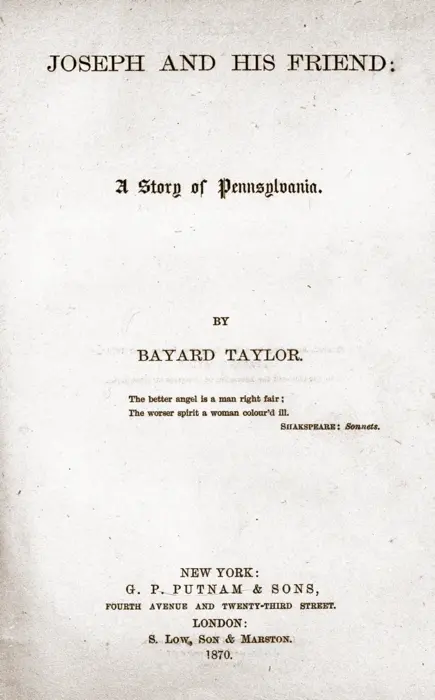
Bayard Taylor
Bayard Taylor
Bayard Taylor
BEHIND THE BOOK
This eBook is for the use of anyone anywhere in the United States and most other parts of the world at no cost and with almost no restrictions whatsoever. You may copy it, give it away or re-use it under the terms of the Project Gutenberg License included with this eBook or online at www.gutenberg.org. If you are not located in the United States, you will have to check the laws of the country where you are located before using this eBook. Read the source licence.
The original source file, including credits and licence, is retained by this library. Request an original-format copy at no charge. Please include the book title and Project Gutenberg identifier #41960.
KEEP YOUR CURIOSITY GOING
Wilfrid Scawen Blunt
Wilfrid Scawen Blunt

E. W. (Edgar Watson) Howe
Cécile Tormay

Moritz Busch
John L. Ransom