
1900; or, The last President
Ingersoll Lockwood
THE CLASSIC COLLECTION · 1889
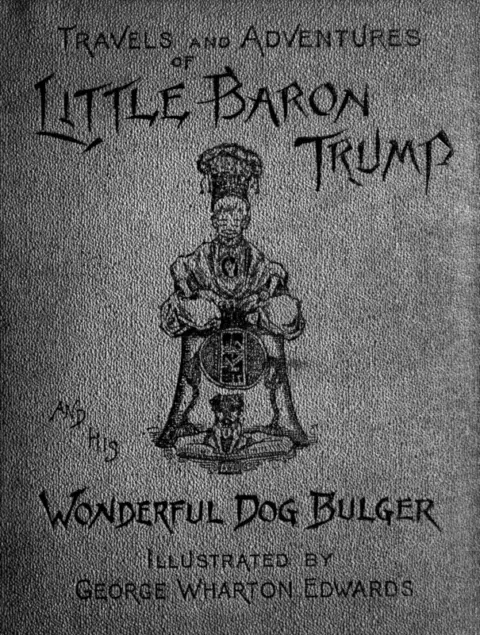
"Travels and Adventures of Little Baron Trump and His Wonderful Dog Bulger" by Ingersoll Lockwood is a children's novel published in 1889. The story follows Wilhelm Heinrich Sebastian Von Troomp, known as Baron Trump, a precocious German boy who journeys through fantastic lands and discovers underground civilizations. Accompanied by his dog Bulger, Baron Trump encounters strange natives, narrowly escapes romantic entanglements, and repeats this pattern of adventure until returning to Castle Trump. The novel remained obscure for over a century before gaining attention in 2017.
Introduction adapted from the source catalogue; source summaries may be automatically generated.
Free to read · English · 94,559 words · No account needed
MAKE TIME FOR A GOOD BOOK
On by default. Untick to stop anonymous reading totals. Each page counts after 10 seconds in view. How this works.
Anonymous counting is on unless you have switched it off.
“The royal library which thou holdest in thy hand, contains eight thousand volumes all rare and valuable, and only to be found in the library of our royal master. These volumes treat of astrology, alchemy, divination, cheirosophy, medicine, mathematics, law, politics, philosophy, pastimes, warfare, fifty volumes of poetry, fifty of history, fifty of wonder-stories, besides several hundred treatises on theosophy, altruism, positivism, hypnotism, mind-reading, transmigration of souls, art of flying, embalming etc., etc.!”
“O, wonderful! Most wonderful!” was my ejaculation.
“But I beseech thee, O, learned Poly-dotto,” I continued, “impart to me the secret of all this! Unfold to me the origin of this most wonderful system of writing whereby the wisdom of ages may be recorded in one small volume!”
Poly-dotto glanced at the king, who bowed his head in sign of his royal consent that the aged sage might speak.
“Where we now stand,” began Poly-dotto, tossing back the long tufts of white hair which reached from his ears to his shoulders, “was once a rugged and mountainous country. In those days, now some thirty thousand years ago, our people were more like thine than at present. To climb the rocky sides of these mountains required long, sinewy arms and strong hands of great grasping power, and flexible legs, moving quite independently of each other, like mountaineers in all lands. But, all of a sudden, these rock-crested heights began to sink and the valleys to rise; true, very slowly and gradually, but yet uninterruptedly, so that in a few years, what had been a rough, broken country, ridged and wrinkled, began to take on the aspect of a perfectly level land. With these changes our people began to change.
“Having no longer any use for hands of iron grip and arms of tireless muscles, they were not long in finding out that this strength was leaving them, that their great breadth of shoulder and depth of chest were slowly but surely disappearing in their sons and grandsons. By a strange fatality, about this time, a terrible flood passed over our luckless land. Our panic-stricken people had just time enough to escape. For several months the regions once inhabited by a contented little nation were covered by water many fathoms deep. When, at last, the waters had subsided, and our ancestors were permitted to set foot again on their native soil, what a change met their eyes! This vast domain of our gracious master, King Gâ-roo—the Thousandth, had become as you now see it, a perfectly level plain, net-worked by the countless narrow but deep and swift-rolling streams. But the soil brought in the arms, so to speak, of these raging waters and cast upon our houses, burying them far beneath, was of most extraordinary fertility, just as you see it now. Every manner of plant, fruit, flower, vegetable and grain grows here without cultivation when once planted. Our people were not slow to take advantage of Nature’s kindness and build up once more the happy homes destroyed by the flood. But now we were brought face to face with a most wonderful state of things. Here we were shut in, surrounded by a vast network of streams, and yet taught by our terrible experience so to dread water, that not even to escape from death itself could our people be induced to swim across one of these little rivers or pass over it in any sort of boat. Time went on. It was either a question of living on these long narrow necks of land, and walking scores of miles to pass around the bends and curves of the streams, or else jump over them. Our wise men issued instructions to our forefathers, telling them how from early childhood they must train their little ones to leap, encouraging them by rewards to keep up the practice until leaping became as easy to them as walking and running had been. The royal ancestors of our most gracious master enacted most stringent laws against walking and running. In a few generations great changes took place. It was not an unusual thing to see a child of eight or ten leap six or eight feet over rivulets while playing some game like your hide and seek. As these child-hoppers increased in years, their power of leaping soon led them to see that they could advance much more rapidly by jumping than by the ancient, toilsome way of setting first one and then the other foot forward.
Your reading position is saved on this browser. Take it to another device with a library code. Reading pages adapt to text, rather than matching a printed edition.
Ingersoll Lockwood
Ingersoll Lockwood
Frank R. Stockton & Edgar Fawcett & Franklin Fyles & Anna Katharine Green & Henry Harland & Ingersoll Lockwood & Joaquin Miller & Kirk Munroe & Brainard Gardner Smith & Maurice Thompson & A. C. (Andrew Carpenter) Wheeler
BEHIND THE BOOK
This eBook is for the use of anyone anywhere in the United States and most other parts of the world at no cost and with almost no restrictions whatsoever. You may copy it, give it away or re-use it under the terms of the Project Gutenberg License included with this eBook or online at www.gutenberg.org. If you are not located in the United States, you will have to check the laws of the country where you are located before using this eBook. Read the source licence.
The original source file, including credits and licence, is retained by this library. Request an original-format copy at no charge. Please include the book title and Project Gutenberg identifier #58566.
KEEP YOUR CURIOSITY GOING
Wilfrid Scawen Blunt
Wilfrid Scawen Blunt

E. W. (Edgar Watson) Howe
Coulson Kernahan

Maurice Baring
Frances Wright