THE CLASSIC COLLECTION✦On the Nature of ThingsCLASSIC FREE BOOKS
On the Nature of Things
Titus Lucretius Carus
THE CLASSIC COLLECTION · 1920
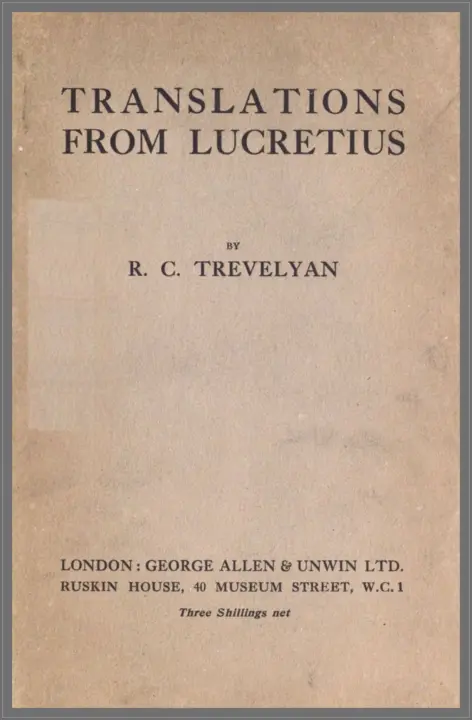
"Translations from Lucretius" by Titus Lucretius Carus is a philosophical text written in the early 1st century BC. This work offers a poetic interpretation of Lucretius' original ideas, focusing on themes of nature, reality, and the human condition. The text serves to explore and explain the nature of existence, the universe, and the principles of atomism, providing insights into life, death, and the pursuit of happiness. The beginning of "Translations from Lucretius" sets the stage for these profound themes by invoking Venus, the goddess associated with love and creation, as a muse for the poet’s exploration of nature. The opening lines elaborate on the influence of Venus over all living things and seek her assistance in articulating complex thoughts about the natural world. Lucretius argues against the cruelty of religion, advocating instead for a rational understanding of the universe founded on the principles of atomism. The text delves into discussions on matter, the cycle of life and death, and the innate fears humans have regarding mortality and divine punishment, laying the groundwork for a philosophical inquiry into the essence of existence and the futility of fearing death.
Introduction adapted from the source catalogue; source summaries may be automatically generated.
Free to read · English · 29,507 words · No account needed
MAKE TIME FOR A GOOD BOOK
On by default. Untick to stop anonymous reading totals. Each page counts after 10 seconds in view. How this works.
Anonymous counting is on unless you have switched it off.
The plaited garment came before the dress Of woven stuff. Weaving comes after iron, Since weaving tools need iron to fashion them. By no means else can such smooth things be made As heddles, spindles, shuttles and clattering yarn-beams. Men before womankind did Nature prompt To work wool; for in general the male sex Is by far the more skilful and ingenious: Till the rough peasants chided them so sternly That at length they consented to resign Such lighter tasks into the hands of women, And themselves took their share in heavier toils, Hardening with hard labour limbs and hands.
But Nature, the creatress, herself first Taught men to sow and prompted them to graft. For berries and acorns dropping from the trees Would put forth in due season underneath Swarms of seedlings: and hence the fancy came To insert grafts upon the boughs, and plant Young saplings in the soil about the fields. Next they would try another and yet another Method of tilling their loved piece of land, And so could watch how kindly fostering culture Helped the earth to improve its own wild fruits. And they would force the forests day by day To retreat higher up the mountain-sides And yield the ground below to husbandry, That so meadows and ponds, rivulets, crops, And glad vineyards might cover hill and plain, While grey-green boundary strips of olive trees Might run between the fields, stretching far out O’er hillock, valley and plain; as now we see Whole countrysides glowing with varied beauty, Adorned with rows of sweet fruit-bearing trees, And enclosed round about with joyous groves.
But the art of imitating with their mouths The liquid notes of birds, came long before Men could delight their ears by singing words To smooth tunes; and the whistlings of the zephyr In hollow reeds first taught the husbandman To blow through hollow stalks. Then by degrees They learnt those sweet sad ditties, which the pipe, Touched by the fingers of the melodist, Pours forth, such as are heard ’mid pathless woods, Forests and glades, or in the lonely haunts Of shepherds, and the abodes of magic calm. Thus would they soothe and gratify their minds, When satiate with food; for all such things Give pleasure then. So often, couched together On the soft grass, beside a waterbrook Beneath a tall tree’s boughs, at no great cost They would regale their bodies joyously, At those times chiefly when the weather smiled, And the year’s seasons painted the green herbage With flowers. Then went round the jest, the tale, The merry laugh, for then the rustic muse Was in full force: then frolick jollity Would prompt them to enwreathe their heads and shoulders With plaited garlands woven of flowers and leaves, Or dancing out of measure to move their limbs Clumsily, and with clumsy foot to beat Their mother earth; whence smiles and jovial laughter Would rise; since the more novel then and strange All such sports seemed, the more they were admired. And they would find a salve for wakefulness In giving voice to many varied tones Of winding melody, running with curved lip Over the reed-pipes: and from them this custom Is handed down to watchmen nowadays, Who, though they have better learnt to observe time, Yet not one whit more pleasure do they enjoy Than once that silvan race of earth-born men. For what is present, if we have never known Anything more delightful, gives us pleasure Beyond all else, and seems to be the best; But if some better thing be afterwards Discovered, this will often spoil for us all That pleased us once, and change our feelings towards it. Thus it was acorns came to be disliked: Thus were abandoned those beds of strewn grass And heaped leaves: the dress too of wild beast’s skin Fell thus into contempt. Yet I suppose That when it was invented it would rouse Such envy, that the man who wore it first Would be waylaid and slain: yet after all It would be torn to pieces among the thieves And with much bloodshed utterly destroyed, So that it never could be turned to use. Therefore skins then, now gold and purple vex Men’s lives with cares and wear them out with war. And here, I think, the greater guilt is ours; For the cold would torment these earth-born men Naked without their skins; but us no harm Whatever can it cause to go without A purple robe broidered with large designs In gold thread, so we have but on our backs A plain plebeian cloak to keep us warm. Therefore mankind is always toiling vainly, Fruitlessly wasting life in empty cares, Doubtless because they will not recognise The limits of possession, nor the bounds Beyond which no true pleasure can increase. And so by slow degrees this ignorance Has carried life out into the deep seas, And from the bottom stirred up war’s huge waves.
Your reading position is saved on this browser. Take it to another device with a library code. Reading pages adapt to text, rather than matching a printed edition.
BEHIND THE BOOK
This eBook is for the use of anyone anywhere in the United States and most other parts of the world at no cost and with almost no restrictions whatsoever. You may copy it, give it away or re-use it under the terms of the Project Gutenberg License included with this eBook or online at www.gutenberg.org. If you are not located in the United States, you will have to check the laws of the country where you are located before using this eBook. Read the source licence.
The original source file, including credits and licence, is retained by this library. Request an original-format copy at no charge. Please include the book title and Project Gutenberg identifier #64024.
KEEP YOUR CURIOSITY GOING

David Patterson (Spirit) Hatch
Coulson Kernahan

Ralph Waldo Emerson
Frances Wright

Edwin Abbott Abbott

Joseph Droz