THE CLASSIC COLLECTION✦On the Nature of ThingsCLASSIC FREE BOOKS
On the Nature of Things
Titus Lucretius Carus
THE CLASSIC COLLECTION · 1920
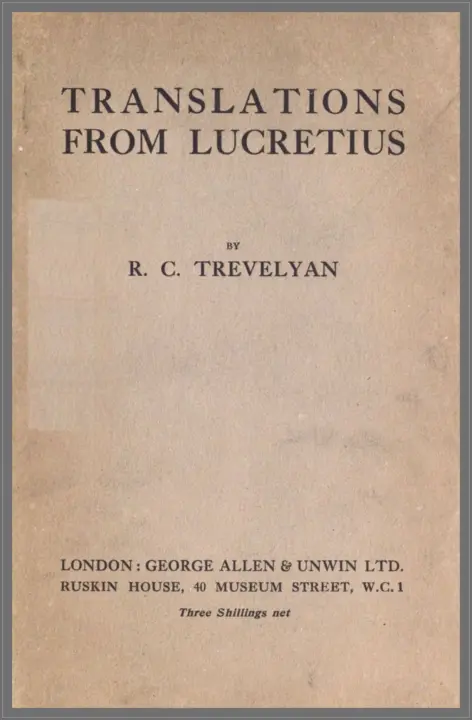
"Translations from Lucretius" by Titus Lucretius Carus is a philosophical text written in the early 1st century BC. This work offers a poetic interpretation of Lucretius' original ideas, focusing on themes of nature, reality, and the human condition. The text serves to explore and explain the nature of existence, the universe, and the principles of atomism, providing insights into life, death, and the pursuit of happiness. The beginning of "Translations from Lucretius" sets the stage for these profound themes by invoking Venus, the goddess associated with love and creation, as a muse for the poet’s exploration of nature. The opening lines elaborate on the influence of Venus over all living things and seek her assistance in articulating complex thoughts about the natural world. Lucretius argues against the cruelty of religion, advocating instead for a rational understanding of the universe founded on the principles of atomism. The text delves into discussions on matter, the cycle of life and death, and the innate fears humans have regarding mortality and divine punishment, laying the groundwork for a philosophical inquiry into the essence of existence and the futility of fearing death.
Introduction adapted from the source catalogue; source summaries may be automatically generated.
Free to read · English · 29,507 words · No account needed
MAKE TIME FOR A GOOD BOOK
On by default. Untick to stop anonymous reading totals. Each page counts after 10 seconds in view. How this works.
Anonymous counting is on unless you have switched it off.
Likewise at a fixed time Matuta spreads
The rosy dawn abroad through the sky’s borders,
And opens out her light; either because
The same sun, travelling back below the earth,
Seizes the sky beforehand, and is fain
To kindle it with his rays; or else because
Fires meet together, and many seeds of heat
Are wont at a fixed time to stream together
Causing new sunlight each day to be born.
Even so ’tis told that from the mountain heights
Of Ida at daybreak scattered fires are seen;
These then unite as if into one globe
And make up the sun’s orb. Nor yet herein
Should it cause wonder that these seeds of fire
Can stream together at a time so fixed,
Repairing thus the radiance of the sun.
For everywhere we see many events
Happening at fixed times. Thus trees both flower
And shed their blossoms at fixed times; and age
At a time no less fixed bids the teeth drop,
And the boy clothe his features with the down
Of puberty, and let a soft beard fall
From either cheek. Lastly lightning and snow,
Rains, clouds and winds happen at more or less
Regular yearly seasons. For where causes
From the beginning have remained the same,
And things from the first origin of the world
Have so fallen out, they still repeat themselves
In regular sequence after a fixed order.
The cause too why days lengthen and nights wane,
While daylight shortens as the nights increase,
May either be because the same sun, journeying
Underneath and above the earth in curves
Of unlike length, parts the celestial regions
And into unequal halves divides his orbit:
Whatever he has subtracted from one half,
Just so much does he add, when he comes round,
On to the other half, till he has reached
That sign of heaven where the year’s node makes
The night’s shade equal to the light of day.
For in the sun’s mid course between the blasts
Of south wind and of north, the heaven holds
His turning-points apart at distances
Now equalised, since such is the position
Of the whole starry circle, to glide through which
The sun takes up the period of a year,
Lighting the earth and sky with slanting rays,
As is shown by the arguments of those
Who have mapped out all the quarters of the sky,
Adorned with their twelve signs spaced out in order.
Or else because the air in certain parts
Is thicker, therefore the trembling lamp of fire
Is hindered in its course beneath the earth,
And cannot easily force a passage through
And emerge at the place where it should rise.
So in winter-time the nights are long and lingering,
Ere the day’s radiant oriflamme comes forth.
Or else again those fires which cause the sun
To rise from a fixed point, for a like reason
Are wont to stream together slower or quicker
In alternating periods of the year.
So those would seem to speak the truth who hold
That every morning a new sun is born.
It may be the moon shines because she is struck
By the sun’s rays, and turns towards our eyes
A larger portion of this light each day,
The further she recedes from the sun’s orb,
Until over against him with full light
She has shone forth, and as she rises up
Has looked upon his setting from on high.
Thereafter in her gradual backward course
In the same manner she must hide her light,
The nearer she now glides to the sun’s fire
Travelling through the circle of the signs
From an opposite direction: as those hold
Who fancy that the moon is like a ball,
And moves along a course below the sun.
It is also possible that she revolves
With her own light, and yet shows varying
Phases of brightness: for there may well be
Another body which glides on beside her,
Obstructing and occulting her continually,
And yet cannot be seen, because it moves
Without light. Or perhaps she may turn round
Like a ball, let us say, whose sphere is tinged
With glowing light over one-half its surface;
And as she turns her sphere, she may present
Varying phases, till she has turned that side
Which glows with fire towards our gazing eyes;
Then she twists gradually back once more
And hides the luminous half of her round ball:
As the Chaldean sages seek to prove,
Refuting with their Babylonian doctrine
The opposing science of the astronomers;
Just as though what each sect is fighting for
Might not be true, or there were any reason
Why you should risk embracing the one creed
Less than the other. Again why every time
There should not be created a fresh moon,
With fixed succession of phases and fixed shapes,
So that each day this new-created moon
Would perish, and another in its stead
Be reproduced, this were no easy task
To prove by argument convincingly,
Since there can be so many things created
In fixed succession. Thus Spring goes its way,
And Venus, and the wingèd harbinger
Of Venus leads them on; while treading close
On Zephyr’s footsteps, mother Flora strews
The path before them, covering it all over
With every loveliest colour and rich scent.
Next in procession follows parching heat,
With dusty Ceres in its company,
And the Etesian blasts of the North winds.
After these Autumn comes, and by its side
Advances Euhius Euan,[G] following whom
The other Seasons with their winds appear,
Volturnus thundering on high, and Auster
Terrible with its lightnings. Then at length
December brings snow and renews numb frost.
Winter follows with teeth chattering for cold.
Wherefore it seems less wonderful that the moon
Should be begotten and destroyed again
At fixed times, seeing that so many things
Can come to pass at times so surely fixed.
Your reading position is saved on this browser. Take it to another device with a library code. Reading pages adapt to text, rather than matching a printed edition.
BEHIND THE BOOK
This eBook is for the use of anyone anywhere in the United States and most other parts of the world at no cost and with almost no restrictions whatsoever. You may copy it, give it away or re-use it under the terms of the Project Gutenberg License included with this eBook or online at www.gutenberg.org. If you are not located in the United States, you will have to check the laws of the country where you are located before using this eBook. Read the source licence.
The original source file, including credits and licence, is retained by this library. Request an original-format copy at no charge. Please include the book title and Project Gutenberg identifier #64024.
KEEP YOUR CURIOSITY GOING

David Patterson (Spirit) Hatch
Coulson Kernahan

Ralph Waldo Emerson
Frances Wright

Edwin Abbott Abbott

Joseph Droz