THE CLASSIC COLLECTION✦On the Nature of ThingsCLASSIC FREE BOOKS
On the Nature of Things
Titus Lucretius Carus
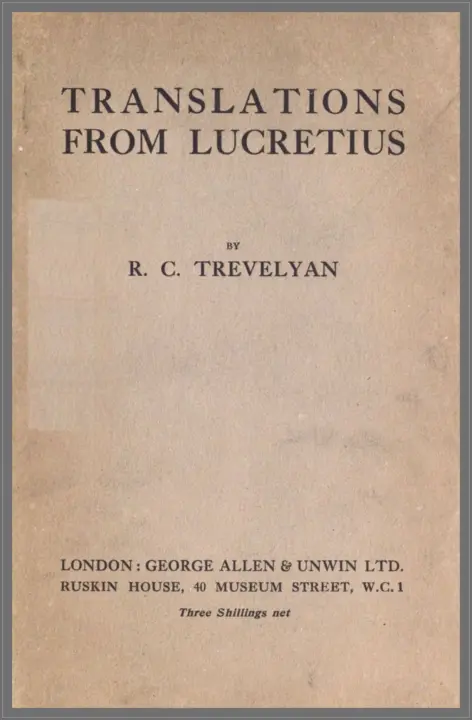
THE CLASSIC COLLECTION · 1920
"Translations from Lucretius" by Titus Lucretius Carus is a philosophical text written in the early 1st century BC. This work offers a poetic interpretation of Lucretius' original ideas, focusing on themes of nature, reality, and the human condition. The text serves to explore and explain the nature of existence, the universe, and the principles of atomism, providing insights into life, death, and the pursuit of happiness. The beginning of "Translations from Lucretius" sets the stage for these profound themes by invoking Venus, the goddess associated with love and creation, as a muse for the poet’s exploration of nature. The opening lines elaborate on the influence of Venus over all living things and seek her assistance in articulating complex thoughts about the natural world. Lucretius argues against the cruelty of religion, advocating instead for a rational understanding of the universe founded on the principles of atomism. The text delves into discussions on matter, the cycle of life and death, and the innate fears humans have regarding mortality and divine punishment, laying the groundwork for a philosophical inquiry into the essence of existence and the futility of fearing death.
Introduction adapted from the source catalogue; source summaries may be automatically generated.
Free to read · English · 29,507 words · No account needed
MAKE TIME FOR A GOOD BOOK
On by default. Untick to stop anonymous reading totals. Each page counts after 10 seconds in view. How this works.
Anonymous counting is on unless you have switched it off.
Nor am I unaware how hard my task
In Latin verses to set clearly forth
The obscure truths discovered by the Greeks,
Chiefly because so much will need new terms
To deal with it, owing to our poverty
Of language, and the novelty of the themes.
Nevertheless your worth and the delight
Of your sweet friendship, which I hope to win,
Prompt me to bear the burden of any toil,
And lead me on to watch the calm nights through,
Seeking by means of what words and what measures
I may attain my end, and shed so clear
A light upon your spirit, that thereby
Your gaze may search the depths of hidden things.
This terror, then, and darkness of the mind
Must needs be scattered not by the sun’s beams
And day’s bright arrows, but by contemplation
Of nature’s aspect and her inward law.
And this first principle of her design
Shall be our starting point: nothing is ever
By divine will begotten out of nothing.
In truth the reason fear so dominates
All mortals, is that they behold on earth
And in the sky many things happening,
Yet of these operations by no means
Can they perceive the causes, and so fancy
That they must come to pass by power divine.
Therefore when we have understood that nothing
Can be born out of nothing, we shall then
Win juster knowledge of the truth we seek,
Both from what elements each thing can be formed,
And in what way all things can come to pass
Without the intervention of the gods.
For if things came from nothing, any kind Might be born out of anything; naught then Would require seed. Thus men might rise from ocean The scaly race out of the land, while birds Might suddenly be hatched forth from the sky: Cattle and other herds and every kind Of wild beast, bred by no fixed law of birth, Would roam o’er tilth and wilderness alike. No fruit would remain constant to its tree, But would change; every tree would bear all kinds. For if there were not for each thing its own Begetting particles, how could they have A fixed unvarying mother? But in fact Since all are formed from fixed seeds, each is born And issues into the borders of the light From that alone wherein resides its substance And its first bodies. And for this cause all things Cannot be generated out of all, Since in each dwells its own particular power. Again why do we see in spring the rose, Corn in the summer’s heat, vines bursting forth When autumn summons them, if not because When in their own time the fixed seeds of things Have flowed together, there is then revealed Whatever has been born, while the due seasons Are present, and the quickened earth brings forth Safely into the borders of the light Its tender nurslings? But if they were formed From nothing, they would suddenly spring up At unfixed periods and hostile times, Since there would then be no fixed particles To be kept from a begetting union By the unpropitious season of the year. Nor yet after the meeting of the seed Would lapse of time be needed for their increase, If they could grow from nothing. Suddenly Small babes would become youths; trees would arise Shooting up in a moment from the ground. But nothing of the kind, ’tis plain, takes place, Seeing that all things grow little by little, As befits, from determined seed, and growing Preserve their kind: so that you may perceive That all things become greater and are nourished Out of their own material. Furthermore Without fixed annual seasons for the rain Earth could not put her gladdening produce forth, Nor yet, if kept apart from nourishment, Could living creatures propagate their kind Or sustain life: so that with greater reason You may think many things have many atoms In common, as we see that different words Have common letters, than that anything Can come to being without first elements. Again, why could not nature have produced Men of such mighty bulk, that they could wade Through the deep places of the sea, or rend Huge mountains with their hands, or in one life Overpass many living generations, If not because there has been set apart A changeless substance for begetting things, And what can thence arise is predetermined? Therefore we must confess this truth, that nothing Can come from nothing, since seed is required For each thing, out of which it may be born And lift itself into the air’s soft breezes. Lastly, since it is evident that tilled lands Excel the untilled, and yield to labouring hands A richer harvest, we may thence infer That in the earth there must be primal atoms, And these, labouring its soil, we stimulate To rise, when with the coulter we turn up The fertile clods. But if none such existed, We should see all things without toil of ours Spring forth far richer of their own accord.
Your reading position is saved on this browser. Take it to another device with a library code. Reading pages adapt to text, rather than matching a printed edition.
BEHIND THE BOOK
This eBook is for the use of anyone anywhere in the United States and most other parts of the world at no cost and with almost no restrictions whatsoever. You may copy it, give it away or re-use it under the terms of the Project Gutenberg License included with this eBook or online at www.gutenberg.org. If you are not located in the United States, you will have to check the laws of the country where you are located before using this eBook. Read the source licence.
The original source file, including credits and licence, is retained by this library. Request an original-format copy at no charge. Please include the book title and Project Gutenberg identifier #64024.
KEEP YOUR CURIOSITY GOING

David Patterson (Spirit) Hatch
Coulson Kernahan

Ralph Waldo Emerson
Frances Wright

Edwin Abbott Abbott

Joseph Droz