THE CLASSIC COLLECTION✦On the Nature of ThingsCLASSIC FREE BOOKS
On the Nature of Things
Titus Lucretius Carus
THE CLASSIC COLLECTION · 1920
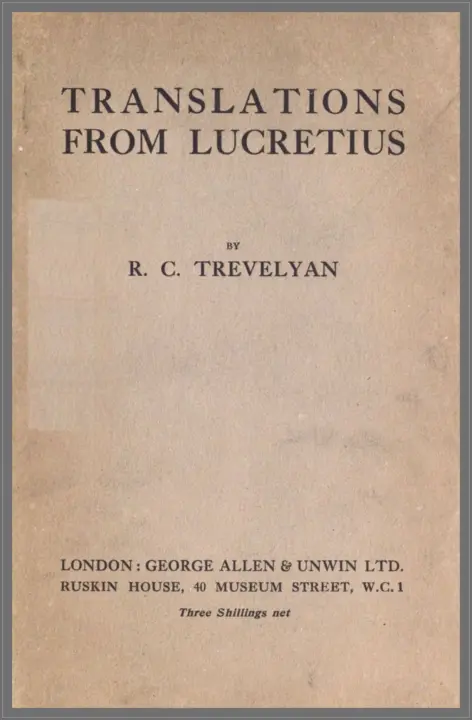
"Translations from Lucretius" by Titus Lucretius Carus is a philosophical text written in the early 1st century BC. This work offers a poetic interpretation of Lucretius' original ideas, focusing on themes of nature, reality, and the human condition. The text serves to explore and explain the nature of existence, the universe, and the principles of atomism, providing insights into life, death, and the pursuit of happiness. The beginning of "Translations from Lucretius" sets the stage for these profound themes by invoking Venus, the goddess associated with love and creation, as a muse for the poet’s exploration of nature. The opening lines elaborate on the influence of Venus over all living things and seek her assistance in articulating complex thoughts about the natural world. Lucretius argues against the cruelty of religion, advocating instead for a rational understanding of the universe founded on the principles of atomism. The text delves into discussions on matter, the cycle of life and death, and the innate fears humans have regarding mortality and divine punishment, laying the groundwork for a philosophical inquiry into the essence of existence and the futility of fearing death.
Introduction adapted from the source catalogue; source summaries may be automatically generated.
Free to read · English · 29,507 words · No account needed
MAKE TIME FOR A GOOD BOOK
On by default. Untick to stop anonymous reading totals. Each page counts after 10 seconds in view. How this works.
Anonymous counting is on unless you have switched it off.
Consider too how they consume their strength And are worn out with toiling; and consider How at another’s beck their life is passed. Meantime their substance vanishes and is changed To Babylonian stuffs; their duties languish; Their reputation totters and grows sick. While at her lover’s cost she anoints herself With precious unguents, and upon her feet Beautiful Sicyonian slippers laugh. Then doubtless she has set for her in gold Big green-lit emeralds; and the sea-purple dress, Worn out by constant use, imbibes the sweat Of love’s encounters. The wealth which their fathers Had nobly gathered, becomes hair-ribbons And head-dresses, or else may be is turned Into a long Greek gown, or stuffs of Alinda And Ceos. Feasts with goodly broideries And viands are prepared, games, numerous cups, Unguents, crowns and festoons; but all in vain; Since from the well-spring of delights some touch Of bitter rises, to give pain amidst The very flowers; either when the mind Perchance grows conscience-stricken, and remorse Gnaws it, thus to be spending a life of sloth, And ruining itself in wanton haunts; Or else because she has launched forth some word And left its sense in doubt, some word that clings To the hungry heart, and quickens there like fire; Or that he fancies she is casting round Her eyes too freely, or looks upon some other, And on her face sees traces of a smile.
When love is permanent and fully prosperous,
These evils are experienced; but if love
Be crossed and hopeless, there are evils such
That you might apprehend them with closed eyes,
Beyond numbering; so that it is wiser,
As I have taught you, to be vigilant
Beforehand, and watch well lest you be snared.
For to avoid being tripped up in love’s toils
Is not so difficult as, once you are caught,
To issue from the nets and to break through
The strong meshes of Venus. None the less
Even when you are tangled and involved,
You may escape the peril, unless you stand
In your own way, and always overlook
Every defect whether of mind or body
In her whom you pursue and long to win.
For this is how men generally behave
Blinded by lust, and assign to those they love
Good qualities which are not truly theirs.
So we see women in various ways misformed
And ugly, to be fondly loved and held
In highest favour. And a man will mock
His fellows, urging them to placate Venus,
Because they are troubled by a degrading love,
Yet often the poor fool will have no eyes
For his own far worse plight. The tawny is called
A honey brown; the filthy and unclean,
Reckless of order; the green-eyed, a Pallas;
The sinewy and angular, a gazelle;
The tiny and dwarfish is a very Grace,
Nothing but sparkle; the monstrous and ungainly,
A marvel, and composed of majesty.
She stammers, cannot talk, why then she lisps;
The mute is bashful; but the fiery-tongued
Malicious gossip becomes a brilliant torch.
One is a slender darling, when she scarce
Can live for lack of flesh; and one half dead
With cough, is merely frail and delicate.
Then the fat and full-bosomed is Ceres’ self
Suckling Iacchus; the snub-nosed, a female
Silenus, or a Satyress; the thick-lipped,
A kiss incarnate. But more of this sort
It were a tedious labour to recite.
Yet be she noble of feature as you will,
And let the might of Venus emanate
From every limb; still there are others too;
Still we have lived without her until now;
Still she does, and we know she does, the same
In all things as the ugly, and, poor wretch,
Perfumes herself with evil-smelling scents,
While her maids run and hide to giggle in secret.
But the excluded lover many a time
With flowers and garlands covers tearfully
The threshold, and anoints the haughty posts
With oil of marjoram, and imprints, poor man,
Kisses upon the doors. Yet when at last
He has been admitted, if but a single breath
Should meet him as he enters, he would seek
Specious excuses to be gone, and so
The long-studied, deep-drawn complaint would fall
To the ground, and he would then convict himself
Of folly, now he sees he had attributed
More to her than is right to grant a mortal.
Nor to our Venuses is this unknown:
Wherefore the more are they at pains to hide
All that takes place behind the scenes of life
From those they would keep fettered in love’s chains
But all in vain, since in imagination
You yet may draw forth all these things to light,
Discovering every cause for ridicule:
And if she be of a mind that still can charm,
And not malicious, you may in your turn
Overlook faults and pardon human frailty.
Your reading position is saved on this browser. Take it to another device with a library code. Reading pages adapt to text, rather than matching a printed edition.
BEHIND THE BOOK
This eBook is for the use of anyone anywhere in the United States and most other parts of the world at no cost and with almost no restrictions whatsoever. You may copy it, give it away or re-use it under the terms of the Project Gutenberg License included with this eBook or online at www.gutenberg.org. If you are not located in the United States, you will have to check the laws of the country where you are located before using this eBook. Read the source licence.
The original source file, including credits and licence, is retained by this library. Request an original-format copy at no charge. Please include the book title and Project Gutenberg identifier #64024.
KEEP YOUR CURIOSITY GOING

David Patterson (Spirit) Hatch
Coulson Kernahan

Ralph Waldo Emerson
Frances Wright

Edwin Abbott Abbott

Joseph Droz