THE CLASSIC COLLECTION✦On the Nature of ThingsCLASSIC FREE BOOKS
On the Nature of Things
Titus Lucretius Carus
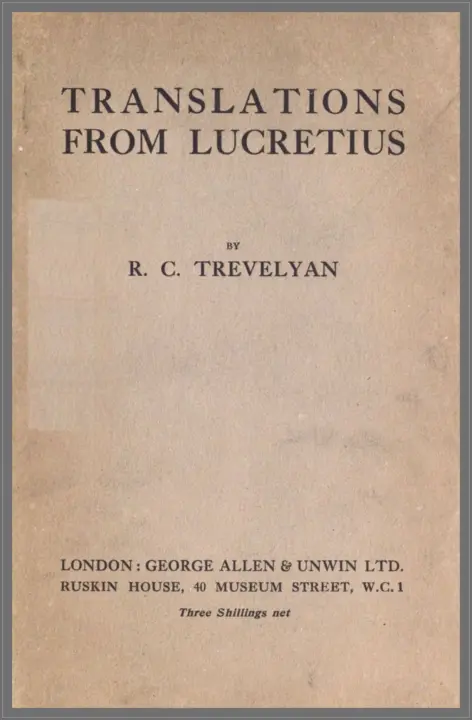
THE CLASSIC COLLECTION · 1920
"Translations from Lucretius" by Titus Lucretius Carus is a philosophical text written in the early 1st century BC. This work offers a poetic interpretation of Lucretius' original ideas, focusing on themes of nature, reality, and the human condition. The text serves to explore and explain the nature of existence, the universe, and the principles of atomism, providing insights into life, death, and the pursuit of happiness. The beginning of "Translations from Lucretius" sets the stage for these profound themes by invoking Venus, the goddess associated with love and creation, as a muse for the poet’s exploration of nature. The opening lines elaborate on the influence of Venus over all living things and seek her assistance in articulating complex thoughts about the natural world. Lucretius argues against the cruelty of religion, advocating instead for a rational understanding of the universe founded on the principles of atomism. The text delves into discussions on matter, the cycle of life and death, and the innate fears humans have regarding mortality and divine punishment, laying the groundwork for a philosophical inquiry into the essence of existence and the futility of fearing death.
Introduction adapted from the source catalogue; source summaries may be automatically generated.
Free to read · English · 29,507 words · No account needed
MAKE TIME FOR A GOOD BOOK
On by default. Untick to stop anonymous reading totals. Each page counts after 10 seconds in view. How this works.
Anonymous counting is on unless you have switched it off.
Now since the birth-time of the world, since sea
And earth’s first natal day and the sun’s origin,
Many atoms have been added from without,
Many seeds from all round, which, shooting them
Hither and thither, the great universe
Has brought together: and by means of these
Sea and land have been able to increase;
Thus too the mansion of the sky has gained
New spaciousness, and lifted its high roof
Far above earth, and the air has risen with it.
For to each thing its own appropriate atoms
Are all distributed by blows from all
Regions of space, so that they separate
Into their proper elements. Moisture joins
With moisture: earth from earthy substance grows;
Fires generate fire, and ether ether,
Till Nature, the creatress, consummating
Her labour, has brought all things to their last
Limit of growth; as happens, when at length
That which is entering the veins of life
Is now no more than what is flowing away
And ebbing thence. In all things at this point
The age of growth must halt: at this point nature
Curbs increase by her powers. For all such things
As you may see waxing with joyous growth,
And climbing step by step to matured age
Receive into themselves more particles
Than they discharge, so long as food is passing
Easily into all their veins, and while
They are not so widely spread as to throw off
Too many atoms and to cause more waste
Than what their life requires for nourishment.
For we must surely grant that many atoms
Are flowing away from things and leaving them:
But still more must be added, till at length
They have attained the highest pitch of growth.
Then age little by little breaks their powers
And their mature strength, as it wastes away
On the worse side of life. And out of doubt
The bulkier and the wider a thing is,
Once its growth ceases, the more particles
Does it now shed around it and discharge
On all sides: nor is food distributed
Easily into all its veins, nor yet
In quantity sufficient that therefrom
A supply may continually rise up
To compensate the copious emanations
Which it exhales. For there is need of food
To preserve all things by renewing them:
Food must uphold, food sustain everything:
Yet all is to no purpose, since the veins
Fail to convey what should suffice, nor yet
Does nature furnish all that is required.
There is good reason therefore why all forms
Should perish, when they are rarefied by flux
Of atoms, and succumb to external blows,
Since food must fail advanced age in the end,
And atoms cease not ever from outside
To buffet each thing till they wear it out
And overpower it by beleaguering blows.
In this way then it is that the walls too
Of the great world from all sides shall be stormed
And so collapsing crumble away to ruins.
And even now already this world’s age
Is broken, and the worn-out earth can scarce
Create the tiniest animals, she who once
Created every kind, and brought to birth
The huge shapes of wild beasts. For, as I think,
Neither did any golden rope let down
The tribes of mortal creatures from the heights
Of heaven on to the fields, nor did the sea
Nor its waves beating on the rocks create them,
But the same earth gave birth to them, which now
Feeds them from her own breast. At first moreover
Herself spontaneously did she create
Flourishing crops and rich vines for mankind,
Herself gave them sweet fruits and joyous pastures;
Which now, though aided by our toil, scarce grow
To any size. Thus we wear out our oxen
And the strength of our peasants: we use up
Our iron tools; yet hardly do we win
A sustenance from the fields, so niggardly
They grudge their produce and increase our toil.
And now shaking his head the aged ploughman
Sighs ever and anon, when he beholds
The labours of his hands all spent in vain;
And when with times past he compares the present,
He praises often the fortune of his sire,
Harping upon that ancient race of men
Who rich in piety supported life
Upon their narrow plots contentedly,
Seeing the land allotted to each man
Was far less in those days than now. So too
The planter of the worn-out shrivelled vine
Disconsolately inveighs against the march
Of time, wearying heaven with complaints,
And understands not how all things are wasting
Little by little, and passing to the grave
Tired out by lengthening age and lapse of days.
Your reading position is saved on this browser. Take it to another device with a library code. Reading pages adapt to text, rather than matching a printed edition.
BEHIND THE BOOK
This eBook is for the use of anyone anywhere in the United States and most other parts of the world at no cost and with almost no restrictions whatsoever. You may copy it, give it away or re-use it under the terms of the Project Gutenberg License included with this eBook or online at www.gutenberg.org. If you are not located in the United States, you will have to check the laws of the country where you are located before using this eBook. Read the source licence.
The original source file, including credits and licence, is retained by this library. Request an original-format copy at no charge. Please include the book title and Project Gutenberg identifier #64024.
KEEP YOUR CURIOSITY GOING

David Patterson (Spirit) Hatch
Coulson Kernahan

Ralph Waldo Emerson
Frances Wright

Edwin Abbott Abbott

Joseph Droz