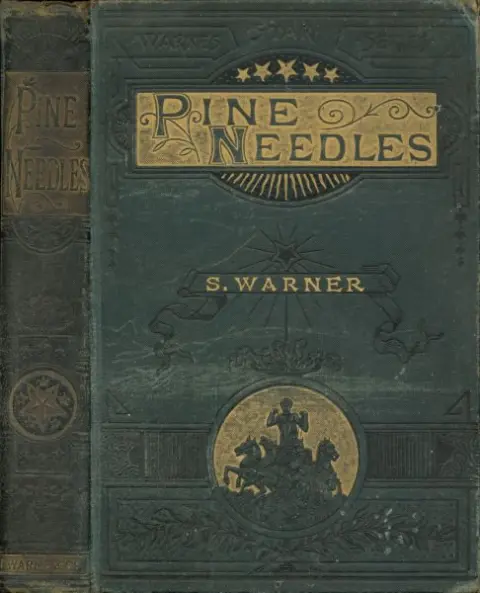
Pine Needles
Susan Warner & Louis Harms
THE CLASSIC COLLECTION · 1873
"Trading" by Susan Warner is a novel written in the late 19th century. The book focuses on the character Matilda Laval, who is happily immersed in her newfound life and the excitement of Christmas, yet she grapples with a sense of responsibility towards the less fortunate. It explores themes of generosity, compassion, and the contrast between social classes through Matilda's experiences and revelations during a festive holiday gathering. At the start of the novel, Christmas is overshadowed by grey clouds, yet the atmosphere inside Mrs. Lloyd's home is filled with warmth and cheer. Matilda is busy preparing for the holiday festivities while contemplating her new life and feelings of happiness contrasted with her worries for others, particularly a poor girl named Sarah Staples living in miserable conditions. As the excitement of the party unfolds, Matilda's internal conflict emerges as she realizes her privileged position in stark contrast to Sarah's hardships. This opening sets the stage for Matilda's journey as she reconciles her joy with a budding desire to help those in need.
Introduction adapted from the source catalogue; source summaries may be automatically generated.
Free to read · English · 66,128 words · No account needed
MAKE TIME FOR A GOOD BOOK
On by default. Untick to stop anonymous reading totals. Each page counts after 10 seconds in view. How this works.
Anonymous counting is on unless you have switched it off.
Matilda read these words, with a quick remembrance of the time when she had read them in the company of her two little schoolmates, and the discussion that had ensued thereupon; curious what their reception would be now. It was stormy.
"The idea!" said Mrs. Bartholomew.
"That would make a finish of society at once," said Mrs. Laval.
"But what do the words mean?" asked Mrs. Lloyd. "There they are. They
must mean something."
"Something!" echoed Mrs. Bartholomew. "Just imagine, that we are to gather in a company of cripples round our dinner table! Send out and ask all the forlorn creatures we can find, and feed them on game and sweetbreads. It looks like it!"
"And give up entertaining our friends," added Mrs. Laval.
"What friends do we entertain, aunt Zara?" David asked. "You do not
care much for most of them."
"You are a ridiculous, absurd, fanatical boy!" said Judy. "What
nonsense you do talk!"
"Nonsense that would make an end of all civilization," said Mrs. Laval;
not quite logically.
"But do you care much for these people you invite?" David persisted.
"Not singly," Mrs. Laval admitted; "but taken together, I care a great deal. At least they are people of our own rank and standing in society, and we can understand what they talk about."
"But what do the words mean?" Mrs. Lloyd asked.
"Why mother," said Mrs. Bartholomew, "you have read them a thousand times. They mean what they always did."
"I don't think I ever raised the question till this minute," said Mrs. Lloyd. "In fact, I don't think I knew the words were there. And I should like to know now what they mean."
"Grandmother," said David, "isn't it safe to conclude they mean just
what they say?"
"Then we should never ask anybody to dinner!" cried his mother.
"And we should never have a party again," said Judy.
"Society would be at an end," said Mrs. Laval.
"And we should fill our house with horrid wretches," cried Judy, "and have to take up our carpets and clean house every time."
David was silent while these various charges were eagerly poured out. Norton looked at him a little scornfully; Matilda anxiously; but he was only sorrowfully quiet, till his grandmother turned to him with her question.
"What would you do, Davy?"
"He'd do anything absurd and ridiculous," said Judy; "the more the better. He is just fit for it. What's the use of asking him, grandma?"
"I would like to hear, my dear, if you will let him speak. I would like to know what the words say to you, Davy."
Your reading position is saved on this browser. Take it to another device with a library code. Reading pages adapt to text, rather than matching a printed edition.
Susan Warner & Louis Harms
Susan Warner
Susan Warner
Susan Warner
BEHIND THE BOOK
This eBook is for the use of anyone anywhere in the United States and most other parts of the world at no cost and with almost no restrictions whatsoever. You may copy it, give it away or re-use it under the terms of the Project Gutenberg License included with this eBook or online at www.gutenberg.org. If you are not located in the United States, you will have to check the laws of the country where you are located before using this eBook. Read the source licence.
The original source file, including credits and licence, is retained by this library. Request an original-format copy at no charge. Please include the book title and Project Gutenberg identifier #30149.
KEEP YOUR CURIOSITY GOING
Coulson Kernahan

Maurice Baring
Frances Wright
Cécile Tormay

Frederic Jesup Stimson

W. H. P. (William Henry Pope) Jarvis