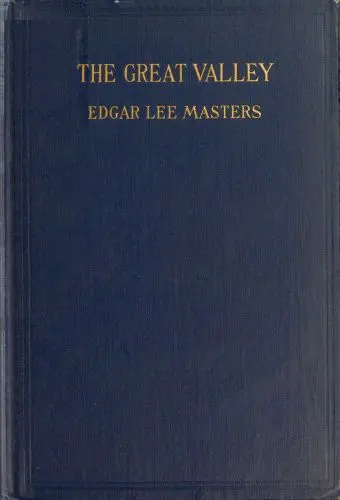
The Great Valley
Edgar Lee Masters
THE CLASSIC COLLECTION · 1918
"Toward the Gulf" by Edgar Lee Masters is a poetic collection written during the early 20th century. This work explores themes of American identity, nature, and the interconnectedness of human experiences through richly crafted verses. The collection reflects on historical figures and events while celebrating the American spirit in a voice that resonates with both nostalgia and social commentary. The opening of "Toward the Gulf" presents a vivid and lyrical portrayal of rivers and landscapes, infused with a sense of movement and progression toward freedom and liberty. Masters begins by depicting the journey from the northern highlands through various terrains toward the Gulf of Mexico, utilizing rich imagery and personification of water as a symbol of life and human struggle. The text evokes the spirits of explorers and settlers who influenced the land, offering a reflection on the past while hinting at the ongoing journey toward democracy and personal freedom in American life. The masterful use of natural elements serves as a metaphor for the complex relationship between humanity and the environment, establishing the collection's central thematic thread.
Introduction adapted from the source catalogue; source summaries may be automatically generated.
Free to read · English · 50,631 words · No account needed
MAKE TIME FOR A GOOD BOOK
On by default. Untick to stop anonymous reading totals. Each page counts after 10 seconds in view. How this works.
Anonymous counting is on unless you have switched it off.
I grew calmer
Almost found peace, got work to do, and lived
Under a widow's roof, who was devout
And knew my love for God. Now listen, doctor,
To every word: I was now twenty-five,
In perfect health, no longer persecuted,
At peace with all the world, if not my soul
Had wholly found its peace, for truth to tell
It had an ache which sometimes I could feel,
And yet I had this soul awakening.
I know I have been counted mad, so watch
Each detail here and judge.
At four o'clock
The thirtieth day of June, my work being done,
My kit upon my back I walked this road
Toward the village. 'Twas an afternoon
Of clouds, no rain, a little breeze, the tinkle
Of cow bells in the air, a heavenly silence
Pervading nature. Reaching the hill's foot
I sat down by a tree to rest, enjoy
The greenness of the forests, meadows, flats
Along the bay, the blueness of the lake,
The ripple of the water at my feet,
The rythmic babble of the little boats
Tied to the bridge. And as I sat there musing,
Myself lost in the self, in time the clouds
Lifted, blew off, to let the sun go down
Over the waters gloriously to rest.
So as I stared upon the sun on the water,
Some minutes, though I know not for how long,
Out of the splendor of the shining sun
Upon the water, Jesus of Nazareth
Clothed all in white, the nimbus round his brow,
His face all wisdom, love, rose to my view,
And then he spake: 'Jacob, my son, arise
And come with me.'
"And in an instant there
Something fell from me, I became a cloud,
A soul with wings. A glory burned about me.
And in that glory I perceived all things:
I saw the eternal wheels, the deepest secrets
Of creatures, herbs and grass, and stars and suns
And I knew God, and knew all things as God:
The All loving, the Perfect One, the Perfect Wisdom,
Truth, love and purity. And in that instant
Atoms and molecules I saw, and faces,
And how they are arranged order to order,
With no break in the order, one harmonious
Whole of universal life all blended
And interfused with universal love.
And as it was with Shelley so I cried,
And clasped my hands in ecstacy and rose
And started back to climb the hill again,
Scarce knowing, neither caring what I did,
Nor where I went, and thinking if this be
A fancy only of the Saviour then
He will not follow me, and if it be
Himself, indeed, he will not let me fall
After the revelation. As I reached
The brow of the hill, I felt his presence with me
And turned, and saw Him. 'Thou hast faith, my son,
Who knowest me, when they who walked with me
Toward Emmaus knew me not, to whom I told
All secrets of the scriptures beginning at Moses,
Who knew me not till I brake bread and then,
As after thought could say, Did not our heart
Within us burn while he talked. O, Jacob Groesbell,
Thou carpenter, as I was, greatly blessed
With visions and my Father's love, this walk
Is your walk toward Emmaus.' So he talked,
Expounding all the scriptures, telling me
About the race of men who live and move
Along a life of meat and drink and sleep
And comforts of the flesh, while here and there
A hungering soul is chosen to lift up
And re-create the race. 'The prophet, poet
Must seek and must find God to keep the race
Awake to the divine and to the orders
Of universal and harmonious life,
All interfused with Universal love,
Which love is God, lest blindness, atheism,
Which sees no order, reason, no intent
Beat down the race to welter in the mire
When storms, and floods come. And the sons of God,
The leaders of the race from age to age
Are chosen for their separate work, each work
Fits in the given order. All who suffer
The martyrdom of thought, whether they think
Themselves as servants of my Father, or even
Mock at the images and rituals
Which prophets of dead creeds did symbolize
The mystery they sensed, or whether they be
Spirits of laughter, logic, divination
Of human life, the human soul, all men
Who give their essence, blindly or in vision
In faith that life is worth their utmost love,
They are my brothers and my Father's sons.'
So Jesus told me as we took my walk
Toward my Emmaus. After a time we turned
And walked through heading rye and purple vetch
Into an orchard where great rows of pears
Sloped up a hill. It was now evening:
Stretches of scarlet clouds were in the west,
And a half moon was hanging just above
The pears' white blossoms. O, that evening!
We came back to the boats at last and loosed
One of them and rowed out into the bay,
And fished, while the stars appeared. He only said
'Whatever they did with me you too shall do.'
A haziness came on me now. I seem
To find myself alone there in that boat.
At mid-night I awoke, the moon was sunk,
The whippoorwills were singing. I walked home
Back to the village in a silence, peace,
A happiness profound.
Your reading position is saved on this browser. Take it to another device with a library code. Reading pages adapt to text, rather than matching a printed edition.
Edgar Lee Masters

Edgar Lee Masters
Edgar Lee Masters
Edgar Lee Masters
BEHIND THE BOOK
This eBook is for the use of anyone anywhere in the United States and most other parts of the world at no cost and with almost no restrictions whatsoever. You may copy it, give it away or re-use it under the terms of the Project Gutenberg License included with this eBook or online at www.gutenberg.org. If you are not located in the United States, you will have to check the laws of the country where you are located before using this eBook. Read the source licence.
The original source file, including credits and licence, is retained by this library. Request an original-format copy at no charge. Please include the book title and Project Gutenberg identifier #7845.
KEEP YOUR CURIOSITY GOING

Eric Mackay
Edmund Gosse
Sophia Margaretta Hensley
Gilbert Parker
George MacDonald

Elizabeth Bibesco