THE CLASSIC COLLECTION✦My diaries, being a personal narrative of events 1888-1914, Part 2 (1900-1914)CLASSIC FREE BOOKS
My diaries, being a personal narrative of events 1888-1914, Part 2 (1900-1914)
Wilfrid Scawen Blunt
THE CLASSIC COLLECTION · 1873
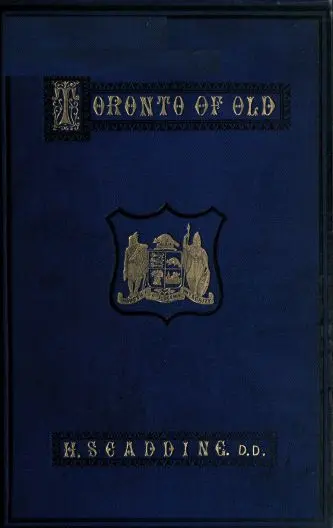
"Toronto of Old" by Henry Scadding is a historical account written in the late 19th century. The book focuses on the early settlement and social life of Toronto, Ontario, exploring the city's formative years and the memories attached to its original establishments, buildings, and notable events. It is an intricate blend of personal recollections, folklore, and early documentation that aims to bring alive the past of this vibrant city. The opening of the book sets the stage for a detailed exploration of Toronto's history, beginning with an introduction that discusses the origins of the city’s name and early French colonial references. Scadding reflects on his own connection to Toronto, hinting at the personal anecdotes and observations that will color his narrative. He outlines the structure and purpose of the work, emphasizing that while it won't serve as a formal history complete with statistics, it will provide detailed recollections of a bygone era, focusing on the evolution of Toronto through its streets and key figures. As he embarks on this historical journey, readers are invited to contemplate the early days of the city and the people who shaped its development, setting a somber yet nostalgic tone for the historical narrative that follows.
Introduction adapted from the source catalogue; source summaries may be automatically generated.
Free to read · English · 236,411 words · No account needed
MAKE TIME FOR A GOOD BOOK
On by default. Untick to stop anonymous reading totals. Each page counts after 10 seconds in view. How this works.
Anonymous counting is on unless you have switched it off.
In a MS. map of this portion of the vicinity of York, dated 1811, the road over the float is marked "Road from York to the Lighthouse." In this map, the lesser Don does not appear. A pond or inlet represents it, stretching in from the bay to the river. A bridge spans the inlet. There is a bridge also over the ravine, through which flows the rivulet by the Parliament Buildings.
Health, however, was not the sole object of all these arrangements. A race-course had been laid out on the sandy neck of land connecting the central portion of the peninsula with the main shore. Here races were periodically held; and we have been assured, by an eye-witness, that twelve fine horses at a time had been seen by him engaged in the contest of speed. The hippodrome in question was not a ring, but a long straight level stadium, extending from the southern end of the second bridge to the outer margin of the lake.
When invasion was threatened in 1812, all the bridges in the direction of the Island were taken down. An earthwork was thrown up across the narrow ridge separating the last long reach of the Don from the Bay; and in addition, a trench was cut across the same ridge. This cut, at first insignificant, became ultimately by a natural process the lesser Don, a deep and wide outlet, a convenient short-cut for skiffs and canoes from the Bay to the Don proper, and from the Don proper to the Bay.
On the return of peace, the absence of bridges, and the existence, in addition, of a second formidable water-filled moat, speedily began to be matters of serious regret to the inhabitants of York, who found themselves uncomfortably cut off from easy access to the peninsula. From the Gazette of April 15, 1822, we learn that "a public subscription among the inhabitants had been entered into, to defray the expense of erecting two bridges on the River Don, leading from this town towards the south, to the Peninsula." And subjoined are the leading names of the place, guaranteeing various sums, in all amounting to L108 5s. The timber was presented by Peter Robinson, Esq., M.P.P. The estimated expense of the undertaking was L325. The following names appear for various sums--fifty, twenty, ten, five and two dollars--Major Hillier, Rev. Dr. Strachan, Hon. J. H. Dunn, Hon. James Baby, Mr. Justice Boulton, John Small, Henry Boulton, Col. Coffin, Thomas Ridout, sen., W. Allen, Grant Powell, Samuel Ridout, J. S. Baldwin, S. Heward, James E. Small, Chas. Small, S. Washburn, J. B. Macaulay, G. Crookshank, A. Mercer, George Boulton, Thomas Taylor, Joseph Spragge, George Hamilton, R. E. Prentice, A. Warffe, W. B. Jarvis, B. Turquand, John Denison, sen., George Denison, John and George Monro, Henry Drean, Peter McDougall, Geo. Duggan, James Nation, Thomas Bright, W. B. Robinson, J. W. Gamble, William Proudfoot, Jesse Ketchum, D. Brooke, jun., R. C. Henderson, David Stegman, L. Fairbairn, Geo. Playter, Joseph Rogers, John French, W. Roe, Thomas Sullivan, John Hay, J. Biglow, John Elliot.
Your reading position is saved on this browser. Take it to another device with a library code. Reading pages adapt to text, rather than matching a printed edition.
BEHIND THE BOOK
This eBook is for the use of anyone anywhere in the United States and most other parts of the world at no cost and with almost no restrictions whatsoever. You may copy it, give it away or re-use it under the terms of the Project Gutenberg License included with this eBook or online at www.gutenberg.org. If you are not located in the United States, you will have to check the laws of the country where you are located before using this eBook. Read the source licence.
The original source file, including credits and licence, is retained by this library. Request an original-format copy at no charge. Please include the book title and Project Gutenberg identifier #35225.
KEEP YOUR CURIOSITY GOING
Wilfrid Scawen Blunt
Wilfrid Scawen Blunt

E. W. (Edgar Watson) Howe
Cécile Tormay

Moritz Busch
John L. Ransom