THE CLASSIC COLLECTION✦My diaries, being a personal narrative of events 1888-1914, Part 2 (1900-1914)CLASSIC FREE BOOKS
My diaries, being a personal narrative of events 1888-1914, Part 2 (1900-1914)
Wilfrid Scawen Blunt
THE CLASSIC COLLECTION · 1873
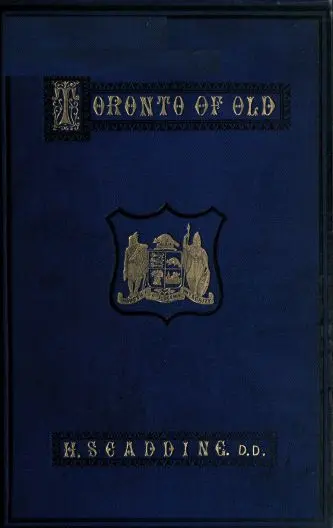
"Toronto of Old" by Henry Scadding is a historical account written in the late 19th century. The book focuses on the early settlement and social life of Toronto, Ontario, exploring the city's formative years and the memories attached to its original establishments, buildings, and notable events. It is an intricate blend of personal recollections, folklore, and early documentation that aims to bring alive the past of this vibrant city. The opening of the book sets the stage for a detailed exploration of Toronto's history, beginning with an introduction that discusses the origins of the city’s name and early French colonial references. Scadding reflects on his own connection to Toronto, hinting at the personal anecdotes and observations that will color his narrative. He outlines the structure and purpose of the work, emphasizing that while it won't serve as a formal history complete with statistics, it will provide detailed recollections of a bygone era, focusing on the evolution of Toronto through its streets and key figures. As he embarks on this historical journey, readers are invited to contemplate the early days of the city and the people who shaped its development, setting a somber yet nostalgic tone for the historical narrative that follows.
Introduction adapted from the source catalogue; source summaries may be automatically generated.
Free to read · English · 236,411 words · No account needed
MAKE TIME FOR A GOOD BOOK
On by default. Untick to stop anonymous reading totals. Each page counts after 10 seconds in view. How this works.
Anonymous counting is on unless you have switched it off.
A notice of the opening of navigation at Buffalo this year appears in the Loyalist of May 23, copied from the Buffalo Republican of the 16th of May. The scene is graphically depicted. "The schooner Eagle," the Republican says, "was the first vessel that entered our harbour this season. She ploughed her way through three or four miles of floating ice to the gratification of about a thousand spectators." The Republican also gives the following, which presents us with even grander spectacles:--"On Thursday morning the steamboat Pioneer started through the ice on her first trip to Dunkirk, with a full load of passengers. In the afternoon the steamer William Penn, Capt. Wright, commenced her first trip to Detroit, having on board upwards of 400 passengers destined to Pennsylvania, Ohio, and Michigan." "On Friday, about noon," the Buffalo paper then adds, "the steamboat Henry Clay, Norton, having previously arrived from Black Rock, left our harbour in fine style, having a heavy and full load of passengers. The steamboat Niagara, Pease, will leave on Monday for Detroit, as we understand."
A casualty in York Bay is noticed in the Loyalist of Oct. 4, 1828. "Mr. William Crone, contractor for gravelling the streets of the town, was unfortunately drowned on Saturday last. It appears that Mr. Crone was knocked overboard from the Durham boat, in which he was bringing a load of gravel from the Island, by the sudden shifting of the boom, and, being stunned by the blow, sunk before assistance could be rendered to him."
In Oct., 1828, Sir Peregrine Maitland arrives in York Harbour on board of the yacht Bullfrog, compelled to put in by stress of weather. He was on his way from the Lower Province to Niagara. "His Excellency Sir P. Maitland, after having visited Quebec, returning by the route of the Rideau Canal, arrived at York," says the Loyalist of Oct. 18, "on Monday morning from Kingston, on board His Majesty's yacht Bullfrog, Commodore Barrie, and on landing was received by a salute from the garrison. It was His Excellency's intention, we understand, to have landed at Niagara, but the Bullfrog having encountered a heavy gale on the previous night, was obliged to make for York. His Excellency proceeded to Niagara on Wednesday by the Canada, and Commodore Barrie with the Bullfrog left the harbour on the same day on return to Kingston." Sir Peregrine, we may observe, was on the point of leaving Upper Canada, having been appointed to the Government of Nova Scotia. The arrival of his successor at New York is announced in the same paper. "The packet ship Corinthian arrived at New York on the evening of the 7th instant. Sir John Colborne and family were passengers in the Corinthian, and may therefore be daily expected at this place (York)." It is announced in the same paper that "a public dinner will be given to His Excellency Sir Peregrine Maitland, previous to his departure from this Province. Tickets of admission to be had at Messrs. Meighan's." In the number for November 4, we have an account of the addresses which are being presented to Sir Peregrine on the occasion of his departure, with the remark:--"The expressions of respect for his administration of the Government, and of personal esteem towards His Excellency and family, which these addresses contain, afford the most satisfactory testimonials that the sincere and anxious desire of His Excellency for the improvement of the country and the happiness of its inhabitants are duly appreciated when the period of a long and arduous administration is about to terminate. These, together with the approbation of his Sovereign, fully evinced by the more important Civil and Military honours conferred upon him, cannot but be gratifying, as well to His Excellency as to the inhabitants of the Province generally." And again in the Loyalist of the 15th Nov., it is stated that "the last Gazette contains addresses to His Excellency Sir Peregrine Maitland, on his departure from the Province--from the Magistrates, Grand Jury, and Bar of the London District, in Quarter Sessions assembled; from the towns of Kingston and Brockville, and from Grimsby, all expressing the same sentiments of personal regard and respect for his administration of this Government, as those which were previously presented from other places to His Excellency."
Your reading position is saved on this browser. Take it to another device with a library code. Reading pages adapt to text, rather than matching a printed edition.
BEHIND THE BOOK
This eBook is for the use of anyone anywhere in the United States and most other parts of the world at no cost and with almost no restrictions whatsoever. You may copy it, give it away or re-use it under the terms of the Project Gutenberg License included with this eBook or online at www.gutenberg.org. If you are not located in the United States, you will have to check the laws of the country where you are located before using this eBook. Read the source licence.
The original source file, including credits and licence, is retained by this library. Request an original-format copy at no charge. Please include the book title and Project Gutenberg identifier #35225.
KEEP YOUR CURIOSITY GOING
Wilfrid Scawen Blunt
Wilfrid Scawen Blunt

E. W. (Edgar Watson) Howe
Cécile Tormay

Moritz Busch
John L. Ransom