THE CLASSIC COLLECTION✦My diaries, being a personal narrative of events 1888-1914, Part 2 (1900-1914)CLASSIC FREE BOOKS
My diaries, being a personal narrative of events 1888-1914, Part 2 (1900-1914)
Wilfrid Scawen Blunt
THE CLASSIC COLLECTION · 1873
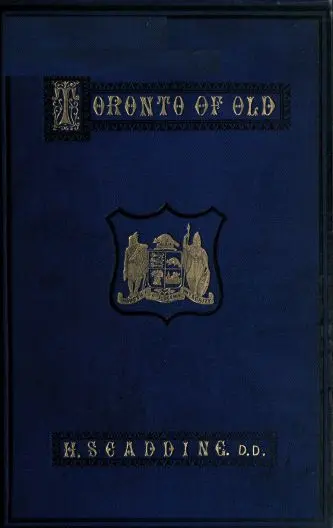
"Toronto of Old" by Henry Scadding is a historical account written in the late 19th century. The book focuses on the early settlement and social life of Toronto, Ontario, exploring the city's formative years and the memories attached to its original establishments, buildings, and notable events. It is an intricate blend of personal recollections, folklore, and early documentation that aims to bring alive the past of this vibrant city. The opening of the book sets the stage for a detailed exploration of Toronto's history, beginning with an introduction that discusses the origins of the city’s name and early French colonial references. Scadding reflects on his own connection to Toronto, hinting at the personal anecdotes and observations that will color his narrative. He outlines the structure and purpose of the work, emphasizing that while it won't serve as a formal history complete with statistics, it will provide detailed recollections of a bygone era, focusing on the evolution of Toronto through its streets and key figures. As he embarks on this historical journey, readers are invited to contemplate the early days of the city and the people who shaped its development, setting a somber yet nostalgic tone for the historical narrative that follows.
Introduction adapted from the source catalogue; source summaries may be automatically generated.
Free to read · English · 236,411 words · No account needed
MAKE TIME FOR A GOOD BOOK
On by default. Untick to stop anonymous reading totals. Each page counts after 10 seconds in view. How this works.
Anonymous counting is on unless you have switched it off.
The Bee, which conveyed Mr. Galt when on his voyage of exploration along the western coast of Lake Huron, was sold by public auction in 1832. In that year the first great reduction of the naval and military establishment at Penetanguishene took place. Step by step the process went on until the ancient depot was finally extinguished; and in 1859 the stone barracks were converted into a Public Reformatory.
The enumeration of the stores disposed of by public vendue, on Thursday, the 15th of March, 1830, and six following days, at Penetanguishene, will not be without pathos. At all events, those who have, at any time, made boats and the appurtenances of boats one of their hobbies, will not dislike to read the homely names of the articles then brought to the hammer.
(It will be observed that no mention is made of a certain memorable anchor laboriously dragged from York as far as the Landing en route to Penetanguishene, but taken no further, becoming, when half embedded in the earth there, an object of perpetual wonderment to beholders: a thing too ponderous to be conveniently handled and removed by an ordinary purchaser, let the amount paid for it be ever so trifling.)
The following, then, were the miscellaneous articles belonging to the Crown advertised to be sold to the highest bidder on the 15th and following days of March, 1832, at Penetanguishene, and so, we may conclude, disposed of accordingly:--The Tecumseh, schooner, 175 tons. The Newash, brigantine, 175 tons. The Bee, gunboat, 41 tons. The Mosquito, gunboat, 31 tons. The Wasp, gunboat, 41 tons. Batteaux, three in number. Thirty-two feet cutter. Two thirty-two feet gigs and their furniture. One whale boat One jolly boat. One nineteen feet gig. Twenty-two pounds old bunting. Canvas, mildewed slightly, 366 yards. Canvas, of all sorts, cut from frigate sails, 2170 yards. Old canvas, 491 yards. Packing cases, 23. Iron casks, 12. Iron bound casks, 8. Wood bound casks, 24. Chests, common, 2. Chests, top, 2. Cordage, worn, 988 fathoms. Cordage, in rounding, 318 fathoms. Cordage, in junk, 28 cwt. 20 lbs. Cordage, in paper stuff, 1 cwt. 3 qrs. 1 lb. Covers, hammock, 5. Iron, old wrought, 12 cwt. 3 qrs. 161/2 lbs. Rigging, brigantine, standing, complete, 1 set. Running, in part, 1 set. Rigging, schooner, standing and running, complete, 1 set. Rigging, Durham boats, standing and running, in part, 2 sets.--Rigging, boats, standing, worn, 1 set. Sails for a 32 gun ship, 1 set brigantine sails, 1 set schooner sails, 1 set Durham boat sails, 18 in number; boat sails 18 in number; unserviceable stores. Axes, felling, 8. Bellows, camp forge, 2 pairs. Blocks, single, 11 inch, 1. Blocks, double, 10 inch, 1. Brushes, tar, 15. Buckets, leather, 14. Chisels, of sorts, 12. Compass glasses, 1. Cordage, 552 fathoms. Glass, broken, 16 panes. Hammocks, 16. Locks, stock, 1. Mallet, caulking, 1. Oars, fir, 7. Paint, white, 1 qr. 2 lbs. Paint, yellow, 2 qrs. 18 lbs. Planes, 10 in number. Punts, boats, 1. Saws, crosscut, 5; Saws, hand, 6; Saws, dove-tail, 1; Saws, rip, 3. Spout for pump, 1. Sweeps, 4. Shovels, 9. Twine, fine, 31/2 lbs. Twine, ordinary, 171/4 lbs. Seines, 1.
Your reading position is saved on this browser. Take it to another device with a library code. Reading pages adapt to text, rather than matching a printed edition.
BEHIND THE BOOK
This eBook is for the use of anyone anywhere in the United States and most other parts of the world at no cost and with almost no restrictions whatsoever. You may copy it, give it away or re-use it under the terms of the Project Gutenberg License included with this eBook or online at www.gutenberg.org. If you are not located in the United States, you will have to check the laws of the country where you are located before using this eBook. Read the source licence.
The original source file, including credits and licence, is retained by this library. Request an original-format copy at no charge. Please include the book title and Project Gutenberg identifier #35225.
KEEP YOUR CURIOSITY GOING
Wilfrid Scawen Blunt
Wilfrid Scawen Blunt

E. W. (Edgar Watson) Howe
Cécile Tormay

Moritz Busch
John L. Ransom