THE CLASSIC COLLECTION✦My diaries, being a personal narrative of events 1888-1914, Part 2 (1900-1914)CLASSIC FREE BOOKS
My diaries, being a personal narrative of events 1888-1914, Part 2 (1900-1914)
Wilfrid Scawen Blunt
THE CLASSIC COLLECTION · 1873
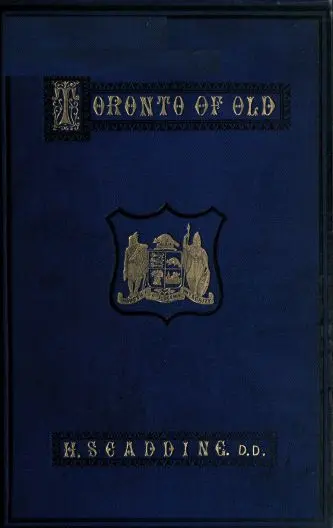
"Toronto of Old" by Henry Scadding is a historical account written in the late 19th century. The book focuses on the early settlement and social life of Toronto, Ontario, exploring the city's formative years and the memories attached to its original establishments, buildings, and notable events. It is an intricate blend of personal recollections, folklore, and early documentation that aims to bring alive the past of this vibrant city. The opening of the book sets the stage for a detailed exploration of Toronto's history, beginning with an introduction that discusses the origins of the city’s name and early French colonial references. Scadding reflects on his own connection to Toronto, hinting at the personal anecdotes and observations that will color his narrative. He outlines the structure and purpose of the work, emphasizing that while it won't serve as a formal history complete with statistics, it will provide detailed recollections of a bygone era, focusing on the evolution of Toronto through its streets and key figures. As he embarks on this historical journey, readers are invited to contemplate the early days of the city and the people who shaped its development, setting a somber yet nostalgic tone for the historical narrative that follows.
Introduction adapted from the source catalogue; source summaries may be automatically generated.
Free to read · English · 236,411 words · No account needed
MAKE TIME FOR A GOOD BOOK
On by default. Untick to stop anonymous reading totals. Each page counts after 10 seconds in view. How this works.
Anonymous counting is on unless you have switched it off.
In July, 1798, the following items appear against the names, conjointly of Messrs. Baby, Hamilton, and Commodore Grant:--Twenty-two dinners at Eight shillings, L8 16s. Sixteen to Coffee, L1 12s. Eight Suppers, 16s. Twenty-three quarts and one pint of wine, L10 11s. 6d. Eight bottles of porter, L2 8s. Two bottles of syrup-punch, L1 4s. One bottle of brandy and one bottle of rum, 18s. Altogether amounting to L26 5s. 6d. (The currency throughout Mr. Miles' books is that of New York, in which the shilling was seven pence half-penny. The total just given denoted between L16 and L17 of modern Canadian money. It is observable that in the entries of which we give specimens, whiskey, the deadly bane of later years, in not named.) On the 17th June, Thomas Ridout, Jonathan Scott, Col. Fortune, Surveyor Jones, Samuel Heron, Mr. Jarvis [the Secretary], Adjutant McGill, and Mr. Crawford are each charged 16s. as his quota of a "St. John's dinner." On the 4th of June, an entry against "the Chief Justice" [Elmsley], runs thus: Eighteen dinners at Eight shillings, L7 4s. Three bottles Madeira, L1 7s. One bottle brandy, 10s. Five bottles of port wine, four bottles of porter and one pint of rum are charged, but the value is not given. The defect is supplied in a later entry against the Chief Justice, of seven dinners (42s.); where two pints of port wine are charged 9s.; one pint of brandy, 5s.; two bottles port wine, 18s.; one bottle white wine, 9s.; one bottle of porter, 6s. On this occasion "four took coffee," at a cost of 8s. Elsewhere, three dinners are charged to the Chief Justice, when three bottles of wine were required; one pint of brandy, and two bottles of porter, all at the rates already quoted. A "mess dinner" is mentioned, for which the Chief Justice, Mr. Hallowell, and Mr. Cartwright pay 6s. each. One bottle of port, one of Madeira, and one of brandy were ordered, and the "three took coffee," as before at 2s. a head. Again, at a "mess dinner," of four, the names not given, two bottles of port and one bottle of porter were taken. A "club" appears to have met here. In July, 1798, a charge against the names of "Esq. Weekes," "Esq. Rogers," and Col. Fortune, respectively, is "liquor in club the 11th at dinner, 1s. 6d." On July 6th "Judge Powell" is charged for supper, 2s.; for one quart of wine, 9s. On the same day "Judge Powell's servant" had a "gill brandy, 1s. 3d. and one glass do., 8d." A few days afterwards, a reverend wayfarer calls at the inn; baits his beast, and modestly refreshes himself. The entry runs:--"Priest from River La Tranche, 3 quarts corn and half-pint of wine. Breakfast, 2s 6d." On another day, Capt. Herrick has a "gill gin sling, 1s. 3d.; also immediately afterwards a "half-pint of gin sling, 3s." At the same time Capt. Demont has "gill rum sling, 1s. 3d.," and "gill rum, 1s." Capt. Fortune has "half-pint wine, 2s.," and "Esq. Weekes," "gill brandy, 1s. 3d." Col. Fortune has "gill sour punch, 2s." This sour punch is approved of by "Dunlap"--who at one place four times in immediate succession, and frequently elsewhere, is charged with "glass sour punch, 2s." Jacob Cozens takes "one bottle Madeira wine, 10s.;" Samuel Cozens, "one bottle Madeira wine, 10s., and bread and cheese, 1s.;" and Shivers Cozens, "bottle of wine, 10s., and bread and cheese, 1s. Conets Cozens has "dinner, 2s., a gill of brandy, 1s., and half a bushel of seed corn, 7s." On the 5th of July, Josiah Phelps has placed opposite his name, "one glass punch, 3s.; three bowls sour punch, 9s.; gill rum, 1s.; two gin slings, 2s. 6d.; bowl punch, 3s.; gill rum, 1s.; two gills syrup punch, 4s.; supper, 2s." About the same time Corporal Wilson had "two mugs beer, 4s." On the 6th of July Commodore Grant had "half-pint rum, for medson, 2s.; and immediately after another half-pint rum, for do., 2s." One "Billy Whitney" figures often; his purchases one day were: "gill rum sling, 1s. 6d.; do., 1s. 6d.; half-pound butter, 1s. 3d." Capt. Hall takes "one gill punch, 2s.; glass rum, 6d., and half-gallon punch, 7s." He at the same time has two dollars in cash advanced to him by the obliging landlord, 16s.
Your reading position is saved on this browser. Take it to another device with a library code. Reading pages adapt to text, rather than matching a printed edition.
BEHIND THE BOOK
This eBook is for the use of anyone anywhere in the United States and most other parts of the world at no cost and with almost no restrictions whatsoever. You may copy it, give it away or re-use it under the terms of the Project Gutenberg License included with this eBook or online at www.gutenberg.org. If you are not located in the United States, you will have to check the laws of the country where you are located before using this eBook. Read the source licence.
The original source file, including credits and licence, is retained by this library. Request an original-format copy at no charge. Please include the book title and Project Gutenberg identifier #35225.
KEEP YOUR CURIOSITY GOING
Wilfrid Scawen Blunt
Wilfrid Scawen Blunt

E. W. (Edgar Watson) Howe
Cécile Tormay

Moritz Busch
John L. Ransom