THE CLASSIC COLLECTION✦My diaries, being a personal narrative of events 1888-1914, Part 2 (1900-1914)CLASSIC FREE BOOKS
My diaries, being a personal narrative of events 1888-1914, Part 2 (1900-1914)
Wilfrid Scawen Blunt
THE CLASSIC COLLECTION · 1873
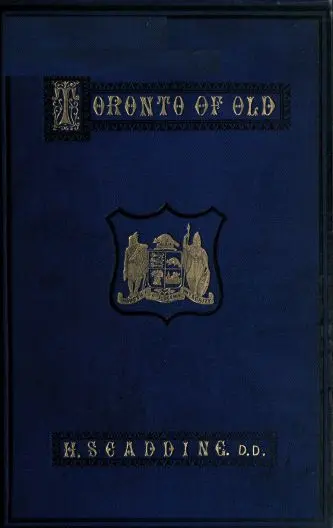
"Toronto of Old" by Henry Scadding is a historical account written in the late 19th century. The book focuses on the early settlement and social life of Toronto, Ontario, exploring the city's formative years and the memories attached to its original establishments, buildings, and notable events. It is an intricate blend of personal recollections, folklore, and early documentation that aims to bring alive the past of this vibrant city. The opening of the book sets the stage for a detailed exploration of Toronto's history, beginning with an introduction that discusses the origins of the city’s name and early French colonial references. Scadding reflects on his own connection to Toronto, hinting at the personal anecdotes and observations that will color his narrative. He outlines the structure and purpose of the work, emphasizing that while it won't serve as a formal history complete with statistics, it will provide detailed recollections of a bygone era, focusing on the evolution of Toronto through its streets and key figures. As he embarks on this historical journey, readers are invited to contemplate the early days of the city and the people who shaped its development, setting a somber yet nostalgic tone for the historical narrative that follows.
Introduction adapted from the source catalogue; source summaries may be automatically generated.
Free to read · English · 236,411 words · No account needed
MAKE TIME FOR A GOOD BOOK
On by default. Untick to stop anonymous reading totals. Each page counts after 10 seconds in view. How this works.
Anonymous counting is on unless you have switched it off.
And again, in winter, peculiarly fine pictures, characteristic of the season, are presented here when, after a plentiful fall of snow, the sleighs are on the move without number and in infinite variety; or when, on the contrary, each long white vista, east, west, north, and south, glistening, perhaps, under a clear December moon, is a scene almost wholly of still life--scarcely a man or beast abroad, so keen is the motionless air, the mercury having shrunk down some way below the zero-line of Fahrenheit.
But we must proceed. From the Lake to the Landing is a long journey.
In the course of our perambulations we have already noticed some instances in the town of long persistency in one place of business or residence. Such evidences of staidness and substantiality are common enough in the old world, but are of necessity somewhat rare amid the chances, changes, and exchanges of young communities on this continent. An additional instance we have to note here, at the intersection of King Street and Yonge Street. At its north-east angle, where, as in a former section we have observed, stood the sole building in this quarter, the house of Mr. John Dennis, for forty years at least has been seen with little alteration of external aspect, the Birmingham, Sheffield and Wolverhampton warehouse of the brothers Mr. Joseph Ridout and Mr. Percival Ridout. A little way to the north, too, on the east side, the name of Piper has been for an equal length of time associated uninterruptedly with a particular business; but here, though outward appearances have remained to some extent the same, death has wrought changes.
Near by, also, we see foundries still in operation where Messrs. W. B. Sheldon, F. R. Dutcher, W. A. Dutcher, Samuel Andrus, J. Vannorman and B. Vannorman, names familiar to all old inhabitants, were among the foremost in that kind of useful enterprise in York. Their advertisement, as showing the condition of one branch of the iron manufacture in York in 1832, will be of interest. Some of the articles enumerated have become old-fashioned. "They respectfully inform their friends and the public that they have lately made large additions to their establishments. They have enlarged their Furnace so as to enable them to make Castings of any size or weight used in this province, and erected Lathes for turning and finishing the same. They have also erected a Steam Engine of ten horse power, of their own manufacture, for propelling their machinery, which is now in complete operation, and they are prepared to build Steam Engines of any size, either high or low pressure. Having a number of experienced engineers employed, whose capability cannot be doubted, they hope to share the patronage of a generous public. They always keep constantly on hand and for sale, either by wholesale or retail, Bark Mills, Cooking, Franklin, Plate and Box Stoves, also, a general assortment of Hollow Ware, consisting of Kettles, from one to one hundred and twenty gallons; Bake-Ovens, Bake-Basins, Belly-Pots, High Pans, Tea Kettles, Wash-Kettles, Portable Furnaces, &c. Also are constantly manufacturing Mill-Gearing of all kinds; Sleigh Shoes, 50, 56, 30, 28, 15, 14, and 7 pound Weights, Clock and Sash Weights, Cranes, Andirons, Cart and Waggon Boxes, Clothiers' Plates, Plough Castings, and Ploughs of all kinds."
Your reading position is saved on this browser. Take it to another device with a library code. Reading pages adapt to text, rather than matching a printed edition.
BEHIND THE BOOK
This eBook is for the use of anyone anywhere in the United States and most other parts of the world at no cost and with almost no restrictions whatsoever. You may copy it, give it away or re-use it under the terms of the Project Gutenberg License included with this eBook or online at www.gutenberg.org. If you are not located in the United States, you will have to check the laws of the country where you are located before using this eBook. Read the source licence.
The original source file, including credits and licence, is retained by this library. Request an original-format copy at no charge. Please include the book title and Project Gutenberg identifier #35225.
KEEP YOUR CURIOSITY GOING
Wilfrid Scawen Blunt
Wilfrid Scawen Blunt

E. W. (Edgar Watson) Howe
Cécile Tormay

Moritz Busch
John L. Ransom