THE CLASSIC COLLECTION✦My diaries, being a personal narrative of events 1888-1914, Part 2 (1900-1914)CLASSIC FREE BOOKS
My diaries, being a personal narrative of events 1888-1914, Part 2 (1900-1914)
Wilfrid Scawen Blunt
THE CLASSIC COLLECTION · 1873
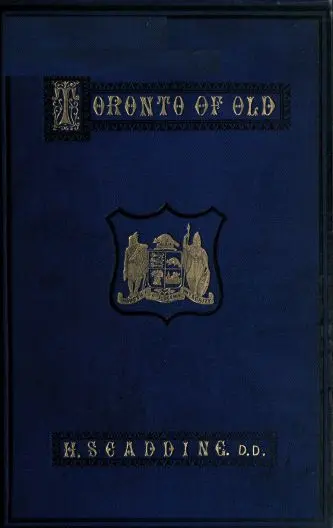
"Toronto of Old" by Henry Scadding is a historical account written in the late 19th century. The book focuses on the early settlement and social life of Toronto, Ontario, exploring the city's formative years and the memories attached to its original establishments, buildings, and notable events. It is an intricate blend of personal recollections, folklore, and early documentation that aims to bring alive the past of this vibrant city. The opening of the book sets the stage for a detailed exploration of Toronto's history, beginning with an introduction that discusses the origins of the city’s name and early French colonial references. Scadding reflects on his own connection to Toronto, hinting at the personal anecdotes and observations that will color his narrative. He outlines the structure and purpose of the work, emphasizing that while it won't serve as a formal history complete with statistics, it will provide detailed recollections of a bygone era, focusing on the evolution of Toronto through its streets and key figures. As he embarks on this historical journey, readers are invited to contemplate the early days of the city and the people who shaped its development, setting a somber yet nostalgic tone for the historical narrative that follows.
Introduction adapted from the source catalogue; source summaries may be automatically generated.
Free to read · English · 236,411 words · No account needed
MAKE TIME FOR A GOOD BOOK
On by default. Untick to stop anonymous reading totals. Each page counts after 10 seconds in view. How this works.
Anonymous counting is on unless you have switched it off.
The concourse of traffickers and idlers in the open space before the old Market Place were free of tongue; they sometimes talked, in no subdued tone, of their fellow-townsfolk of all ranks. In a small community every one was more or less acquainted with every one, with his dealings and appurtenances, with his man-servant and maid-servant, his horse, his dog, his waggon, cart or barrow.
Those of the primitive residentiaries, to whom the commonalty had taken kindly, were honoured in ordinary speech with their militia-titles of Colonel, Major, Captain, or the civilian prefix of Mister, Honourable Mister, Squire or Judge, as the case might be; whilst others, not held to have achieved any special claims to deference, were named, even in mature years, by their plain, baptismal names, John, Andrew, Duncan, George, and so on.
And then, there was a third marking-off of a few, against whom, for some vague reason or another, there had grown up in the popular mind a certain degree of prejudice. These, by a curtailment or national corruption of their proper prenomen, would be ordinarily styled Sandy this, Jock that. In some instances the epithet "old" would irreverently precede, and persons of considerable eminence might be heard spoken of as old Tom so-and-so, old Sam such-a-one.
And similarly in respect to the sons and nephews of these worthy gentlemen. Had the community never been replenished from outside sources, few of them would, to the latest moment of their lives, have ever been distinguished except by the plain John, Stephen, Allan, Christopher, and so on, of their infancy, or by the Bill, Harry, Alec, Mac, Dolph, Dick, or Bob, acquired in the nursery or school.
But enough has been said, for the present at least, on the humors and ways of our secondary characters, as exemplified in the crowd customarily gathered in front of the old Market at York. We shall now proceed on our prescribed route.
The lane leading northward from the north-west corner of Market Square used to be known as Stuart's Lane, from the Rev. George Okill Stuart, once owner of property here. On its west side was a well-known inn, the Farmers' Arms, kept by Mr. Bloor, who, on retiring from business, took up his abode at Yorkville, where it has curiously happened that his name has been attached to a fashionable street, the thoroughfare formerly known as the Concession Line.
Your reading position is saved on this browser. Take it to another device with a library code. Reading pages adapt to text, rather than matching a printed edition.
BEHIND THE BOOK
This eBook is for the use of anyone anywhere in the United States and most other parts of the world at no cost and with almost no restrictions whatsoever. You may copy it, give it away or re-use it under the terms of the Project Gutenberg License included with this eBook or online at www.gutenberg.org. If you are not located in the United States, you will have to check the laws of the country where you are located before using this eBook. Read the source licence.
The original source file, including credits and licence, is retained by this library. Request an original-format copy at no charge. Please include the book title and Project Gutenberg identifier #35225.
KEEP YOUR CURIOSITY GOING
Wilfrid Scawen Blunt
Wilfrid Scawen Blunt

E. W. (Edgar Watson) Howe
Cécile Tormay

Moritz Busch
John L. Ransom