THE CLASSIC COLLECTION✦My diaries, being a personal narrative of events 1888-1914, Part 2 (1900-1914)CLASSIC FREE BOOKS
My diaries, being a personal narrative of events 1888-1914, Part 2 (1900-1914)
Wilfrid Scawen Blunt
THE CLASSIC COLLECTION · 1873
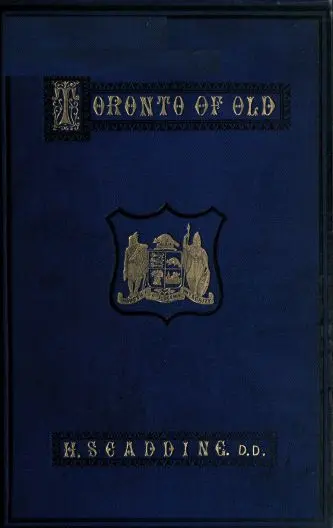
"Toronto of Old" by Henry Scadding is a historical account written in the late 19th century. The book focuses on the early settlement and social life of Toronto, Ontario, exploring the city's formative years and the memories attached to its original establishments, buildings, and notable events. It is an intricate blend of personal recollections, folklore, and early documentation that aims to bring alive the past of this vibrant city. The opening of the book sets the stage for a detailed exploration of Toronto's history, beginning with an introduction that discusses the origins of the city’s name and early French colonial references. Scadding reflects on his own connection to Toronto, hinting at the personal anecdotes and observations that will color his narrative. He outlines the structure and purpose of the work, emphasizing that while it won't serve as a formal history complete with statistics, it will provide detailed recollections of a bygone era, focusing on the evolution of Toronto through its streets and key figures. As he embarks on this historical journey, readers are invited to contemplate the early days of the city and the people who shaped its development, setting a somber yet nostalgic tone for the historical narrative that follows.
Introduction adapted from the source catalogue; source summaries may be automatically generated.
Free to read · English · 236,411 words · No account needed
MAKE TIME FOR A GOOD BOOK
On by default. Untick to stop anonymous reading totals. Each page counts after 10 seconds in view. How this works.
Anonymous counting is on unless you have switched it off.
Notwithstanding the greater glory of the school at Cornwall, (of which institution we may say, in passing, there is an engraving in the board-room of the Toronto Mechanics' Institute,) the lists of the school at York always presented a strong array of the old, well-known and even distinguished, Upper Canadian names. This will be seen by a perusal of the following document, which will also give an idea of the variety of matters to which attention was given in the school. The numerous family names which will at once be recognized, will require no comment.--The intervals between the calling up of each separate class for examination appear to have been very plentifully filled up with recitations and debates.
"Order of examination of the Home District Grammar School [at York]. Wednesday, 11th August, 1819. First Day. The Latin and Greek Classes. Euclid and Trigonometry. Thursday, 12th August. Second day. To commence at 10 o'clock. Prologue, by Robert Baldwin.--Reading Class.--George Strachan, The Excellence of the Bible. Thomas Ridout, The Man of Ross. James McDonell, Liberty and Slavery. St. George Baldwin, The Sword. William McMurray, Soliloquy on Sleep. Arithmetic Class--James Smith, The Sporting Clergyman. William Boulton, jun., The Poets New Year's Gift. Richard Oates, Ode to Apollo. Orville Cassell, The Rose. Book-keeping.--William Myers, My Mother. Francis Heward, My Father. George Dawson, Lapland.--First Grammar Class.--Second Grammar Class.--Debate on the Slave Trade. For the Abolition: Francis Ridout, John Fitzgerald, William Allan, George Boulton, Henry Heward, William Baldwin, John Ridout, John Doyle, James Strachan. Against the Abolition: Abraham Nelles, James Baby, James Doyle, Charles Heward, Allan McDonell, James Myers, Charles Ridout, William Boulton, Walker Smith.--First Geography Class.--Second Geography Class. James Dawson, The Boy that told Lies. James Bigelow, The Vagrant. Thomas Glassco, The Parish Workhouse. Edward Glennon, The Apothecary.--Natural History.--Debate by the Young Boys: Sir William Strickland, Charles Heward. Lord Morpeth, John Owens. Lord Hervey, John Ridout. Mr. Plomer, Raymond Baby. Sir William Yonge, John Fitzgerald. Sir William Windham, John Boulton. Mr. Henry Pelham, Henry Heward. Mr. Bernard, George Strachan. Mr. Noel, William Baldwin. Mr. Shippen, James Baby. Sir Robert Walpole, S. Givins and J. Doyle. Mr. Horace Walpole, James Myers. Mr. Pulteney, Charles Baby.--Civil History.--William Boulton, The Patriot. Francis Ridout, The Grave of Sir John Moore. Saltern Givins, Great Britain. John Boulton, Eulogy on Mr. Pitt. Warren Claus, The Indian Warrior. Charles Heward, The Soldier's Dream. William Boulton, The Heroes of Waterloo.--Catechism.--Debate on the College at Calcutta. Speakers: Mr. Canning, Robert Baldwin. Sir Francis Baring, John Doyle. Mr. Wainwright, Mark Burnham. Mr. Thornton, John Knott. Sir D. Scott, William Boulton. Lord Eldon, Warren Claus. Sir S. Lawrence, Allan Macaulay. Lord Hawkesbury, Abraham Nelles. Lord Bathurst, James McGill Strachan, Sir Thomas Metcalf, Walker Smith. Lord Teignmouth, Horace Ridout.--Religious Questions and Lectures.--James McGill Strachan, Anniversary of the York and Montreal Colleges anticipated for 1st January, 1822. Epilogue, by Horace Ridout."
Your reading position is saved on this browser. Take it to another device with a library code. Reading pages adapt to text, rather than matching a printed edition.
BEHIND THE BOOK
This eBook is for the use of anyone anywhere in the United States and most other parts of the world at no cost and with almost no restrictions whatsoever. You may copy it, give it away or re-use it under the terms of the Project Gutenberg License included with this eBook or online at www.gutenberg.org. If you are not located in the United States, you will have to check the laws of the country where you are located before using this eBook. Read the source licence.
The original source file, including credits and licence, is retained by this library. Request an original-format copy at no charge. Please include the book title and Project Gutenberg identifier #35225.
KEEP YOUR CURIOSITY GOING
Wilfrid Scawen Blunt
Wilfrid Scawen Blunt

E. W. (Edgar Watson) Howe
Cécile Tormay

Moritz Busch
John L. Ransom