THE CLASSIC COLLECTION✦Nigeria and its tin fieldsCLASSIC FREE BOOKS
Nigeria and its tin fields
Albert Frederick Calvert
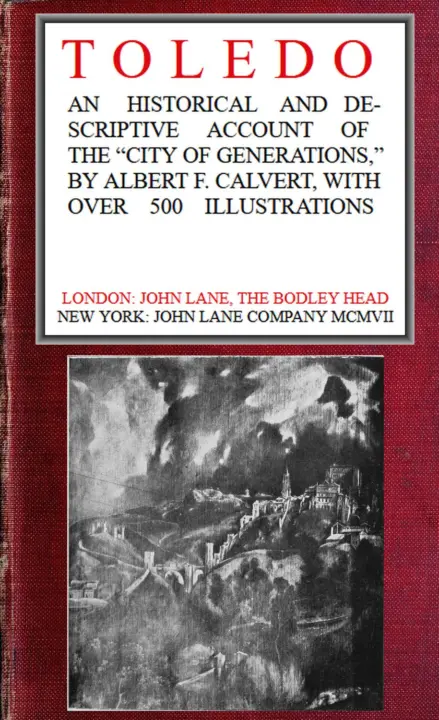
THE CLASSIC COLLECTION · 1907
"Toledo: An Historical and Descriptive Account of the 'City of Generations'" by Albert F. Calvert is a historical account written during the early 20th century. The work delves into the rich history of Toledo, exploring its significance through different eras, beginning with its origins and continuing through the Visigothic and Moorish periods. This volume aims to provide readers with a vivid understanding of Toledo’s architectural and cultural heritage through both detailed text and extensive illustrations. At the start of the book, the author presents Toledo as a city steeped in antiquity, likening it to an island in the sea of time. Calvert discusses the legends surrounding the city's foundation, highlighting its cultural intersections, particularly the role of the Jews in its early history. The narrative touches on the evolution of Toledo from a collection of temporary settlements to a significant urban center during the Roman era, and later as the capital of the Visigothic monarchy. Through rich descriptions, the opening portion sets the tone for a thorough examination of Toledo’s historical journey, reinforcing its status as a vital cultural landmark in Spain.
Introduction adapted from the source catalogue; source summaries may be automatically generated.
Free to read · English · 53,320 words · No account needed
MAKE TIME FOR A GOOD BOOK
On by default. Untick to stop anonymous reading totals. Each page counts after 10 seconds in view. How this works.
Anonymous counting is on unless you have switched it off.
The hospital contains some of El Greco’s most notable work, which will be noticed in the chapter on that master.
To Charles V. Toledo also owes the grand New Gate of Visagra, built in 1550, and restored in 1575. It consists of two separate structures, or gateways, enclosing a patio. On the exterior of the north gate is shown the double eagle with the Spanish arms and a Latin inscription--all in sculptured granite. On the inside is a fine statue of St. Eugenio, variously attributed to Berruguete and Monegro. The statues of Gothic kings, a life-sized angel with unsheathed sword, elegant capitals and balconies, combine to make this gateway one of the finest approaches possessed by any city in the world.
The Ayuntamiento, or town hall, of Toledo was erected in the time of Ferdinand and Isabel by the corregidor Gomez Manrique, and enlarged and restored between 1576 and 1618 by the corregidor Juan Tello, under the supervision of El Greco. The façade is composed of two storeys, the first consisting of nine arches with Doric columns which spring from massive pillars, the second of as many arches with Ionic columns. The edifice is surmounted by two towers, crowned with steeples and weather-vanes. On the fine staircase may be read in letters of gold on a blue ground this admonition to the civic dignitaries of Toledo:
Nobles, discretes varones,
Que gobernais á Toledo,
En aquellas escalones,
Desechad las aficiones,
Codicio temor, y miedo,
For los comunes provechos,
Dejad los particulares;
Pues vos fizo Dios pilares
De tan riquisimos techos,
Estad firmes y derechos.
The Summer Council Chamber is handsomely decorated with azulejos, and contains some battle pictures. The portraits of Carlos II. and his wife are the work of Carreño.
The celebrated Bridge of Alcantara, of which mention has so often been made in these pages, belongs indifferently to all the epochs of Toledo’s history, so no apology is needed for mentioning it here. “It constitutes to-day as in the past,” writes Amador de los Rios, “the principal entrance to the city, and, constructed very wisely on one of the narrowest parts of the river, it is formed of a great central arch of more than twenty-eight metres in breadth, resting on the right on a solid pile, often demolished, behind which is a smaller semicircular arch, which is, in turn, sustained by the bridge head, founded on the rock and pierced by a still smaller arch or passage, where several Visigothic remains have been discovered.” At the outer or country end of the historic bridge formerly stood a fortified tower, which was in 1787 replaced by the existing structure. This is in a pretentious style, and is decorated with various inscriptions, among them one commemorating the building by order of Philip V. The majestic hexagonal tower on the town side, with its picturesque turrets, dates probably from 1259. Above it is a statue of St. Ildefonso, by Berruguete. Over the archway are sculptured the badges of Ferdinand and Isabel (the yoke and bundle of arrows), commemorating the restoration of the tower, in 1489, by Gomez Manrique. A noble bridge is this of Alcantara; old--old as the city--the work of all Toledo’s rulers, and like Toledo, grim, stern, rude, destined, it would seem, to endure for ever. Romans, Visigoths, Moors and Castilians have lingered on it, triumphed on it, fled across it, fought upon it, and across it to-day must walk every traveller entering with reverence this great temple of the mediæval and bygone.
Your reading position is saved on this browser. Take it to another device with a library code. Reading pages adapt to text, rather than matching a printed edition.
Albert Frederick Calvert
Albert Frederick Calvert
Albert Frederick Calvert
Albert Frederick Calvert
BEHIND THE BOOK
This eBook is for the use of anyone anywhere in the United States and most other parts of the world at no cost and with almost no restrictions whatsoever. You may copy it, give it away or re-use it under the terms of the Project Gutenberg License included with this eBook or online at www.gutenberg.org. If you are not located in the United States, you will have to check the laws of the country where you are located before using this eBook. Read the source licence.
The original source file, including credits and licence, is retained by this library. Request an original-format copy at no charge. Please include the book title and Project Gutenberg identifier #64900.
KEEP YOUR CURIOSITY GOING
Wilfrid Scawen Blunt
Wilfrid Scawen Blunt

E. W. (Edgar Watson) Howe
Cécile Tormay

Moritz Busch
John L. Ransom