THE CLASSIC COLLECTION✦Nigeria and its tin fieldsCLASSIC FREE BOOKS
Nigeria and its tin fields
Albert Frederick Calvert
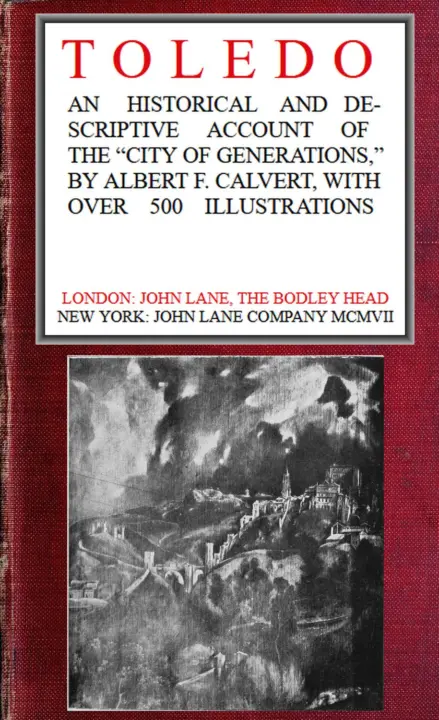
THE CLASSIC COLLECTION · 1907
"Toledo: An Historical and Descriptive Account of the 'City of Generations'" by Albert F. Calvert is a historical account written during the early 20th century. The work delves into the rich history of Toledo, exploring its significance through different eras, beginning with its origins and continuing through the Visigothic and Moorish periods. This volume aims to provide readers with a vivid understanding of Toledo’s architectural and cultural heritage through both detailed text and extensive illustrations. At the start of the book, the author presents Toledo as a city steeped in antiquity, likening it to an island in the sea of time. Calvert discusses the legends surrounding the city's foundation, highlighting its cultural intersections, particularly the role of the Jews in its early history. The narrative touches on the evolution of Toledo from a collection of temporary settlements to a significant urban center during the Roman era, and later as the capital of the Visigothic monarchy. Through rich descriptions, the opening portion sets the tone for a thorough examination of Toledo’s historical journey, reinforcing its status as a vital cultural landmark in Spain.
Introduction adapted from the source catalogue; source summaries may be automatically generated.
Free to read · English · 53,320 words · No account needed
MAKE TIME FOR A GOOD BOOK
On by default. Untick to stop anonymous reading totals. Each page counts after 10 seconds in view. How this works.
Anonymous counting is on unless you have switched it off.
In the south-west angle of the church is the interesting Mozárabic Chapel, built in 1504 by Enrique de Egas, under the orders of the famous Cardinal Ximenes de Cisneros. It is devoted to the celebration of Mass and the offices of the church according to the Mozárabic ritual, which till the middle of the last century was followed in six of the parish churches. The Cupola dates from 1626, and was the work of Jorge Manuel Theotocopuli. The porch is Gothic, and the reja in good Renaissance style, executed by Juan Frances in 1524. The frescoes, of no great value, painted by Juan de Borgoña, represent the expedition against Oran, in which the great Cardinal took part. Miss Hannah Lynch gives a vigorously worded account of a service in this chapel according to its peculiar rite: “The quaint old ritual may be heard every morning at 9 A.M., and will be found extremely puzzling to follow. The canons, in a sombre, flat monotone, chant responses to the officiating priest at the altar. The sound combines the enervating effect of the hum of wings, whirr of looms, wooden thud of pedals, the boom and rush of immense wings circling round and round. After the first stupefaction, I have never heard anything more calculated to produce headache, nervous irritation, or the contrary soporific effect. In summer, it must be terrible.”
At the opposite, or north-west, angle of the church is the Chapel of San Juan or of the Canons, so called because Mass can be celebrated here only by those dignitaries. It was built in 1537 by Covarrubias in the Renaissance style, and occupies the site of the old tower chapel, called the Quo Vadis. The ceiling is of artesonado, in gold and black, with carved flowers and figures. Since 1870 this chapel has been the repository of the Cathedral Treasure, styled Las Alhajas, or the Jewels. Here is kept the gorgeous custodia, or portable tabernacle, made by order of Cardinal Cisneros by Juan de Arfe, who began it in 1517 and completed it without assistance in 1524. This triumph of the silversmith’s craft is in the form of a Gothic temple, eight feet high, with all the architectural details, such as columns, arches, and vaultings, the whole resembling delicate lacework. Scenes from the life of our Saviour are illustrated in reliefs. There are no fewer than two hundred and sixty statues of various sizes, all exhibiting the same skill. The tabernacle was gilded over in 1595 by Valdivieso and Morino. The viril inside, in which the Host is exposed, was made of the first gold brought from America, is completely covered with precious stones, and weighs twenty-nine pounds. In the Treasure is also included the mantle of the Virgen del Sagrario, considered by Señor de Riaño the most remarkable specimen of embroidery that exists in Spain. It is described in the following manner: “It is made of twelve yards of cloth of silver, entirely covered with gold and precious stones. In the centre is an ornament of amethysts and diamonds. Eight other jewels appear on each side of enamelled gold, emeralds, and large rubies; a variety of other jewels are placed at intervals round the mantle, and at the lower part are the arms of Cardinal Sandoval [seventeenth century] enamelled on gold and studded with sapphires and rubies. The centre of this mantle is covered with flowers and pomegranates embroidered in seed-pearls of different sizes. Round the borders are rows of large pearls. Besides the gems which are employed in this superb work of art, no less than 257 ounces of pearls of different sizes, 300 ounces of gold thread, 160 ounces of small pieces of enamelled gold, and eight ounces of emeralds were used.” The beautiful dish, repoussé in silver, the designs on which represent the Rape of the Sabines and the Death of Darius, was believed to be the work of Benvenuto Cellini, but is now ascribed to the Flemish artist, Mathias Méline. Among the Alhajas are also four geographical globes, with large silver figures, gleaming with gems--eighteenth-century work. Of historical interest is the sword, said to have been worn by Alfonso VI. on his entry into Toledo, and the original letter written by St. Louis of France to the Chapter, bestowing sacred relics obtained from the Great Emperor: “Given at Etampes, the year of our Lord, 1248, month of May.” Other objects of value are the Cope of Cardinal Albornoz and the Cruz de la Manga, made in the sixteenth century by Gregorio de Varona, a native of the city. Here, also, are the archiepiscopal cross, planted by Cardinal Mendoza on the summit of the Alhambra in 1492, and the Golden Bible in three volumes, dating from the twelfth century. It is to be doubted if the accumulation of these splendid objects, intended for diverse practical uses, in one collection, serves to show any of them to the best advantage.
Your reading position is saved on this browser. Take it to another device with a library code. Reading pages adapt to text, rather than matching a printed edition.
Albert Frederick Calvert
Albert Frederick Calvert
Albert Frederick Calvert
Albert Frederick Calvert
BEHIND THE BOOK
This eBook is for the use of anyone anywhere in the United States and most other parts of the world at no cost and with almost no restrictions whatsoever. You may copy it, give it away or re-use it under the terms of the Project Gutenberg License included with this eBook or online at www.gutenberg.org. If you are not located in the United States, you will have to check the laws of the country where you are located before using this eBook. Read the source licence.
The original source file, including credits and licence, is retained by this library. Request an original-format copy at no charge. Please include the book title and Project Gutenberg identifier #64900.
KEEP YOUR CURIOSITY GOING
Wilfrid Scawen Blunt
Wilfrid Scawen Blunt

E. W. (Edgar Watson) Howe
Cécile Tormay

Moritz Busch
John L. Ransom