THE CLASSIC COLLECTION✦Allan RamsayCLASSIC FREE BOOKS
Allan Ramsay
William Henry Oliphant Smeaton
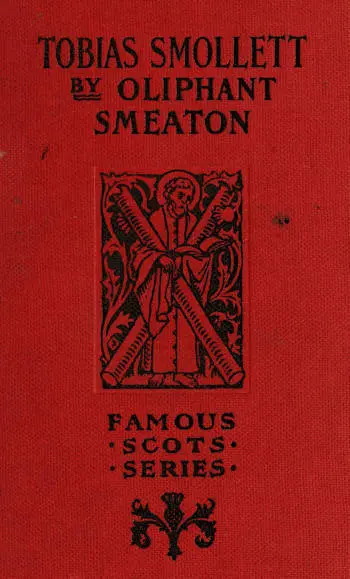
THE CLASSIC COLLECTION · 1897
"Tobias Smollett" by William Henry Oliphant Smeaton is a biographical account written in the early 20th century. The book explores the life and achievements of Tobias George Smollett, a prominent 18th-century Scottish novelist and critic. It likely chronicles Smollett’s formative years, including his education and early literary influences, as well as his later works and contributions to English literature. The opening of the book delves into Smollett's background, emphasizing his birth, family history, and early education. The narrative illustrates the challenges he faced in his upbringing, including his father's struggles and his mother’s efforts to provide for him following his father’s death. Smollett's educational journey is highlighted, noting his early schooling and influential teachers, which ultimately fostered his literary ambitions. It sets the stage for his career as a novelist and critic, foreshadowing his significant role in the development of the English novel.
Introduction adapted from the source catalogue; source summaries may be automatically generated.
Free to read · English · 43,582 words · No account needed
MAKE TIME FOR A GOOD BOOK
On by default. Untick to stop anonymous reading totals. Each page counts after 10 seconds in view. How this works.
Anonymous counting is on unless you have switched it off.
Viewing his novels as a whole,—Roderick Random, Peregrine Pickle, Ferdinand Count Fathom, Launcelot Greaves, The Adventures of an Atom, and Humphrey Clinker,—the first quality which strikes a critical reader is the family likeness existing between all the leading characters. Dissimilar though Roderick Random and Ferdinand Count Fathom may be in their impulses toward evil, distinct though Peregrine Pickle is from Launcelot Greaves, Matthew Bramble, and Lismahago in what may be termed his nobler qualities, there is nevertheless in all that happy–go–lucky carelessness, that supreme indifference to consequences, that courage that never flinches from the penalties of its own misdeeds, but accepts them without a murmur—in a word, a bonhomie diversified by egotism, that appears in equal measure in no other novelist of his time. Richardson displays that sentimental, melodramatic, watery ‘gush’ which the taste of last century denominated pathos—the sort of thing Dickens long after described in the phrase ‘drawing tears from his eyes and a handkerchief from his pocket’; but of that quality there is not the faintest trace in Smollett. If anything, his characters are too callous, too fond of the rough–and–tumble Tom–and–Jerry life in which their creator so perceptibly revelled. Fielding, on the other hand, patiently elaborates his characters, adding here a line and there a curve, heightening the light in one place, deepening the shading in another, never picturing an incident or a trait without some definite end to be served in perfecting the final portrait. Smollett never takes time for such microscopic character studies. He is a veritable pen–and–ink draughtsman. With bold, rapid, vigorous strokes, he sketches, through the agency of incident, the outlines of his characters, filling in these outlines with but few subsidiary details regarding the feelings and moral impulses of his creations. For such he has neither the time nor the space. Let any reader lift the conceptions of Roderick Random, or Peregrine Pickle, or Matthew Bramble out of the setting of the story and study them apart, paying no heed to anything affecting the other personages, and he will see at once how completely Smollett relied on incident to do the work of explaining and analysing the feelings of his heroes. Fielding was the greater artist, Smollett the better story–teller; Fielding was the greater moral teacher, Smollett the more vigorous painter of contemporary manners. Further, let the reader carefully study Lovelace in Richardson’s Clarissa Harlowe, Blifil in Fielding’s novel of Tom Jones, and Smollett’s Ferdinand Count Fathom, and he will perceive in even a stronger degree the diverse method of the three great novelists. Richardson builds up what might be called the ‘architectonic’ of the creation by a series of great scenes wherein dialogue plays the greatest part. Lovelace has all the light–hearted villainy of a man to whom virtue is a myth, who has no conscience, and whose standard of right is his gross animal devilishness. Richardson does everything by square and rule. He expends at the outset a wealth of ingenuity in portraying the most insignificant qualities of Lovelace’s nature. And so fully does he make us acquainted with his nature, that at the end of the novel we know in reality very little more of him than we did at the outset. Fielding, on the other hand, winds his way into the very heart of a character, ‘like a serpent round its prey,’ as Goldsmith said of Burke’s treatment of a subject in conversation. Every chapter gives us some addition to the creation, even to the very close of the novel. But when that is reached, the great synthesis is complete. Not a trait is lacking, and Master Blifil stands pilloried to all time as the type of everything that is contemptible and deceitful. Not so Smollett. In the case of Ferdinand Count Fathom the initial description of the character is reduced to a minimum. Everything is left to the effect produced by incident. All Fathom’s pitilessness, his absolute love of vice for its own sake, his colossal selfishness, are in reality merely suggested to the reader’s own mind, by the thread of rapidly succeeding incident, not formally labelled as such. In the case of both Richardson and Fielding the author is constantly present in his creation. So with Smollett, he is ever in evidence. None of them attain that superb art of Walter Scott, who simply effaces himself in his creations, or, as Hazlitt says: ‘He sits like a magician in his cell and conjures up all shapes and sights to the view; but in the midst of all this phantasmagoria the author himself never appears to take part with his characters. It is the perfection of art to conceal art, and this is here done so completely, that, while it adds to our pleasure in the work, it seems to take away from the merit of the author. As he does not thrust himself into the foreground, he loses the credit of the performance.’
Your reading position is saved on this browser. Take it to another device with a library code. Reading pages adapt to text, rather than matching a printed edition.
William Henry Oliphant Smeaton
BEHIND THE BOOK
This eBook is for the use of anyone anywhere in the United States and most other parts of the world at no cost and with almost no restrictions whatsoever. You may copy it, give it away or re-use it under the terms of the Project Gutenberg License included with this eBook or online at www.gutenberg.org. If you are not located in the United States, you will have to check the laws of the country where you are located before using this eBook. Read the source licence.
The original source file, including credits and licence, is retained by this library. Request an original-format copy at no charge. Please include the book title and Project Gutenberg identifier #47306.
KEEP YOUR CURIOSITY GOING
John L. Ransom

Herman W. Mudgett

Harriet Monroe
Daniel Dulany Addison
Charles Lanman

Harold Rosher