THE CLASSIC COLLECTION✦Creative EvolutionCLASSIC FREE BOOKS
Creative Evolution
Henri Bergson
THE CLASSIC COLLECTION · 1900
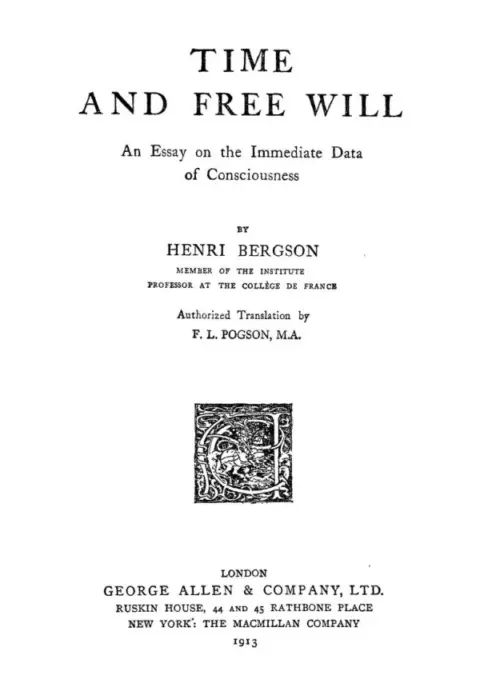
"Time and Free Will: An Essay on the Immediate Data of Consciousness" by Henri Bergson is a philosophical work written during the late 19th century. In this essay, Bergson explores the nature of time, consciousness, and the concept of free will, arguing against traditional deterministic views by emphasizing the importance of real duration and qualitative experiences. The opening of the text sets the stage for Bergson's exploration of the intensity of conscious states, questioning how we perceive and measure qualities such as emotions and sensations. He challenges the notion that these qualitative experiences can be quantified like physical magnitudes, advocating instead for an understanding of consciousness as a complex, interconnected flow of experiences. This critical examination of sensory intensity is just the beginning of Bergson's deeper inquiry into the relationship between consciousness and free will, preparing the reader for a philosophical journey that blends empirical observations with intuitive understanding.
Introduction adapted from the source catalogue; source summaries may be automatically generated.
Free to read · English · 66,044 words · No account needed
MAKE TIME FOR A GOOD BOOK
On by default. Untick to stop anonymous reading totals. Each page counts after 10 seconds in view. How this works.
Anonymous counting is on unless you have switched it off.
But we must own that the amount of freedom which is left to us after strictly complying with the principle of the conservation of energy is rather limited. For, even if this law does not exert a necessitating influence over the course of our ideas, it will at least determine our movements. Our inner life will still depend upon ourselves up to a certain point; but, to an outside observer, there will be nothing to distinguish our activity from absolute automatism. We are thus led to inquire whether the very extension of the principle of the conservation of energy to all the bodies in nature does not itself involve some psychological theory, and whether the scientist who did not possess a priori any prejudice against human freedom would think of setting up this principle as a universal law.
[Sidenote: It implies that a system can return to its original state. Neglects duration, hence inapplicable to living beings and conscious states.]
We must not overrate the part played by the principle of the conservation of energy in the history of the natural sciences. In its present form it marks a certain phase in the evolution of certain sciences; but it has not been the governing factor in this evolution and we should be wrong in making it the indispensable postulate of all scientific research. Certainly, every mathematical operation which we carry out on a given quantity implies the permanence of this quantity throughout the course of the operation, in whatever way we may split it up. In other words, what is given is given, what is not given is not given, and in whatever order we add up the same terms we shall get the same result. Science will for ever remain subject to this law, which is nothing but the law of non-contradiction; but this law does not involve any special hypothesis as to the nature of what we ought to take as given, or what will remain constant. No doubt it informs us that something cannot come from nothing; but experience alone will tell us which aspects or functions of reality must count for something, and which for nothing, from the point of view of positive science. In short, in order to foresee the state of a determinate system at a determinate moment, it is absolutely necessary that something should persist as a constant quantity throughout a series of combinations; but it belongs to experience to decide as to the nature of this something, and especially to let us know whether it is found in all possible systems, whether, in other words, all possible systems lend themselves to our calculations. It is not certain that all the physicists before Leibniz believed, like Descartes, in the conservation of a fixed quantity of motion in the universe: were their discoveries less valuable on this account or their researches less successful? Even when Leibniz had substituted for this principle that of the conservation of vis viva, it was not possible to regard the law as quite general, since it admitted of an obvious exception in the case of the direct impact of two inelastic bodies. Thus science has done for a very long time without a universal conservative principle. In its present form, and since the development of the mechanical theory of heat, the principle of the conservation of energy certainly seems to apply to the whole range of physico-chemical phenomena. But no one can tell whether the study of physiological phenomena in general, and of nervous phenomena in particular, will not reveal to us, besides the vis viva or kinetic energy of which Leibniz spoke, and the potential energy which was a later and necessary adjunct, some new kind of energy which may differ from the other two by rebelling against calculation. Physical science would not thereby lose any of its exactitude or geometrical rigour, as has lately been asserted: only it would be realized that conservative systems are not the only systems possible, and even, perhaps, that in the whole of concrete reality each of these systems plays the same part as the chemist's atom in bodies and their combinations. Let us note that the most radical of mechanical theories is that which makes consciousness an epiphenomenon which, in given circumstances, may supervene on certain molecular movements. But, if molecular movement can create sensation out of a zero of consciousness, why should not consciousness in its turn create movement either out of a zero of kinetic and potential energy, or by making use of this energy in its own way? Let us also note that the law of the conservation of energy can only be intelligibly applied to a system of which the points, after moving, can return to their former positions. This return is at least conceived of as possible, and it is supposed that under these conditions nothing would be changed in the original state of the system as a whole or of its elements. In short, time cannot bite into it; and the instinctive, though vague, belief of mankind in the conservation of a fixed quantity of matter, a fixed quantity of energy, perhaps has its root in the very fact that inert matter does not seem to endure or to preserve any trace of past time. But this is not the case in the realm of life. Here duration certainly seems to act like a cause, and the idea of putting things back in their place at the end of a certain time involves a kind of absurdity, since such a turning backwards has never been accomplished in the case of a living being. But let us admit that the absurdity is a mere appearance, and that the impossibility for living beings to come back to the past is simply owing to the fact that the physico-chemical phenomena which take place in living bodies, being infinitely complex, have no chance of ever occurring again all at the same time: at least it will be granted to us that the hypothesis of a turning backwards is almost meaningless in the sphere of conscious states. A sensation, by the mere fact of being prolonged, is altered to the point of becoming unbearable. The same does not here remain the same, but is reinforced and swollen by the whole of its past. In short, while the material point, as mechanics understands it, remains in an eternal present, the past is a reality perhaps for living bodies, and certainly for conscious beings. While past time is neither a gain nor a loss for a system assumed to be conservative, it may be a gain for the living being, and it is indisputably one for the conscious being. Such being the case, is there not much to be said for the hypothesis of a conscious force or free will, which, subject to the action of time and storing up duration, may thereby escape the law of the conservation of energy?
Your reading position is saved on this browser. Take it to another device with a library code. Reading pages adapt to text, rather than matching a printed edition.
Henri Bergson
Henri Bergson
Henri Bergson
BEHIND THE BOOK
This eBook is for the use of anyone anywhere in the United States and most other parts of the world at no cost and with almost no restrictions whatsoever. You may copy it, give it away or re-use it under the terms of the Project Gutenberg License included with this eBook or online at www.gutenberg.org. If you are not located in the United States, you will have to check the laws of the country where you are located before using this eBook. Read the source licence.
The original source file, including credits and licence, is retained by this library. Request an original-format copy at no charge. Please include the book title and Project Gutenberg identifier #56852.
KEEP YOUR CURIOSITY GOING

David Patterson (Spirit) Hatch
Coulson Kernahan

Ralph Waldo Emerson
Frances Wright

Edwin Abbott Abbott

Joseph Droz