THE CLASSIC COLLECTION✦Creative EvolutionCLASSIC FREE BOOKS
Creative Evolution
Henri Bergson
THE CLASSIC COLLECTION · 1900
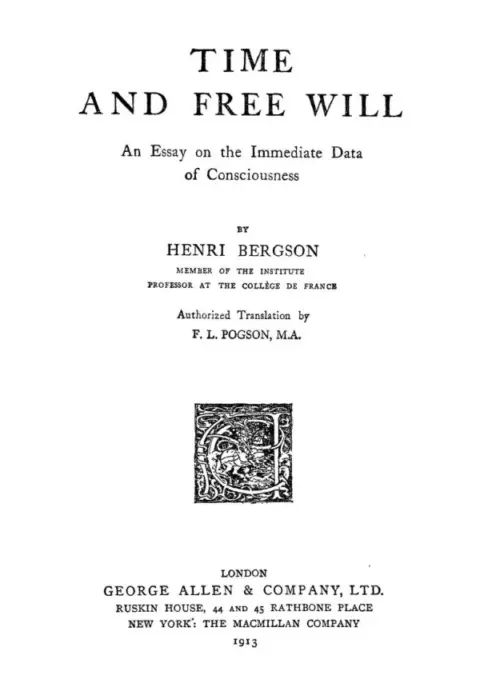
"Time and Free Will: An Essay on the Immediate Data of Consciousness" by Henri Bergson is a philosophical work written during the late 19th century. In this essay, Bergson explores the nature of time, consciousness, and the concept of free will, arguing against traditional deterministic views by emphasizing the importance of real duration and qualitative experiences. The opening of the text sets the stage for Bergson's exploration of the intensity of conscious states, questioning how we perceive and measure qualities such as emotions and sensations. He challenges the notion that these qualitative experiences can be quantified like physical magnitudes, advocating instead for an understanding of consciousness as a complex, interconnected flow of experiences. This critical examination of sensory intensity is just the beginning of Bergson's deeper inquiry into the relationship between consciousness and free will, preparing the reader for a philosophical journey that blends empirical observations with intuitive understanding.
Introduction adapted from the source catalogue; source summaries may be automatically generated.
Free to read · English · 66,044 words · No account needed
MAKE TIME FOR A GOOD BOOK
On by default. Untick to stop anonymous reading totals. Each page counts after 10 seconds in view. How this works.
Anonymous counting is on unless you have switched it off.
It follows from this analysis that space alone is homogeneous, that objects in space form a discrete multiplicity, and that every discrete multiplicity is got by a process of unfolding in space. It also follows that there is neither duration nor even succession in space, if we give to these words the meaning in which consciousness takes them: each of the so-called successive states of the external world exists alone; their multiplicity is real only for a consciousness that can first retain them and then set them side by side by externalizing them in relation to one another. If it retains them, it is because these distinct states of the external world give rise to states of consciousness which permeate one another, imperceptibly organize themselves into a whole, and bind the past to the present by this very process of connexion. If it externalizes them in relation to one another, the reason is that, thinking of their radical distinctness (the one having ceased to be when the other appears on the scene), it perceives them under the form of a discrete multiplicity, which amounts to setting them out in line, in the space in which each of them existed separately. The space employed for this purpose is just that which is called homogeneous time.
[Sidenote: Two kinds of multiplicity: two senses of the word "distinguish," the one qualitative and the other quantitative.]
But another conclusion results from this analysis, namely, that the multiplicity of conscious states, regarded in its original purity, is not at all like the discrete multiplicity which goes to form a number. In such a case there is, as we said, a qualitative multiplicity. In short, we must admit two kinds of multiplicity, two possible senses of the word "distinguish," two conceptions, the one qualitative and the other quantitative, of the difference between same and other. Sometimes this multiplicity, this distinctness, this heterogeneity contains number only potentially, as Aristotle would have said. Consciousness, then, makes a qualitative discrimination without any further thought of counting the qualities or even of distinguishing them as several. In such a case we have multiplicity without quantity. Sometimes, on the other hand, it is a question of a multiplicity of terms which are counted or which are conceived as capable of being counted; but we think then of the possibility of externalizing them in relation to one another, we set them out in space. Unfortunately, we are so accustomed to illustrate one of these two meanings of the same word by the other, and even to perceive the one in the other, that we find it extraordinarily difficult to distinguish between them or at least to express this distinction in words. Thus I said that several conscious states are organized into a whole, permeate one another, gradually gain a richer content, and might thus give any one ignorant of space the feeling of pure duration; but the very use of the word "several" shows that I had already isolated these states, externalized them in relation to one another, and, in a word, set them side by side; thus, by the very language which I was compelled to use, I betrayed the deeply ingrained habit of setting out time in space. From this spatial setting out, already accomplished, we are compelled to borrow the terms which we use to describe the state of a mind which has not yet accomplished it: these terms are thus misleading from the very beginning, and the idea of a multiplicity without relation to number or space, although clear for pure reflective thought, cannot be translated into the language of common sense. And yet we cannot even form the idea of discrete multiplicity without considering at the same time a qualitative multiplicity. When we explicitly count units by stringing them along a spatial line, is it not the case that, alongside this addition of identical terms standing out from a homogeneous background, an organization of these units is going on in the depths of the soul, a wholly dynamic process, not unlike the purely qualitative way in which an anvil, if it could feel, would realize a series of blows from a hammer? In this sense we might almost say that the numbers in daily use have each their emotional equivalent. Tradesmen are well aware of it, and instead of indicating the price of an object by a round number of shillings, they will mark the next smaller number, leaving themselves to insert afterwards a sufficient number of pence and farthings. In a word, the process by which we count units and make them into a discrete multiplicity has two sides; on the one hand we assume that they are identical, which is conceivable only on condition that these units are ranged alongside each other in a homogeneous medium; but on the other hand the third unit, for example, when added to the other two, alters the nature, the appearance and, as it were, the rhythm of the whole; without this interpenetration and this, so to speak, qualitative progress, no addition would be possible. Hence it is through the quality of quantity that we form the idea of quantity without quality.
Your reading position is saved on this browser. Take it to another device with a library code. Reading pages adapt to text, rather than matching a printed edition.
Henri Bergson
Henri Bergson
Henri Bergson
BEHIND THE BOOK
This eBook is for the use of anyone anywhere in the United States and most other parts of the world at no cost and with almost no restrictions whatsoever. You may copy it, give it away or re-use it under the terms of the Project Gutenberg License included with this eBook or online at www.gutenberg.org. If you are not located in the United States, you will have to check the laws of the country where you are located before using this eBook. Read the source licence.
The original source file, including credits and licence, is retained by this library. Request an original-format copy at no charge. Please include the book title and Project Gutenberg identifier #56852.
KEEP YOUR CURIOSITY GOING

David Patterson (Spirit) Hatch
Coulson Kernahan

Ralph Waldo Emerson
Frances Wright

Edwin Abbott Abbott

Joseph Droz