THE CLASSIC COLLECTION✦Creative EvolutionCLASSIC FREE BOOKS
Creative Evolution
Henri Bergson
THE CLASSIC COLLECTION · 1900
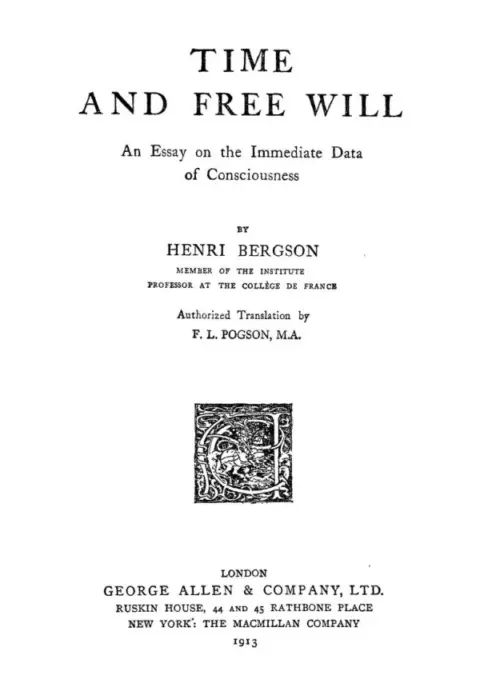
"Time and Free Will: An Essay on the Immediate Data of Consciousness" by Henri Bergson is a philosophical work written during the late 19th century. In this essay, Bergson explores the nature of time, consciousness, and the concept of free will, arguing against traditional deterministic views by emphasizing the importance of real duration and qualitative experiences. The opening of the text sets the stage for Bergson's exploration of the intensity of conscious states, questioning how we perceive and measure qualities such as emotions and sensations. He challenges the notion that these qualitative experiences can be quantified like physical magnitudes, advocating instead for an understanding of consciousness as a complex, interconnected flow of experiences. This critical examination of sensory intensity is just the beginning of Bergson's deeper inquiry into the relationship between consciousness and free will, preparing the reader for a philosophical journey that blends empirical observations with intuitive understanding.
Introduction adapted from the source catalogue; source summaries may be automatically generated.
Free to read · English · 66,044 words · No account needed
MAKE TIME FOR A GOOD BOOK
On by default. Untick to stop anonymous reading totals. Each page counts after 10 seconds in view. How this works.
Anonymous counting is on unless you have switched it off.
[Sidenote: Time, as dealt with by the astronomer and the physicist, does indeed seem to be measurable and therefore homogeneous.]
But we find it extraordinarily difficult to think of duration in its original purity; this is due, no doubt, to the fact that we do not endure alone, external objects, it seems, endure as we do, and time, regarded from this point of view, has every appearance of a homogeneous medium. Not only do the moments of this duration seem to be external to one another, like bodies in space, but the movement perceived by our senses is the, so to speak, palpable sign of a homogeneous and measurable duration. Nay more, time enters into the formulae of mechanics, into the calculations of the astronomer, and even of the physicist, under the form of a quantity. We measure the velocity of a movement, implying that time itself is a magnitude. Indeed, the analysis which we have just attempted requires to be completed, for if duration properly so-called cannot be measured, what is it that is measured by the oscillations of the pendulum? Granted that inner duration, perceived by consciousness, is nothing else but the melting of states of consciousness into one another, and the gradual growth of the ego, it will be said, notwithstanding, that the time which the astronomer introduces into his formulae, the time which our clocks divide into equal portions, this time, at least, is something different: it must be a measurable and therefore homogeneous magnitude.--It is nothing of the sort, however, and a close examination will dispel this last illusion.
[Sidenote: But what we call measuring time is nothing but counting simultaneities. The clock taken as an illustration.]
When I follow with my eyes on the dial of a clock the movement of the hand which corresponds to the oscillations of the pendulum, I do not measure duration, as seems to be thought; I merely count simultaneities, which is very different. Outside of me, in space, there is never more than a single position of the hand and the pendulum, for nothing is left of the past positions. Within myself a process of organization or interpenetration of conscious states is going on, which constitutes true duration. It is because I endure in this way that I picture to myself what I call the past oscillations of the pendulum at the same time as I perceive the present oscillation. Now, let us withdraw for a moment the ego which thinks these so-called successive oscillations: there will never be more than a single oscillation, and indeed only a single position, of the pendulum, and hence no duration. Withdraw, on the other hand, the pendulum and its oscillations; there will no longer be anything but the heterogeneous duration of the ego, without moments external to one another, without relation to number. Thus, within our ego, there is succession without mutual externality; outside the ego, in pure space, mutual externality without succession: mutual externality, since the present oscillation is radically distinct from the previous oscillation, which no longer exists; but no succession, since succession exists solely for a conscious spectator who keeps the past in mind and sets the two oscillations or their symbols side by side in an auxiliary space. Now, between this succession without externality and this externality without succession, a kind of exchange takes place, very similar to what physicists call the phenomenon of endosmosis. As the successive phases of our conscious life, although interpenetrating, correspond individually to an oscillation of the pendulum which occurs at the same time, and as, moreover, these oscillations are sharply distinguished from one another, we get into the habit of setting up the same distinction between the successive moments of our conscious life: the oscillations of the pendulum break it up, so to speak, into parts external to one another: hence the mistaken idea of a homogeneous inner duration, similar to space, the moments of which are identical and follow, without penetrating, one another. But, on the other hand, the oscillations of the pendulum, which are distinct only because one has disappeared when the other appears on the scene, profit, as it were, from the influence which they have thus exercised over our conscious life. Owing to the fact that our consciousness has organized them as a whole in memory, they are first preserved and afterwards disposed in a series: in a word, we create for them a fourth dimension of space, which we call homogeneous time, and which enables the movement of the pendulum, although taking place at one spot, to be continually set in juxtaposition to itself. Now, if we try to determine the exact part played by the real and the imaginary in this very complex process, this is what we find. There is a real space, without duration, in which phenomena appear and disappear simultaneously with our states of consciousness. There is a real duration, the heterogeneous moments of which permeate one another; each moment, however, can be brought into relation with a state of the external world which is contemporaneous with it, and can be separated from the other moments in consequence of this very process. The comparison of these two realities gives rise to a symbolical representation of duration, derived from space. Duration thus assumes the illusory form of a homogeneous medium, and the connecting link between these two terms, space and duration, is simultaneity, which might be defined as the intersection of time and space.
Your reading position is saved on this browser. Take it to another device with a library code. Reading pages adapt to text, rather than matching a printed edition.
Henri Bergson
Henri Bergson
Henri Bergson
BEHIND THE BOOK
This eBook is for the use of anyone anywhere in the United States and most other parts of the world at no cost and with almost no restrictions whatsoever. You may copy it, give it away or re-use it under the terms of the Project Gutenberg License included with this eBook or online at www.gutenberg.org. If you are not located in the United States, you will have to check the laws of the country where you are located before using this eBook. Read the source licence.
The original source file, including credits and licence, is retained by this library. Request an original-format copy at no charge. Please include the book title and Project Gutenberg identifier #56852.
KEEP YOUR CURIOSITY GOING

David Patterson (Spirit) Hatch
Coulson Kernahan

Ralph Waldo Emerson
Frances Wright

Edwin Abbott Abbott

Joseph Droz