THE CLASSIC COLLECTION✦Creative EvolutionCLASSIC FREE BOOKS
Creative Evolution
Henri Bergson
THE CLASSIC COLLECTION · 1900
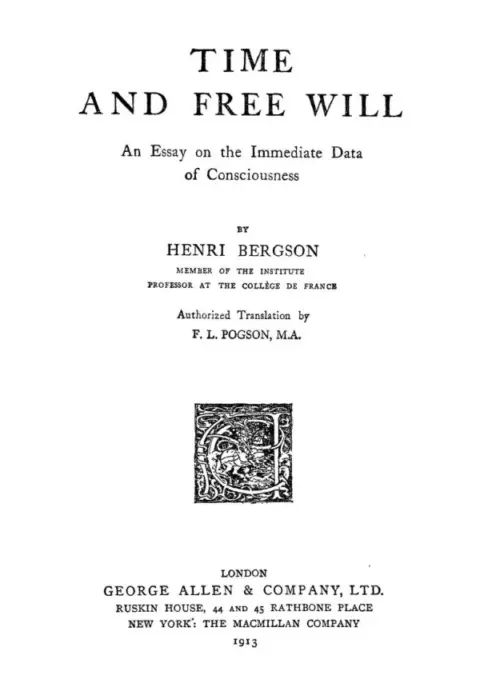
"Time and Free Will: An Essay on the Immediate Data of Consciousness" by Henri Bergson is a philosophical work written during the late 19th century. In this essay, Bergson explores the nature of time, consciousness, and the concept of free will, arguing against traditional deterministic views by emphasizing the importance of real duration and qualitative experiences. The opening of the text sets the stage for Bergson's exploration of the intensity of conscious states, questioning how we perceive and measure qualities such as emotions and sensations. He challenges the notion that these qualitative experiences can be quantified like physical magnitudes, advocating instead for an understanding of consciousness as a complex, interconnected flow of experiences. This critical examination of sensory intensity is just the beginning of Bergson's deeper inquiry into the relationship between consciousness and free will, preparing the reader for a philosophical journey that blends empirical observations with intuitive understanding.
Introduction adapted from the source catalogue; source summaries may be automatically generated.
Free to read · English · 66,044 words · No account needed
MAKE TIME FOR A GOOD BOOK
On by default. Untick to stop anonymous reading totals. Each page counts after 10 seconds in view. How this works.
Anonymous counting is on unless you have switched it off.
The English school tries, in fact, to reduce relations of extensity to more or less complex relations of succession in time. When, with our eyes shut, we run our hands along a surface, the rubbing of our fingers against the surface, and especially the varied play of our joints, provide a series of sensations, which differ only by their qualities and which exhibit a certain order in time. Moreover, experience teaches us that this series can be reversed, that we can, by an effort of a different kind (or, as we shall call it later, in an opposite direction), obtain the same sensations over again in an inverse order: relations of position in space might then be defined as reversible relations of succession in time. But such a definition involves a vicious circle, or at least a very superficial idea of time. There are, indeed, as we shall show a little later, two possible conceptions of time, the one free from all alloy, the other surreptitiously bringing in the idea of space. Pure duration is the form which the succession of our conscious states assumes when our ego lets itself live, when it refrains from separating its present state from its former states. For this purpose it need not be entirely absorbed in the passing sensation or idea; for then, on the contrary, it would no longer endure. Nor need it forget its former states: it is enough that, in recalling these states, it does not set them alongside its actual state as one point alongside another, but forms both the past and the present states into an organic whole, as happens when we recall the notes of a tune, melting, so to speak, into one another. Might it not be said that, even if these notes succeed one another, yet we perceive them in one another, and that their totality may be compared to a living being whose parts, although distinct, permeate one another just because they are so closely connected? The proof is that, if we interrupt the rhythm by dwelling longer than is right on one note of the tune, it is not its exaggerated length, as length, which will warn us of our mistake, but the qualitative change thereby caused in the whole of the musical phrase. We can thus conceive of succession without distinction, and think of it as a mutual penetration, an interconnexion and organization of elements, each one of which represents the whole, and cannot be distinguished or isolated from it except by abstract thought. Such is the account of duration which would be given by a being who was ever the same and ever changing, and who had no idea of space. But, familiar with the latter idea and indeed beset by it, we introduce it unwittingly into our feeling of pure succession; we set our states of consciousness side by side in such a way as to perceive them simultaneously, no longer in one another, but alongside one another; in a word, we project time into space, we express duration in terms of extensity, and succession thus takes the form of a continuous line or a chain, the parts of which touch without penetrating one another. Note that the mental image thus shaped implies the perception, no longer successive, but simultaneous, of a before and after, and that it would be a contradiction to suppose a succession which was only a succession, and which nevertheless was contained in one and the same instant. Now, when we speak of an order of succession in duration, and of the reversibility of this order, is the succession we are dealing with pure succession, such as we have just defined it, without any admixture of extensity, or is it succession developing in space, in such a way that we can take in at once a number of elements which are both distinct and set side by side? There is no doubt about the answer: we could not introduce order among terms without first distinguishing them and then comparing the places which they occupy; hence we must perceive them as multiple, simultaneous and distinct; in a word, we set them side by side, and if we introduce an order in what is successive, the reason is that succession is converted into simultaneity and is projected into space. In short, when the movement of my finger along a surface or a line provides me with a series of sensations of different qualities, one of two things happens: either I picture these sensations to myself as in duration only, and in that case they succeed one another in such a way that I cannot at a given moment perceive a number of them as simultaneous and yet distinct; or else I make out an order of succession, but in that case I display the faculty not only of perceiving a succession of elements, but also of setting them out in line after having distinguished them: in a word, I already possess the idea of space. Hence the idea of a reversible series in duration, or even simply of a certain order of succession in time, itself implies the representation of space, and cannot be used to define it.
Your reading position is saved on this browser. Take it to another device with a library code. Reading pages adapt to text, rather than matching a printed edition.
Henri Bergson
Henri Bergson
Henri Bergson
BEHIND THE BOOK
This eBook is for the use of anyone anywhere in the United States and most other parts of the world at no cost and with almost no restrictions whatsoever. You may copy it, give it away or re-use it under the terms of the Project Gutenberg License included with this eBook or online at www.gutenberg.org. If you are not located in the United States, you will have to check the laws of the country where you are located before using this eBook. Read the source licence.
The original source file, including credits and licence, is retained by this library. Request an original-format copy at no charge. Please include the book title and Project Gutenberg identifier #56852.
KEEP YOUR CURIOSITY GOING

David Patterson (Spirit) Hatch
Coulson Kernahan

Ralph Waldo Emerson
Frances Wright

Edwin Abbott Abbott

Joseph Droz