THE CLASSIC COLLECTION✦Creative EvolutionCLASSIC FREE BOOKS
Creative Evolution
Henri Bergson
THE CLASSIC COLLECTION · 1900
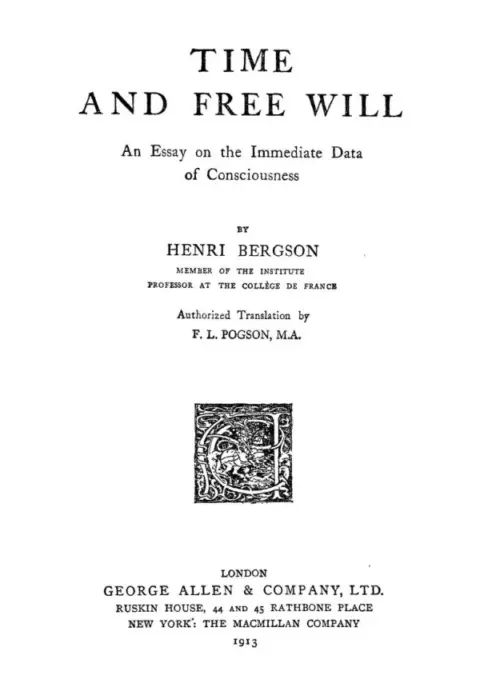
"Time and Free Will: An Essay on the Immediate Data of Consciousness" by Henri Bergson is a philosophical work written during the late 19th century. In this essay, Bergson explores the nature of time, consciousness, and the concept of free will, arguing against traditional deterministic views by emphasizing the importance of real duration and qualitative experiences. The opening of the text sets the stage for Bergson's exploration of the intensity of conscious states, questioning how we perceive and measure qualities such as emotions and sensations. He challenges the notion that these qualitative experiences can be quantified like physical magnitudes, advocating instead for an understanding of consciousness as a complex, interconnected flow of experiences. This critical examination of sensory intensity is just the beginning of Bergson's deeper inquiry into the relationship between consciousness and free will, preparing the reader for a philosophical journey that blends empirical observations with intuitive understanding.
Introduction adapted from the source catalogue; source summaries may be automatically generated.
Free to read · English · 66,044 words · No account needed
MAKE TIME FOR A GOOD BOOK
On by default. Untick to stop anonymous reading totals. Each page counts after 10 seconds in view. How this works.
Anonymous counting is on unless you have switched it off.
Properly speaking, it is arithmetic which teaches us to split up without limit the units of which number consists. Common sense is very much inclined to build up number with indivisibles.
[Sidenote: It follows that number is actually thought of as a
juxtaposition in space.]
And this is easily understood, since the provisional simplicity of the component units is just what they owe to the mind, and the latter pays more attention to its own acts than to the material on which it works. Science confines itself, here, to drawing our attention to this material: if we did not already localize number in space, science would certainly not succeed in making us transfer it thither. From the beginning, therefore, we must have thought of number as of a juxtaposition in space. This is the conclusion which we reached at first, basing ourselves on the fact that all addition implies a multiplicity of parts simultaneously perceived.
[Sidenote: Two kinds of multiplicity: (1) material objects, counted in space; (2) conscious states, not countable unless symbolically represented in space.]
Now, if this conception of number is granted, it will be seen that everything is not counted in the same way, and that there are two very different kinds of multiplicity. When we speak of material objects, we refer to the possibility of seeing and touching them; we localize them in space. In that case, no effort of the inventive faculty or of symbolical representation is necessary in order to count them; we have only to think them, at first separately, and then simultaneously, within the very medium in which they come under our observation. The case is no longer the same when we consider purely affective psychic states, or even mental images other than those built up by means of sight and touch. Here, the terms being no longer given in space, it seems, a priori, that we can hardly count them except by some process of symbolical representation. In fact, we are well aware of a representation of this kind when we are dealing with sensations the cause of which is obviously situated in space. Thus, when we hear a noise of steps in the street, we have a confused vision of somebody walking along: each of the successive sounds is then localized at a point in space where the passer-by might tread: we count our sensations in the very space in which their tangible causes are ranged. Perhaps some people count the successive strokes of a distant bell in a similar way, their imagination pictures the bell coming and going; this spatial sort of image is sufficient for the first two units, and the others follow naturally. But most people's minds do not proceed in this way. They range the successive sounds in an ideal space and then fancy that they are counting them in pure duration. Yet we must be clear on this point. The sounds of the bell certainly reach me one after the other; but one of two alternatives must be true. Either I retain each of these successive sensations in order to combine it with the others and form a group which reminds me of an air or rhythm which I know: in that case I do not count the sounds, I limit myself to gathering, so to speak, the qualitative impression produced by the whole series. Or else I intend explicitly to count them, and then I shall have to separate them, and this separation must take place within some homogeneous medium in which the sounds, stripped of their qualities, and in a manner emptied, leave traces of their presence which are absolutely alike. The question now is, whether this medium is time or space. But a moment of time, we repeat, cannot persist in order to be added to others. If the sounds are separated, they must leave empty intervals bet ween them. If we count them, the intervals must remain though the sounds disappear: how could these intervals remain, if they were pure duration and not space? It is in space, therefore, that the operation takes place. It becomes, indeed, more and more difficult as we penetrate further into the depths of consciousness. Here we find ourselves confronted by a confused multiplicity of sensations and feelings which analysis alone can distinguish. Their number is identical with the number of the moments which we take up when we count them; but these moments, as they can be added to one another, are again points in space. Our final conclusion, therefore, is that there are two kinds of multiplicity: that of material objects, to which the conception of number is immediately applicable; and the multiplicity of states of consciousness, which cannot be regarded as numerical without the help of some symbolical representation, in which a necessary element is space.
Your reading position is saved on this browser. Take it to another device with a library code. Reading pages adapt to text, rather than matching a printed edition.
Henri Bergson
Henri Bergson
Henri Bergson
BEHIND THE BOOK
This eBook is for the use of anyone anywhere in the United States and most other parts of the world at no cost and with almost no restrictions whatsoever. You may copy it, give it away or re-use it under the terms of the Project Gutenberg License included with this eBook or online at www.gutenberg.org. If you are not located in the United States, you will have to check the laws of the country where you are located before using this eBook. Read the source licence.
The original source file, including credits and licence, is retained by this library. Request an original-format copy at no charge. Please include the book title and Project Gutenberg identifier #56852.
KEEP YOUR CURIOSITY GOING

David Patterson (Spirit) Hatch
Coulson Kernahan

Ralph Waldo Emerson
Frances Wright

Edwin Abbott Abbott

Joseph Droz