THE CLASSIC COLLECTION✦Creative EvolutionCLASSIC FREE BOOKS
Creative Evolution
Henri Bergson
THE CLASSIC COLLECTION · 1900
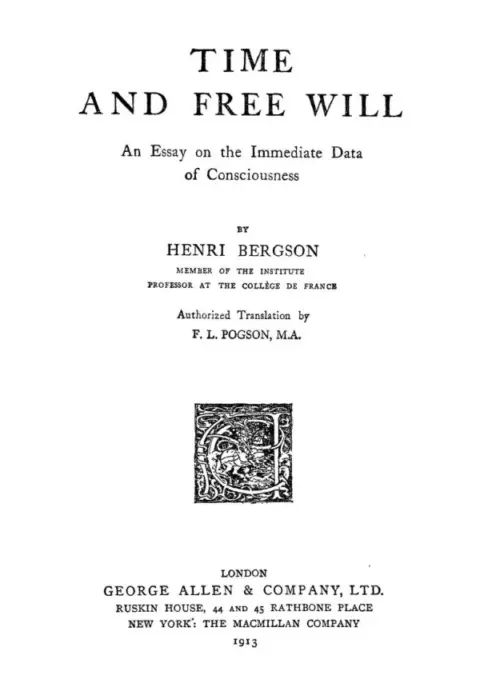
"Time and Free Will: An Essay on the Immediate Data of Consciousness" by Henri Bergson is a philosophical work written during the late 19th century. In this essay, Bergson explores the nature of time, consciousness, and the concept of free will, arguing against traditional deterministic views by emphasizing the importance of real duration and qualitative experiences. The opening of the text sets the stage for Bergson's exploration of the intensity of conscious states, questioning how we perceive and measure qualities such as emotions and sensations. He challenges the notion that these qualitative experiences can be quantified like physical magnitudes, advocating instead for an understanding of consciousness as a complex, interconnected flow of experiences. This critical examination of sensory intensity is just the beginning of Bergson's deeper inquiry into the relationship between consciousness and free will, preparing the reader for a philosophical journey that blends empirical observations with intuitive understanding.
Introduction adapted from the source catalogue; source summaries may be automatically generated.
Free to read · English · 66,044 words · No account needed
MAKE TIME FOR A GOOD BOOK
On by default. Untick to stop anonymous reading totals. Each page counts after 10 seconds in view. How this works.
Anonymous counting is on unless you have switched it off.
[1] Essays, (Library Edition, 1891), Vol. ii, p. 381.
[2] The Senses and the Intellect,4th ed., (1894), p. 79.
[3] Grundzüge der Physiologischen Psychologie,2nd ed. (1880), Vol. i,
p. 375.
[4] W. James, Le sentiment de l'effort (Critique philosophique, 1880, Vol. ii,) cf. Principles of Psychology, (1891), Vol. ii, chap, xxvi.
[5] Functions of the Brain, 2nd ed. (1886), p. 386.
[6] Handbuch der Physiologischen Optik, 1st ed. (1867), pp. 600-601.
[7] Le mécanisme de l'attention. Alcan, 1888.
[8] The Expression of the Emotions, 1st ed., (1872), p. 74.
[9] "What is an Emotion?" Mind,1884, p. 189.
[10] Principles of Psychology, 3rd. ed., (1890), Vol. i, p. 482.
[11] The Expression of the Emotions, 1st ed., p. 78.
[12] L'homme et l'intelligence, p. 36.
[13] Ibid. p. 37.
[14] Ibid. p. 43.
[15] The Expression of the Emotions, 1st ed., pp. 72, 69, 70.
[16] C. Féré, Sensation et Mouvement, Paris, 1887.
[17] Grundzüge der Physiologischen Psychologie, 2nd ed., (1880), Vol.
ii, p. 437.
[18] "On the Temperature Sense," Mind, 1885.
[19] Rood, Modern Chromatics,(1879), pp. 181-187.
[20] Handbuch der Physiologischen Optik, 1st ed. (1867), pp. 318-319.
[21] Éléments de psychophysique. Paris, 1883.
[22] See the account given of these experiments in the Revue philosophique, 1887, Vol. i, p. 71, and Vol. ii, p. 180.
[23] Éléments de psychophysique, pp. 61, 69.
[24] In the particular case where we admit without restriction Weber's Law ΔE/E=const., integration gives S=C log. E/Q. Q being a constant. This is Fechner's "logarithmic law."
[25] Latterly it has been assumed that ΔS is proportional to S.
[26] Revue scientifique, March 13 and April 24, 1875.
Your reading position is saved on this browser. Take it to another device with a library code. Reading pages adapt to text, rather than matching a printed edition.
Henri Bergson
Henri Bergson
Henri Bergson
BEHIND THE BOOK
This eBook is for the use of anyone anywhere in the United States and most other parts of the world at no cost and with almost no restrictions whatsoever. You may copy it, give it away or re-use it under the terms of the Project Gutenberg License included with this eBook or online at www.gutenberg.org. If you are not located in the United States, you will have to check the laws of the country where you are located before using this eBook. Read the source licence.
The original source file, including credits and licence, is retained by this library. Request an original-format copy at no charge. Please include the book title and Project Gutenberg identifier #56852.
KEEP YOUR CURIOSITY GOING

David Patterson (Spirit) Hatch
Coulson Kernahan

Ralph Waldo Emerson
Frances Wright

Edwin Abbott Abbott

Joseph Droz